
WHAT 50+ EXECUTIVE COACHING SESSIONS REVEAL ABOUT COMMUNICATION, STRATEGY, AND SELF-LEADERSHIP
A Moment to Look Back Before We Sprint Forward
2026 has launched at full speed. In just the first two months, I've personally been in 7 states for coaching and trainings, working virtually across 5 countries, and our collective team has supported more than 30 leaders. When I look ahead, I'm genuinely honored to partner with more leaders, teams, and organizations — and excited about the impact that advancing leaders creates far beyond the coaching room. But before we sprint further into the year, we're taking a moment to pause. As my mentor coach called it, a time for evaluated experience. What are we actually learning about leadership?
Setting aside coaching instincts, we needed an empirical approach — a way to measure the real trends, recurring issues, and growth opportunities showing up for leaders today. So we did the work. And here's what we're learning that we want to share with you as a resource as you consider your own leadership challenges and development opportunities.
There's something uniquely isolating about executive leadership. The problems land on your desk already escalated. The decisions are yours to make — often with incomplete information, competing priorities, and real consequences for real people. You're not just professionally invested; you're personally vested in a way that's hard to explain to anyone who hasn't stood in that seat. You wake up thinking about the team dynamic that's quietly fracturing, the strategic pivot that needs to happen faster, the high performer you can't afford to lose. You're committed, all-in, and genuinely trying to move the organization forward — which is exactly why it stings when the same problems keep resurfacing. It feels singular. It feels like your challenge, in your organization, with your particular cast of people and pressures. But here's what the data reveals: the patterns underneath your unique circumstances are remarkably consistent. After analyzing more than 50 executive coaching sessions across industries, geographies, and organizational sizes, the same five leadership breakdowns show up everywhere — from $150M companies to $10B enterprises. Your context is yours. The fault lines are universal. And that's actually good news, because it means the path forward is clearer than it might feel right now.
The Data Behind the Patterns
This isn't a collection of anecdotes. It's a data-backed look at how leadership actually functions inside real organizations. The dataset spans Senior VPs to C-suite executives across construction, technology, healthcare, financial services, nonprofit, and government — with global reach across the United States, Europe, the Middle East, and Latin America. Communication failures, burnout, weak delegation, and inconsistent accountability aren't soft-skill issues. They are enterprise risks that directly affect performance, retention, and organizational capacity. When leaders address them, teams move faster. When they don't, the organization pays in time, talent, and momentum.
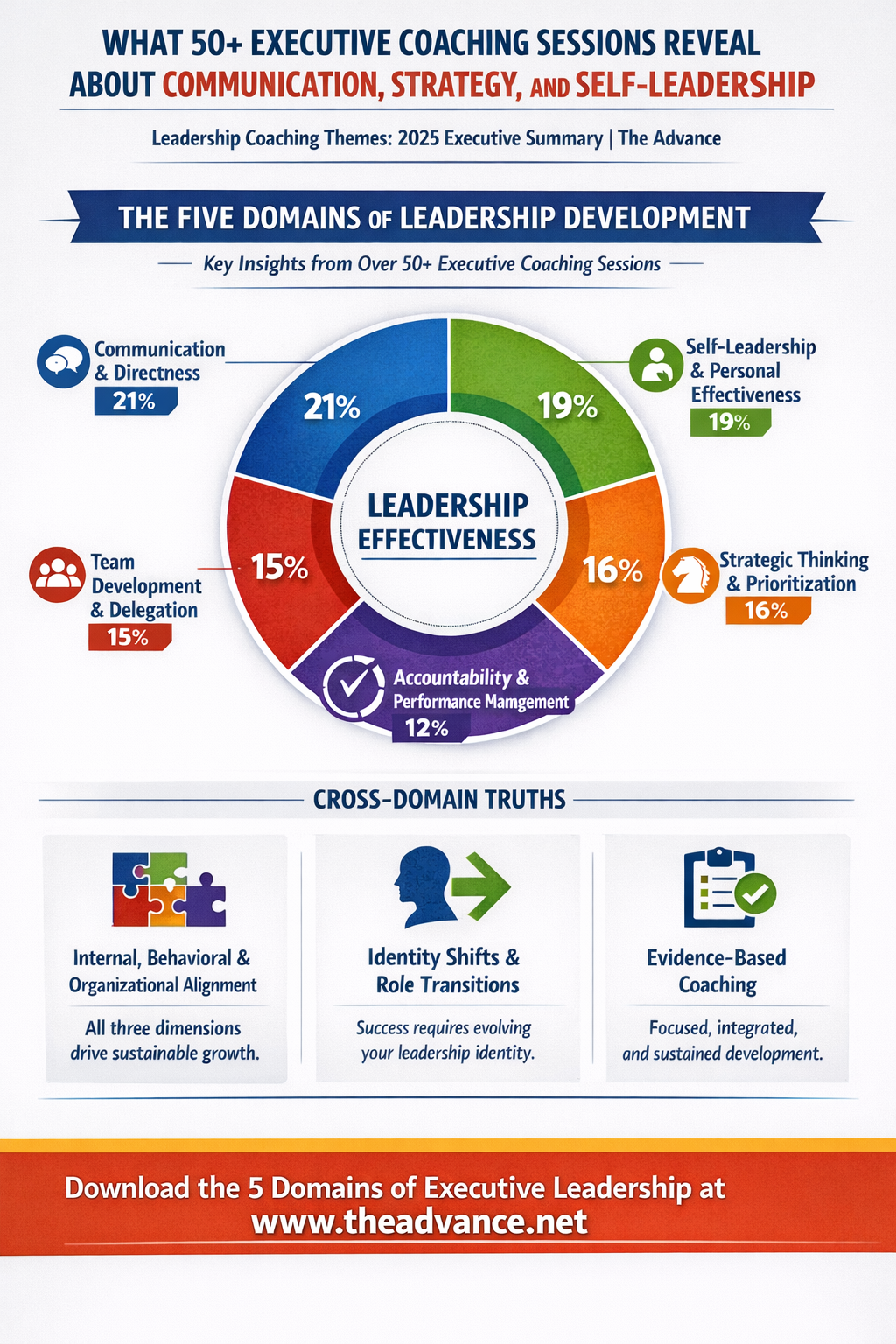
The Five Domains That Define Leadership Effectiveness
Across all engagements, five structural pressure points emerged where leaders consistently stalled:
Communication & Directness (21%) — Clarity, candor, and addressing issues before they become crises.
Self-Leadership & Personal Effectiveness (19%) — Energy, boundaries, resilience, and sustainability as strategic assets, not personal luxuries.
Strategic Thinking & Prioritization (16%) — Shifting from tactical execution to enterprise-level focus, and from measuring activity to measuring outcomes.
Team Development & Delegation (15%) — Scaling impact through others and dismantling the hero leadership patterns that quietly become bottlenecks.
Accountability & Performance Management (12%) — Consistent, developmental accountability that doesn't swing between too soft and suddenly too hard.
Three Observations That Cut Across Every Domain
Beyond the five domains, three deeper truths emerged consistently across the full body of work — and they matter regardless of your industry, title, or organizational context.
First, leadership effectiveness is the product of internal capacity, external behavior, and organizational alignment working together. Developing one without the others produces incomplete and temporary results. The leader who gains self-awareness but doesn't change behavior stalls. The leader who changes behavior without internal alignment reverts. Sustainable growth requires all three dimensions moving in concert.
Second, promotions require identity shifts, not just new skills. The strengths that drove success at one level frequently become liabilities at the next. The technical expert rewarded for having all the answers must become the strategic leader who asks better questions. The high-performer who succeeded through individual excellence must become the developer of talent who succeeds through others. This transition is rarely instinctive and almost always requires deliberate, supported development.
Third, evidence-based coaching works — but only under the right conditions. The engagements that produced the most measurable change shared five characteristics: a concrete behavioral focus, stakeholder integration, deep organizational context, sustained engagement over six to twelve months, and a whole-person approach that addressed personal effectiveness alongside professional competence. Awareness alone doesn't move the needle. Accountability and application do.
What This Means for You
The executives who made the most meaningful progress in 2025 didn't reinvent themselves. They became more fully and effectively who they already were — clearer, more focused, more sustainable, and better aligned with the leaders their organizations needed them to be. That shift is concrete, observable, and achievable within a focused year of intentional development.
Over the next five weeks, we'll break down each domain with data, anonymized case examples, and practical frameworks you can apply now. Download the full 2025 Executive Coaching Summary to explore the complete research today.
The path forward is clearer than it feels. Let's map it together.
Russell Verhey, PhD, MCC — Executive Coach, The Advance | russell@leadersadvance.net