
The powder was magnificent.
Twelve inches overnight at Keystone, Colorado — the kind of snowfall that makes even seasoned skiers behave like giddy children on Christmas morning. I was cruising off the ridge at roughly 35 miles per hour, wind howling at 60, visibility reduced to a painter’s smear of white-on-white. What I thought was a jump was, in fact, a ravine. The mountain made the correction for me. I met it — hard — and heard the fibula go.
Here’s the humbling part: I’ve been skiing double-black diamonds for decades. I have the muscle memory, the edge control, the swagger. What I didn’t have that day? My glasses. I simply could not see clearly at speed in those conditions. A $4 lens prescription. That’s what cost me eight to ten weeks of recovery, a walking boot, and a very significant portion of my pride.
A blindspot isn’t always arrogance. Sometimes it’s just a gap between what we assume we see and what is actually in front of us.
“A blindspot isn’t always arrogance. Sometimes it’s just the quiet, costly gap between what we assume we see and what is actually in front of us.”
— THE OTHER KIND OF BOOT —
I’ve been fired once in my life. Once was enough to understand: it lands differently than any other professional setback. There’s a particular sting to being escorted to the door — it’s not just a job loss, it’s a disruption to your sense of self, your rhythm, your identity. And here’s what most leadership books conveniently omit: the longer you’ve been in the role, the harder it is to get moving again. The roots go deeper. The boot fits tighter.
In my work as an executive coach, I sit on both sides of those transition conversations — with leaders who must make the painful call to let someone go, and with leaders who suddenly find themselves on the other side of that desk, blindsided. After decades in those rooms, I’ve arrived at one unshakeable conviction.
“Getting the boot may break a leg, but it doesn’t have to break someone’s spirit. Losing a job takes a hit — it doesn’t have to take someone out.”
Executives, directors, managers, front-line workers — they may be giving everything they have and still be battling a blindspot. Not seeing the full picture. And even when they do see it, consider the conditions: sixty-mile-per-hour winds don’t always show up on the outside. Some of the fiercest storms are the invisible ones — stress, family pressure, depleted reserves, grief — raging entirely within. We genuinely have no idea what our people are carrying while they perform.
Whatever precipitates the transition — performance, culture mismatch, budget, or plain bad timing — I challenge every leader with a single, non-negotiable imperative: Honor your people. Honor them with the same dignity you would want if the positions were reversed. Finish well. Let them go, yes — but set them up for what comes next. Because getting the boot is harder than most of us realize until it happens to us.
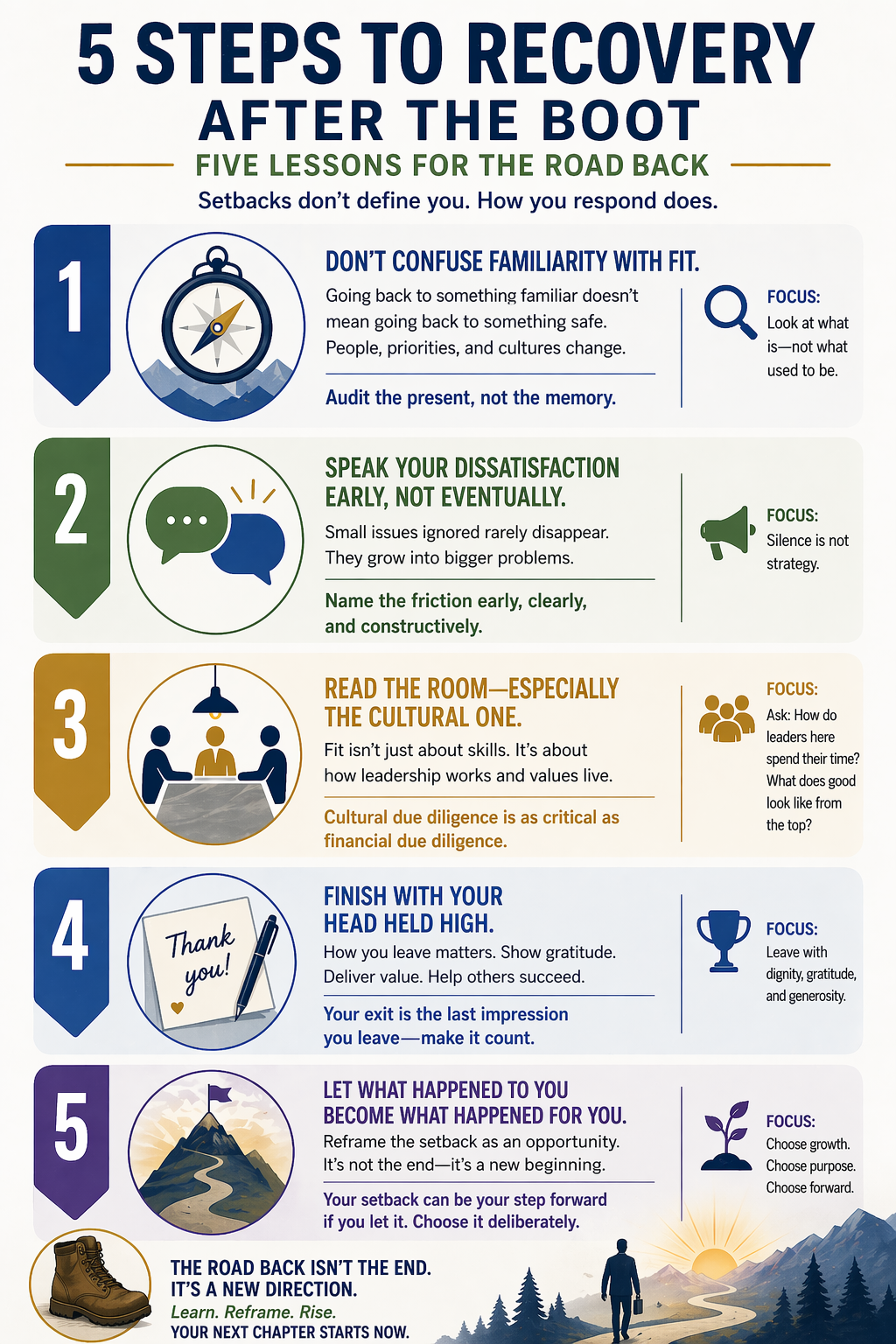
If you've experienced a setback, disappointment, missed moment, or you ran into a mountain. There's a perspective shift on the horizon! A reframe to seeing your life from a different viewpoint! Your disappointment may lead to your next appointment. Getting the Boot may be what launches you forward.
— THE SKI SLOPE POSTSCRIPT —
Here’s what I didn’t tell you about that day at Keystone: after I hit that ravine and felt the sickening impact, I stood up. Somehow, I stood up. The shock does that — it insulates you from the full damage report. I skied down slowly, convinced it was a bad sprain. I limped through three more days — three days — before the pain became impossible to rationalize. Only then did I go for the X-ray. Only then did the image confirm what my body had been trying to tell me since the moment of impact: broken fibula.
That’s the thing about getting the boot. It often lands harder than we first register. The shock absorbs some of it. The adrenaline of what’s next absorbs more. We tell ourselves it’s a sprain and keep moving. But there is a moment — usually quiet, usually unwelcome — when we have to stop, sit down, and take an honest inventory of how we’re actually doing. What help is genuinely needed. What recovery looks like, truthfully.
Give yourself that pause. Don’t limp on it for days pretending it’s fine.
My break and the boot have been hard. I still have recovery work to do, but I plan to be back on the slopes next season. Next time, I will absolutely be wearing my glasses.