Chapter 3 Who’s Glory? Where we Invest our Time

The Mathematical Models of Glory

Rob offered frameworks that added quantifiable precision to the discussion of spiritual formation—though both would be quick to note that God's work transcends all formulas.

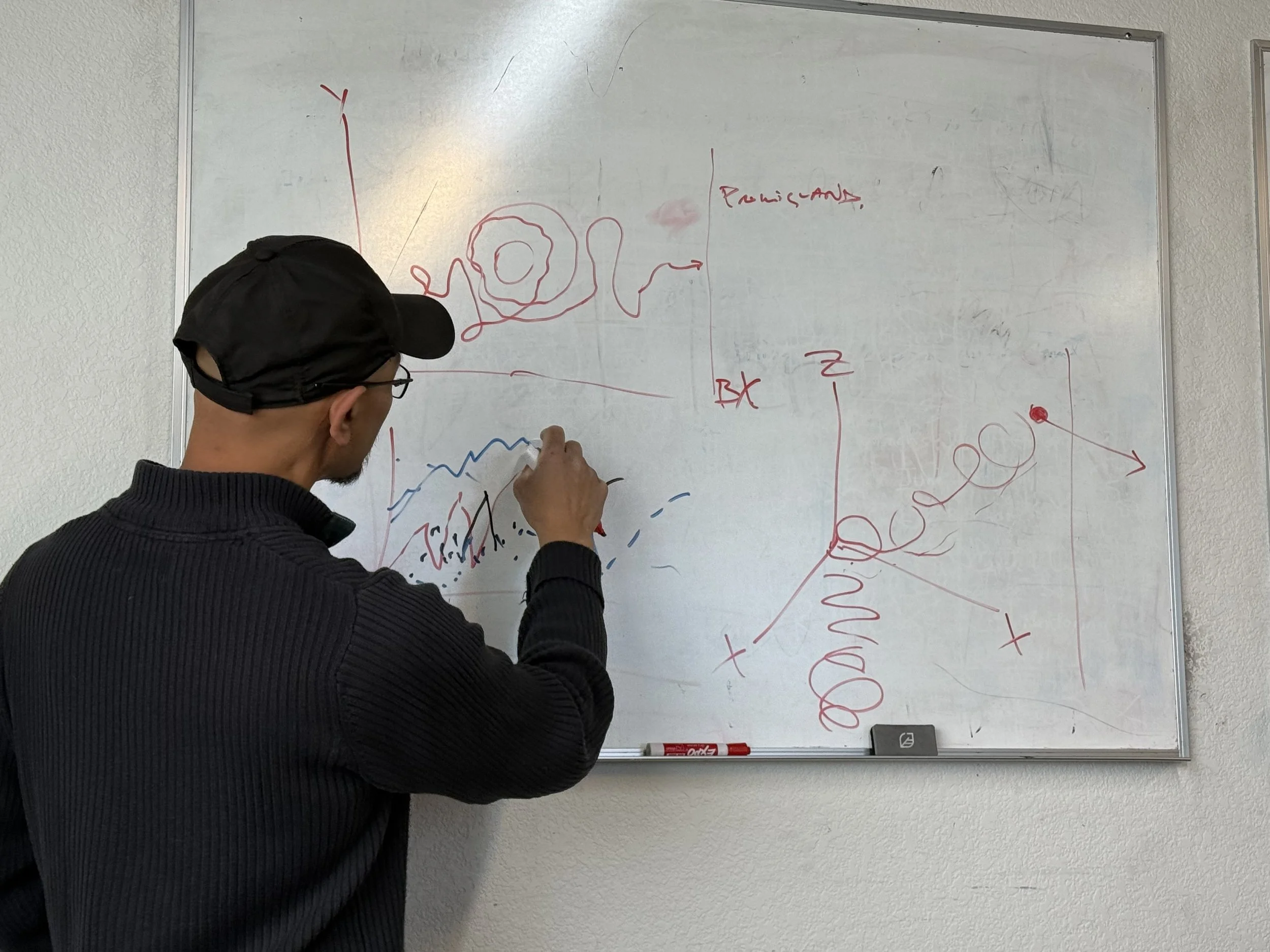
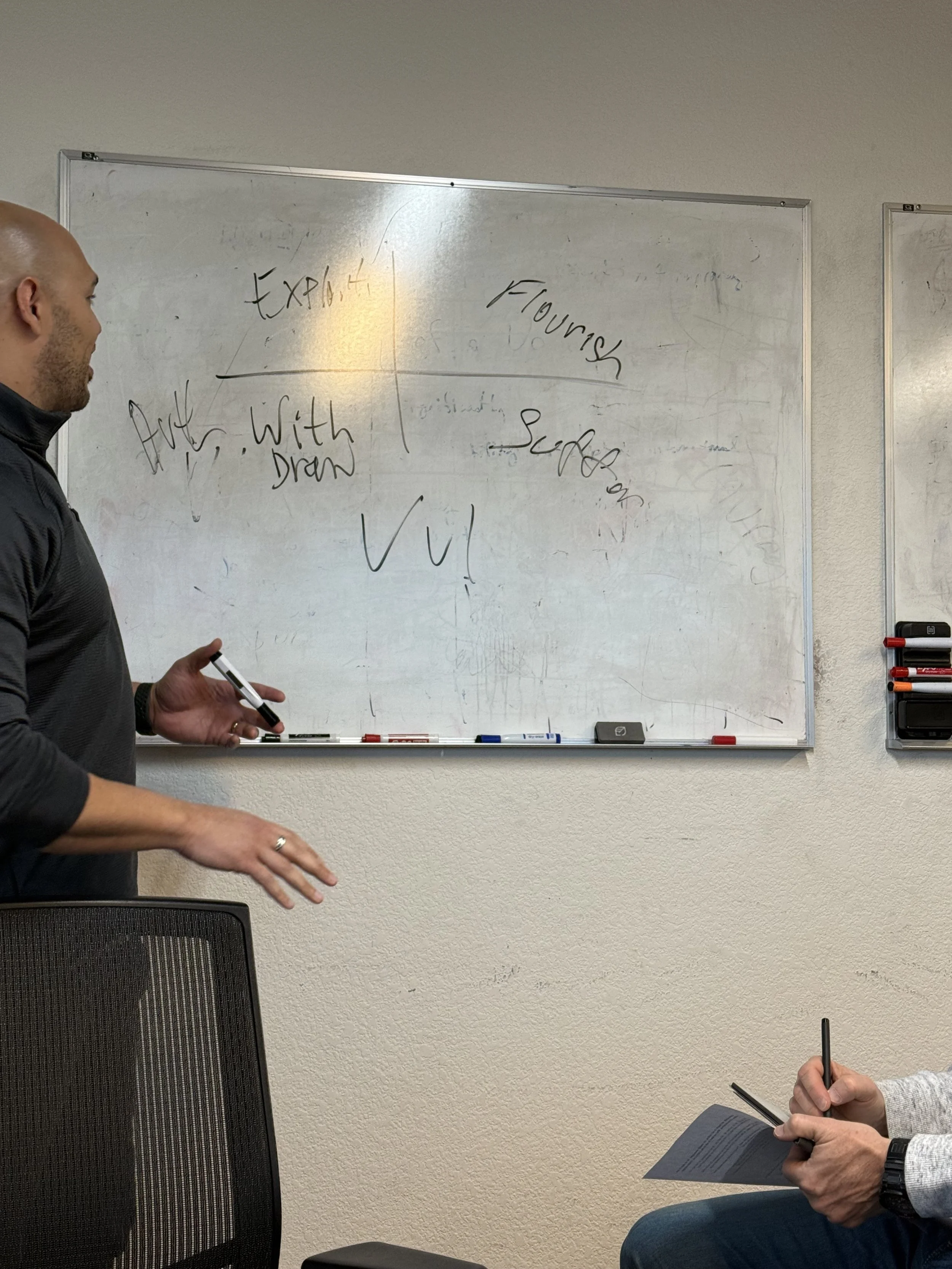
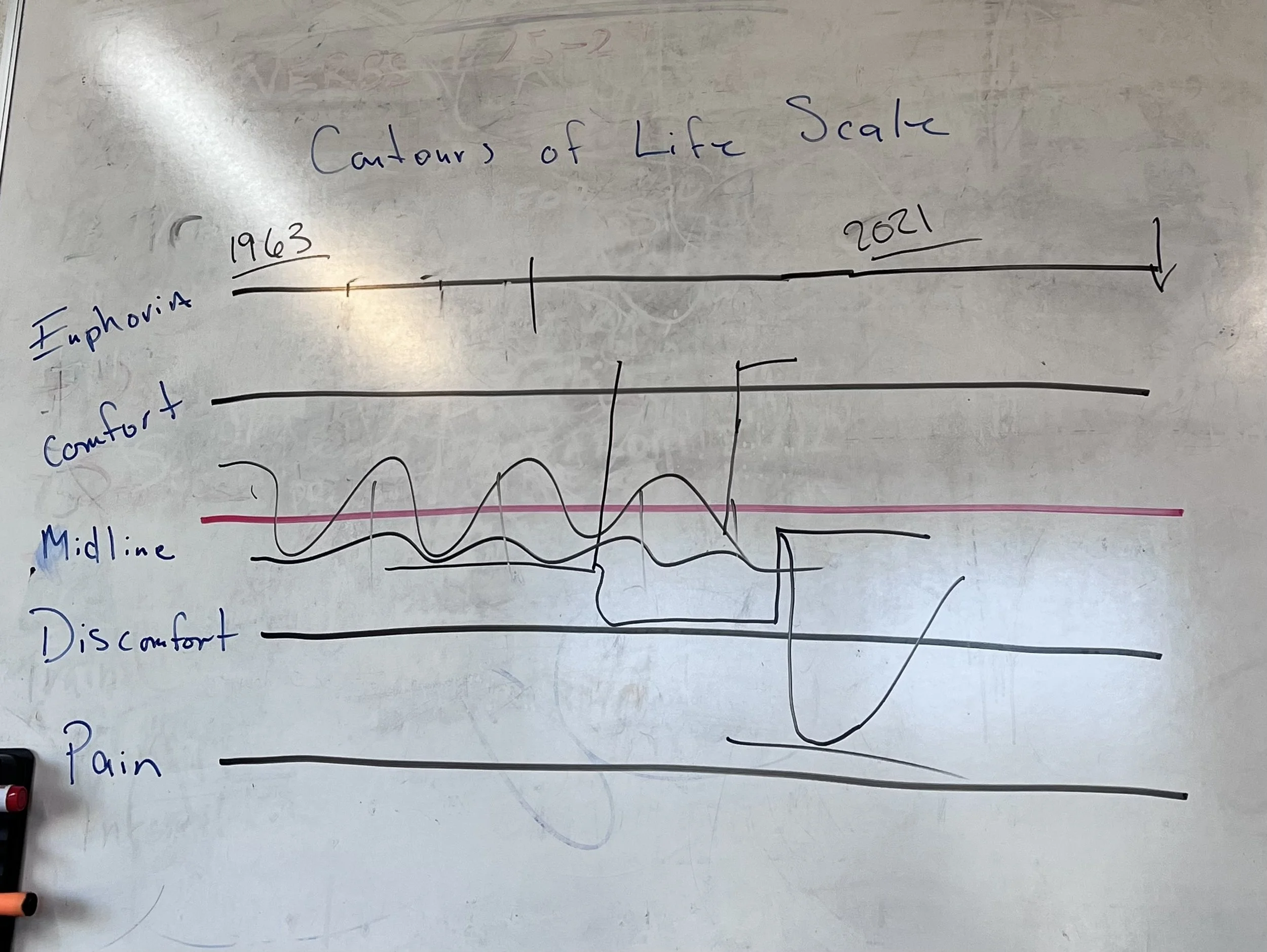
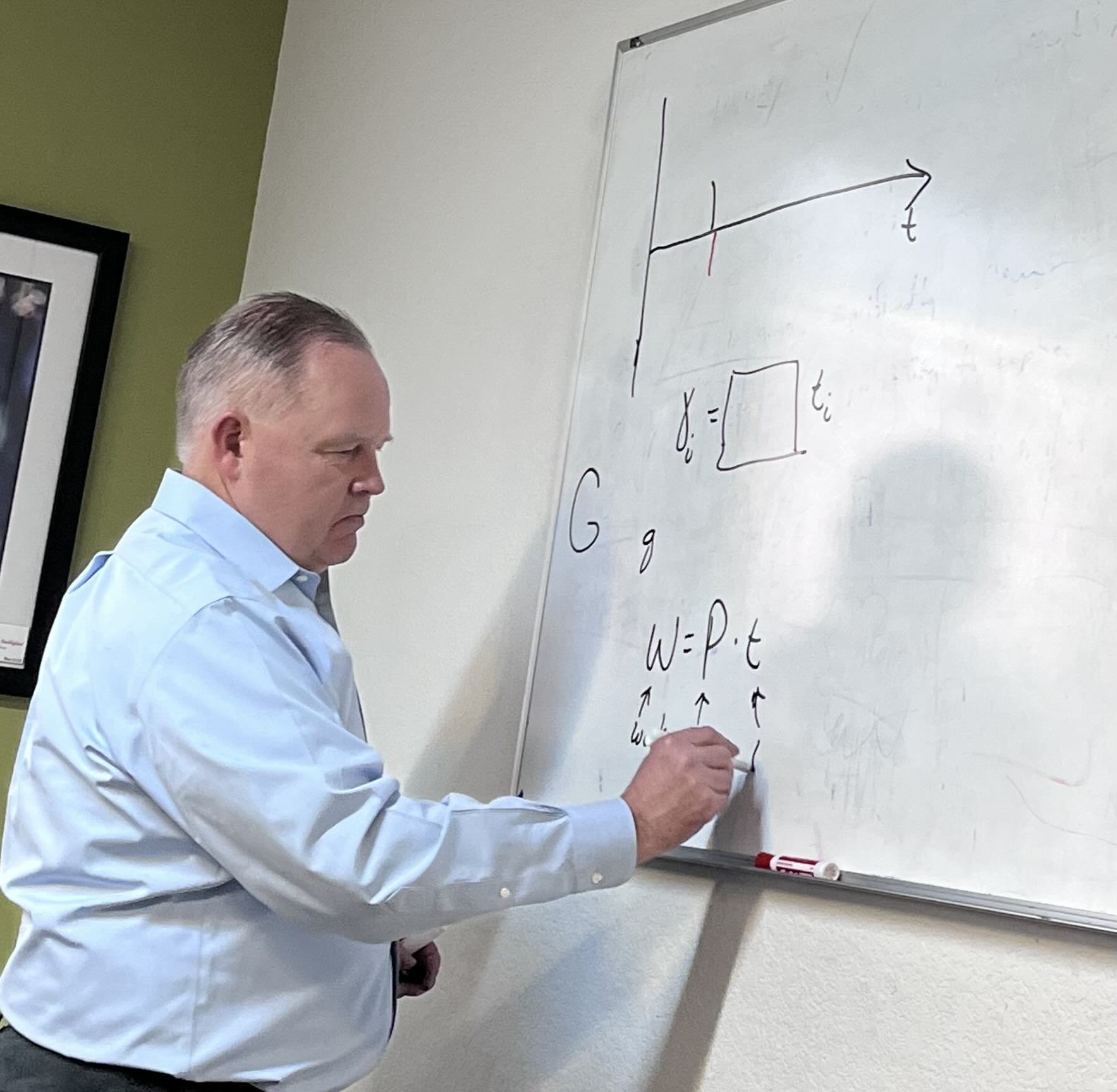
Rob, the engineer, presented what he called "a super geeky engineering version of up and to the right." Drawing on a whiteboard, he explained: "The idea of glory being what this is all about for God—the amount of glory we're giving Him is proportional to the amount of time we're spending in the Spirit. So the Spirit is where all of peace, joy, love, all those characteristics are coming from. The amount of glory we're giving God at any given time is the amount of time we're spending in the Holy Spirit."

He continued building the model: "When we think about our life over time and we're looking at the cumulative glory that we're giving God at any given time on any given day, the amount of cumulative glory of our life is being added based on how much of the time that day we're walking in the Holy Spirit."

Then came the stunning insight: "Actually, we could be generating more glory for God here"—he pointed to the valley, the breaking stage—"because of our decision to spend more time in the Spirit through that. So we might actually be accelerating glory for God during those hardest things. But all along, this is all up into the right."

He added one final layer: "Every time temptation happens, we fall down or sin equals negative glory. So sin would be decreasing the glory of God. But this integral"—he drew the calculus symbol—"this is the idea of cumulative glory over time."

The room erupted in laughter and amazement. "We'll get all the engineers to read it at least," someone joked. But beneath the humor was profound truth: the valleys aren't wasted time in God's economy. If we walk in the Spirit through the breaking, we may actually multiply glory more in the depths than on the peaks.

Tom— offered an essential caveat: "I would add that I think I struggle with performance-based thinking, and the caveat of whether this is a good thing or not is whether we have an attitude of 'I have to' or 'I get to.' Because this could become performance-based, which is fear-based relationship rather than a joy-based relationship. The God of all grace who has called you to His eternal glory in Christ will Himself restore you and confirm you and strengthen you and establish you. The tendency of this, if we're not careful, is it's back to our performance."

The distinction mattered immensely. Rob's formula was true, but it could be weaponized by shame if divorced from grace. The goal isn't to white-knuckle our way through suffering to manufacture glory for God. The goal is to remain present to God in the suffering, to let Him restore our hearts in the breaking, to surrender to His formation even when it hurts. The glory is a byproduct of intimacy, not a product of performance.

Russell's voice carried both strength and tenderness: "Even in Scripture, in the gospels, it talks about standing before the Father. You want to hear, 'Well done, my good and faithful servant.' So there's still—even if you don't look at that as a performance-based thing, but as a relationship-based thing—what kid doesn't want to stand in front of their dad and hear, 'Hey, you did really good. Nice work.' Wow."

The math and the heart, the formula and the relationship, the quantifiable and the qualitative—all held together in tension. Glory for God's sake, yes. But also intimacy with the Father. Both. Always both.

Chapter 2: Circles of Righteousness - Understanding Life's Formative Patterns

"It's doubtful whether God can bless a man greatly until he has hurt him deeply." — A.W. Tozer

The Path That Wasn't Straight

Danny stood before the group of men that morning with a transparency that would set the tone for everything that followed. His story wasn't one of triumph in the conventional sense—it was something far more valuable. It was a story of formation through fracture, of becoming through breaking.

"At age 17, I went to a church camp and I had a very significant spiritual experience with the Lord I would consider to be my true conversion," Danny began, his voice carrying the weight of remembered conviction. "I also, at that time, sensed this calling on my life to be a pastor or minister of some kind. That's the trajectory that I was headed on from 17."

What unfolded from that moment was a masterclass in the difference between our plans and God's purposes. Danny had it all mapped out: get the Christian girlfriend (his youth pastor's daughter, no less), move back to Colorado Springs, attend Nazarene Bible College, earn his four-year degree, become a pastor. Linear. Logical. Destined.

"And it went nothing like that," he said with a rueful smile.

The girlfriend's family moved to Missouri. Danny followed—two weeks after high school graduation. They married young, had three children, and got stuck in Missouri for six years, tangled in conflicts with his father-in-law, wrestling with a wife who couldn't cut the apron strings. When Danny finally left, he left everything behind. The marriage eventually dissolved. The ministry trajectory derailed. The plan shattered.

But then came the pivot—the reframe that made the entire discussion possible.

"If I think about the potential for what life would've been if everything had gone the way that I thought it should, I don't have—I'm not the man I am today," Danny reflected. "I don't have the experiences and the raw relationship that I have with the Lord today when I did seven years of ministry to the homeless every Sunday night. I couldn't relate to that brokenness."

He paused, letting the room absorb the gravity of what he'd just articulated. "There's a lot of things that just wouldn't have worked out the way that they have—the good things that have come about in my life. Now do I recommend, hey, set your life on fire? No. But as Joseph summed things up in Genesis chapter 50: you meant all these things to hurt me and God meant it for good."

This wasn't a man minimizing his pain or spiritualizing his mistakes. This was a man who had walked through the wilderness long enough to recognize the shepherd's voice in it. And from that foundation of hard-won wisdom, Danny introduced a framework that would help the men understand the formative patterns woven throughout Scripture and their own lives.

The Six-Stage Cycle of Formation

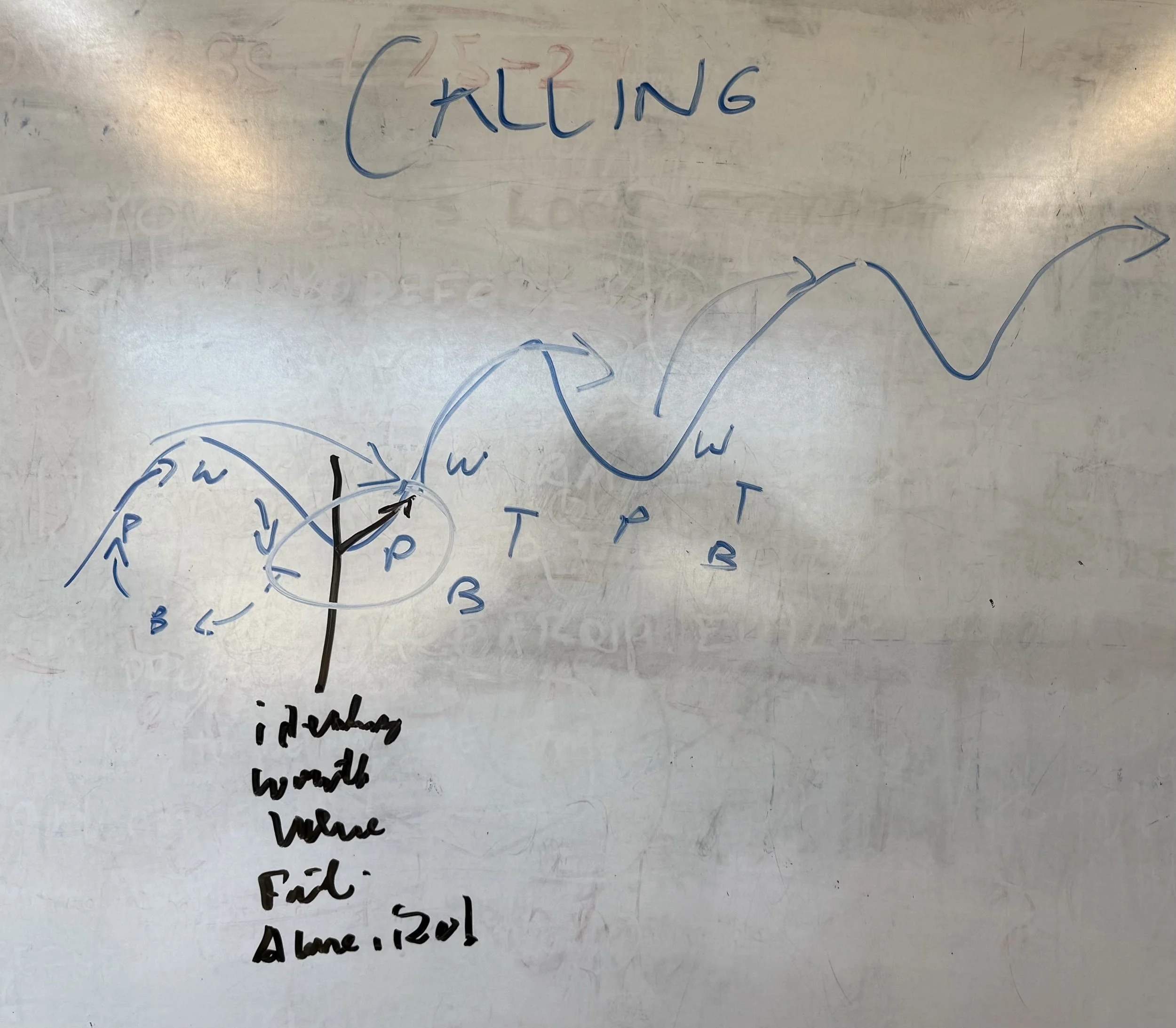
Drawing from the lives of Abraham, Moses, Joseph, David, Peter, Paul, and even Jesus Himself, Danny outlined six distinct movements that appear repeatedly in the spiritual formation of God's leaders:

  1. Calling — The initial summons, the burning bush, the divine invitation

  2. Wilderness — The season of isolation, testing, and stripping

  3. Testing — The proving ground where faith meets fire

  4. Breaking — The crushing that releases the oil

  5. Promotion — The elevation into greater responsibility

  6. Multiplication — The fruit that reproduces and extends impact

But here's where Danny's insight transcended typical leadership development paradigms: these stages don't form a straight line. They form circles.

"When I was over in Israel in 2018 and 2019," Danny explained, "our guide pointed out on these hills where sheep go to pasture—it looks like eyes. It's the shape of an eye, and it goes all the way up to the top of the hill. When these sheep are making their way up the hill, they circle. They don't go straight, they circle."

His guide, a man named Ari, called them "circles of righteousness." Up a little bit, down a little bit, back a little bit, then up some more. Not the efficient path. Not the path that makes sense on paper. But the path that forms rather than merely transports.

"As we go through these cycles in our lives," Danny continued, "this pattern—calling, wilderness, testing, breaking, promotion, multiplication—it's circles of righteousness. You're called, you got a destination in mind. You go through the wilderness, you're gonna go through some testing, you might go through some breaking, you're likely gonna go through some breaking, you're gonna get promoted. And then the end result, hopefully, is there's multiplication."

Tom— "If you look at the physics of waves in the ocean, people think that waves are moving across like that, but they're actually circles. The energy goes down hundreds of feet and it goes like this, and it affects everything around it. It creates these cells that are side by side that look like it's moving across the surface, but it's not."

The image landed. Life's forward progress isn't actually forward—it's cyclical, spiraling, circling upward through repetition and rhythm. And critically, as one man observed, "Every time you hit this level of promotion, God's like, 'Yeah, you leveled up, but now you got the next level wilderness. You got the next level testing. I'm getting you ready for the next thing.'"

Question One: What Season Are You In?

The first question Danny posed to the group was deceptively simple: Can you identify which season you're currently in?

Russell immediately grasped the multi-layered nature of the question. "Just even as you were talking, it's like I can almost resonate just even in the course of a day," he said. "Just even looking at what happens in the course of a day—the way I would put language to even this week is I got to hold this sweet little chunky cute baby, and then at the same time I'm dealing with death and dying all within the same few hours."

He continued, his voice carrying pastoral wisdom: "Just the juxtaposition of what happens in the course of a day where you're having a conversation and you're laughing your head off about something, and then you're crying. Just the fullness—what happens even in the course of the day, whether it's an email exchange or text or just in life is so full of dynamic. And it doesn't always have to be that way, but it's just like the cycles of waves you're talking about. But then just recognizing how that hits in seasons. And if we ignore that, man, things don't go well."

Danny validated this observation immediately: "You can be on multiple points of this at the same time. There can be something really great that's going on—just like the reconciliation stuff. There was something great happening as I was having a relationship reconciled on one Sunday, and at the same time, and it didn't really manifest until the next Sunday, God's like, 'This is awesome, but hey, you got some work to do over here too.'"

One man synthesized the insight beautifully: "God is helping you see a principle that is truth, and then He's showing you how that can apply elsewhere. Which is multiplication, right? You're getting clarity and then you're looking for application."

The men began to recognize that God doesn't necessarily limit Himself to revealing one thing at a time in our lives. Rather, He works on multiple fronts simultaneously—calling us forward in one area while crushing us in another, promoting us here while testing us there. The seasons overlap, interpenetrate, and inform one another.

Jeff— "We live in Colorado, we talk about seasons," another man offered. "This is like microclimates—small iterations of a different season within the big season. And I was thinking of those times my wife and I have been in that horrible testing, breaking moment. But what comes from that? The promotion. What comes from that? If there's a healthy relationship—which, but that's grace—the intimacy that comes from that brokenness and the times where we're literally on our knees in our bedroom and we just hold each other. That promotion, that multiplication, because that intimacy is a completely different intimacy from the physical, sexual intimacy. The most powerful intimacy in my marriage has been those times when we're in the shit, we're in the worst place, but we come together."

Todd added a critical observation about proportionality—or the lack thereof: "It's important to realize these are not proportional usually. If we're going with the waves analogy, if you are in a really deep part of the ocean, you have a deep wave and that's going down deep into that test or wilderness area. But then you could have a tsunami where your multiplication and promotion is a very massive wave. It's not usually proportional at all. You'll have small waves that are closer to shore, you'll have deeper waves that are further out. There's not often where it's 'alright, five days of this and five days of that.'"

The seasons, the men were discovering, are both simultaneous and successive, both micro and macro, both personal and corporate. Recognizing which season you're in—or which seasons, plural—becomes an essential skill in spiritual navigation.

Question Two: Arrival Focus or Formation Focus?

The second question Danny posed struck at the heart of how men typically approach life: Are you arrival-focused or formation-focused?

"If all of this is about 'I want to arrive at this status, this place, this whatever,' then those cycles, those circles of righteousness are gonna feel like walls," Danny explained. "They're gonna feel like you're stuck. But if I realize that—if I have a perspective of that being one cycle in my formation, of God calling me into sonship, God developing me into the man that He wants me to be—that's not a wall, that's a lesson."

The distinction cut deep. Most men, if they're honest, are wired for arrival. We want the summit, the trophy, the title, the achievement. We want to cross the finish line, plant the flag, and move on to the next conquest. Formation, by contrast, requires staying in the fire long enough to be shaped. It means valuing who we're becoming over what we're accomplishing.

But Russell, with characteristic insight, refused to let the distinction become binary. "As I look around at you men and as y'all are all speaking, I think about Matthew 11: 'From the days of John the Baptist until now, the kingdom of heaven has been forcefully advancing and forceful men lay hold of it.' There are men here at this table who have a fire in their belly to advance the kingdom of God. Otherwise you wouldn't be putting on an event this fall, otherwise y'all wouldn't be doing some of the things that you're doing. There's something that God has put inside the hearts of men to go after the things that God has called them to do."

He leaned forward, his intensity palpable. "So there is an arrival focus that is anointed. There's things that stir in your bones at three in the morning. You wake up with a shuddering that God is calling me into something. He's anointed and called you to do it. And He's put men around you to be able to see the thing done. So it's not that being arrival-focused or being goal-oriented is bad—it's just a matter of what the aim is directed towards. At the same time, there's a work that's happening in us so it can happen through us."

Russell continued with fire: "I don't have a problem with that arrival focus, but I also recognize that if I'm just going out there to get mine or conquer that hill for the sake of my own pride or ego, man, I'm off. So there's a balance of both. And I just want to be mindful not to dumb this thing down or emasculate ourselves, if I can say it. Y'all are leaders. Every one of you. You have influence in your bones. You go out and—He's made you to be strong and courageous, to be more than conquerors. That's arrival focus."

The room held the tension. Yes to formation. Yes to the long obedience in the same direction. But also yes to holy ambition, to Spirit-led boldness, to the aggressive advancement of God's kingdom through surrendered men. The key, the men were discovering, wasn't choosing between arrival and formation—it was ensuring that the formation preceded and sustained the arrival, that the inner work enabled the outer work, that character kept pace with calling.

"The harder you push towards the summit, the harder it gets and the more you feel like you're punched in the gut, you lose your air. Just the reality—whatever goal, whether it's an Olympics metaphor, whatever race you're running, the harder you push towards that, the more exhausted you are. And so there has to be something that fuels you, that gives respite, whether it's a marathon mindset or a sprint mindset or just, again, the cycles and understanding the rhythms."

Question Three: What Do You Usually Try to Escape From?

Danny's third question brought the discussion into uncomfortable specificity: What do you usually try to escape from?

He offered his own answer first, vulnerably sharing about building his first house—a teenage dream finally realized—and the incredibly difficult homeowner who showed up every day, cycling between happiness and rage.

"There's something that God is doing in me in dealing with him in the midst of this thing that I've always wanted to do," Danny confessed. "He's saying, 'You gotta—I need to teach you how to deal with this guy. I gotta teach you how to relate to this guy and to work through this, even though you're doing this thing that you always wanted to do. There's something that I gotta work out in you, Danny, in dealing with this guy.'"

The vulnerability gave permission. Danny continued: "And He's using this guy to sharpen this iron and it sucks. And a couple of weeks ago, I came in here and I gave this maybe really lofty sounding idea—I could quote Jim Carrey in a joke: 'I wish everybody could make a lot of money so they realize it doesn't do anything for you.' And God convicted me after that. And He's like, 'No, I brought you here and this is the first of many houses you're gonna build. But in the middle of all that, I gotta teach you how to deal with difficult people. And I gotta teach you how to put your pride down so that you don't walk up here on your first house thinking you know everything.'"

The room recognized the pattern immediately. God wasn't withholding the dream—He was using the dream as the context for formation. The arrival and the formation weren't sequential; they were simultaneous. And Danny's first instinct had been escape.

“When I'm around you men, something—I get heart back. My heart, I'm encouraged. And there's things that trip me up along the way that keep me from that. But that's what's common to me—there's things that the enemy can take me out and heap this stuff that results in me being discouraged where it's just like I got no fuel in the tank. And that's my greatest strength of encouraging men, but my Achilles is that I get discouraged."

He named it clearly: "Being aware of the temptations that are common to man and temptations that every one of us—where some of us are strong in some areas, we're weak in others. And being aware of what that is so we just don't give the devil a foothold. And just being reconciled with myself, with Carrie, with you men—there's just some things that take me out. And that's where the enemy absolutely 100% wins the day. Come hell or high water, that better not be the thing that takes me out, which is why I'm sitting here this morning."

The men began naming their escape routes: isolation when feeling like a failure, numbing behaviors when overwhelmed, workaholism when facing relational pain, cynicism when hope feels too costly. Each man's pattern of escape was unique, yet universally recognizable. And beneath each pattern was the same core issue: the unwillingness to stay present to what God was doing in the difficulty.

"My most common area that I have to watch out for leads to massive discouragement," 

"It just takes me out. I lose all my fuel, lose all my energy. I have no interest in doing anything. And the root of that is I lose heart. I lose heart. And so when I'm around you men, I get heart back."

The antidote to escape, the men were discovering, wasn't simply willpower or determination. It was presence—the presence of God and the presence of brothers who could carry hope when you couldn't see it yourself.

The Wall and the Breakwater

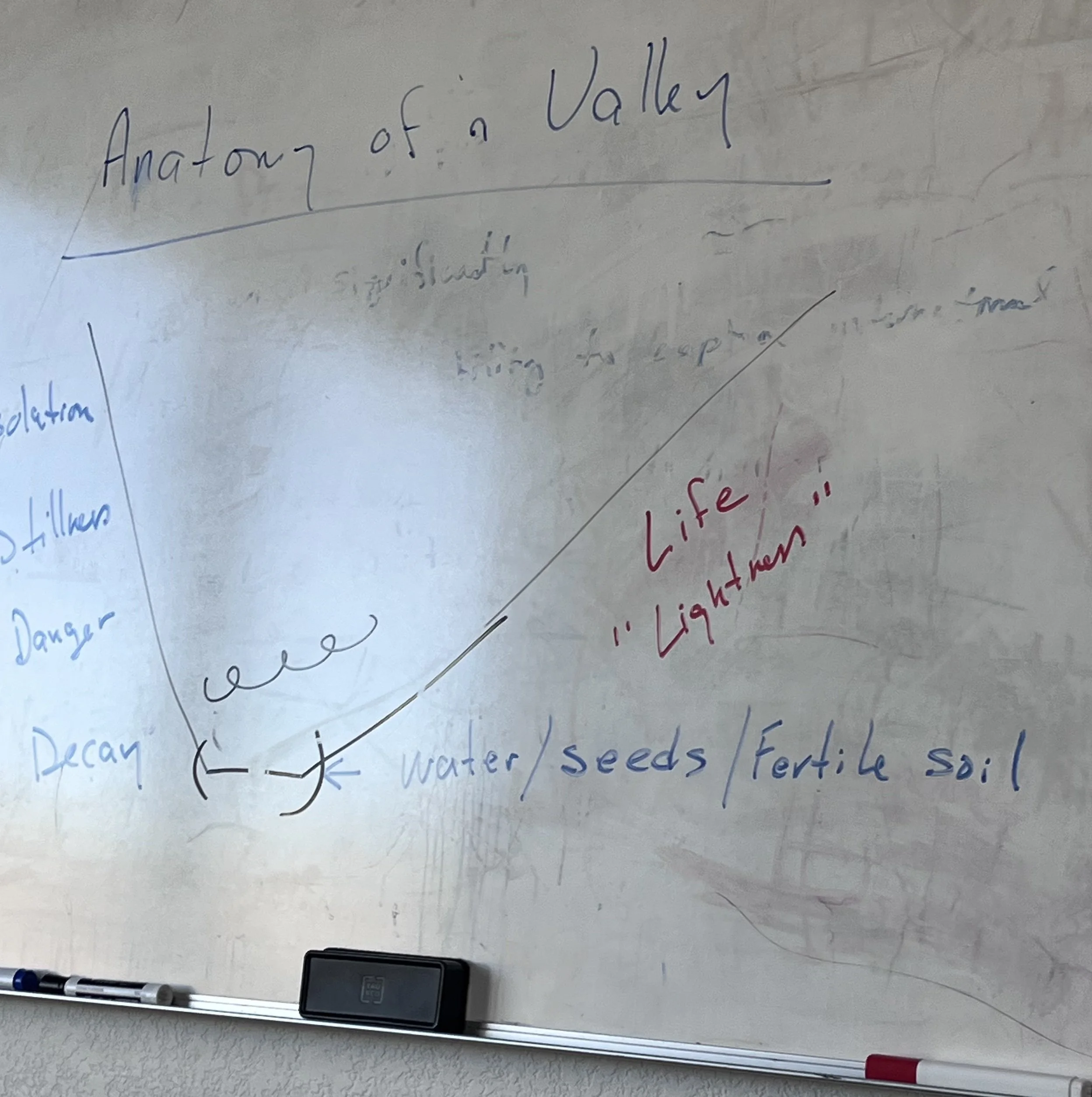
One of the newer members, Matt, brought a diagram to life that captured a struggle many men experience but few articulate. He drew on Danny's journal, creating a visual representation of his experience with the cycle.

"I don't see those things happening necessarily all the time in that order," Matt explained. "There's—like you said, you can be in two different seasons. But what I've struggled with over the years is that I get here"—he pointed to the breaking stage—"and then that season becomes a sentence on my life. And there's a wall here that prevents this movement to the next season because I lose identity, worth, value. I'm failing. Or it's just there's this space of being alone, isolated."

He continued, his honesty creating space: "Getting through the season usually is okay, but then it's like, I gotta face another freaking season and I've lost some things in the midst of some of these processes. And I don't know which—all of those things that I feel, that I've lost in the midst of that season, I have to restore that. My identity, I have to restore that. And for me, it's like this thing is a big piece of what finding all of those things is about. Because I can't do it on my own. It's gotta be with other guys. It's gotta be in that space where if my identity isn't straight with the Lord and my value isn't right, then I want to isolate. I feel like I'm failing."

Ron offered a stunning reframe: "It may not be failure per se, but using an ancient term—a breakwater. A breakwater breaks the energy so that you can find this rest, this joy. So that—see, that's interesting. God is calming you or us to be able to focus on these things. Like I said, He's not gonna show us everything all at once. Maybe He's giving us one thing at a time that we can handle to get to the next."

Matt's response was immediate and visceral: "So I see that wall as like a complete monster and a detriment. But when you look at it as just a place where it's calming the storm for the next tide to come in—wow. Ron, that one freaking hit me."

The conversation had shifted from viewing obstacles as evidence of failure to seeing them as instruments of formation. The wall wasn't blocking progress—it was creating the conditions for transformation. The breakwater wasn't stopping the journey—it was making the journey sustainable.

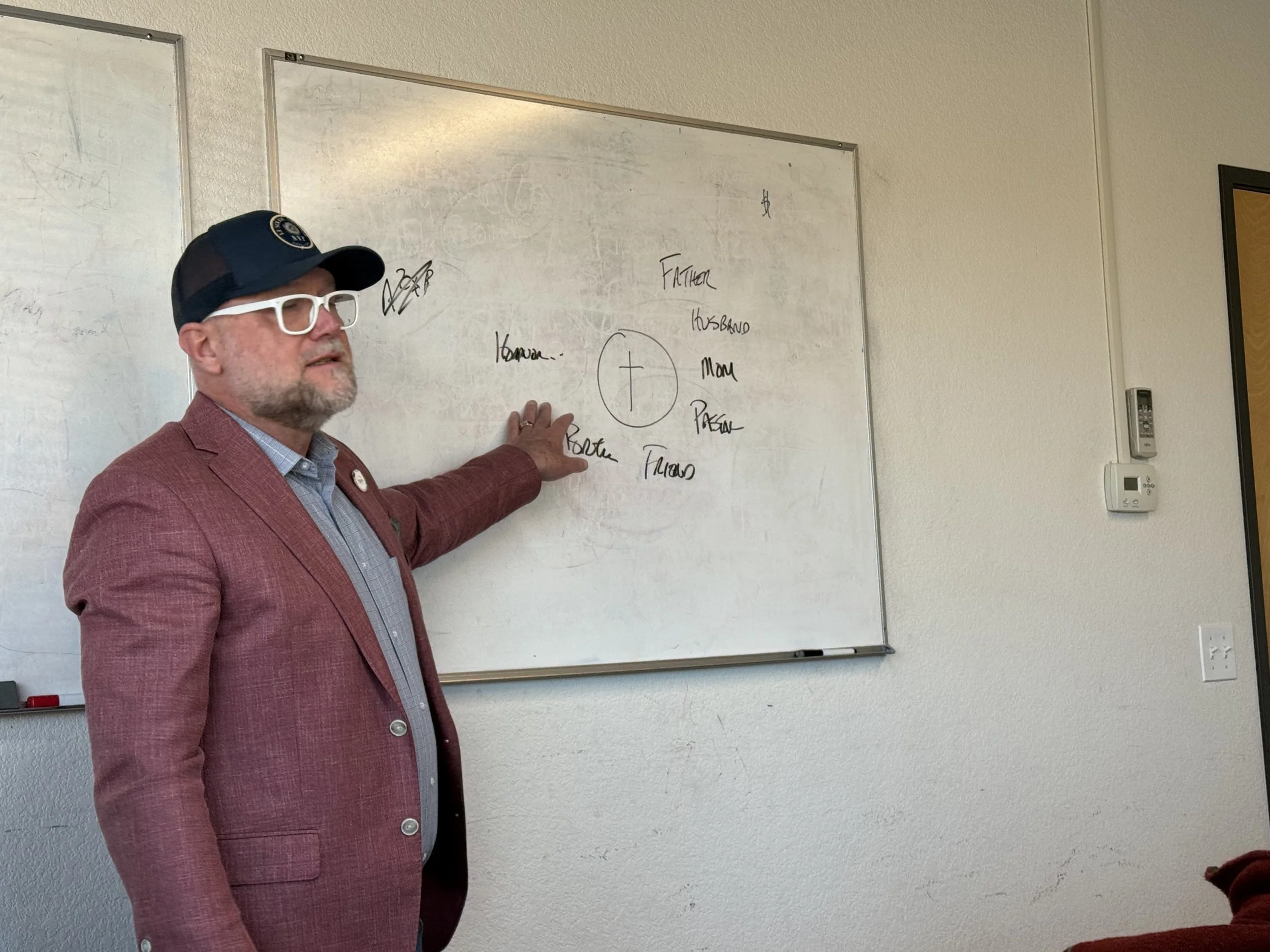
Todd added crucial theology: "It's important to realize who is behind this cycle, and it's not me, it's not life—it's the Father. So this cycle, it's His work in us. So the point is not to get from this point to this point. The point is to get right there"—he pointed to the breaking stage. "That's where you're at. The Lord is taking your identity to a more true and deeper level of identity. That's the whole point. You are the son of God who loves you. Your self-worth, everything you just said, everything comes from that. That's in your heart and that's what the Lord is after. It's your heart."

Matthias synthesized powerfully: "Those dips are pauses, those are times to pause. And He's given you that opportunity to reflect on what's your identity, what's your worth, what's your value. You're my son. I love you. Your identity is in me. Reflect on that. Look at that. Live on that. Soak on that. And the enemy can steal that and say, 'Oh, I'm just gonna get stuck. I'm just gonna isolate myself.' Or we could let Him step into that season or that moment."

Tom added: "We've talked about this in previous sessions—could it be that you're not losing identity? God's telling you what you don't know about yourself and stripping away what you thought was—false identities you built it on. You're not losing anything. You're gaining."

The wall, the men were discovering, was actually a classroom. The breakwater was actually a sanctuary. The pause that felt like death was actually preparation for resurrection.

Where Does the Enemy Fit In?

Rob raised a question that had been hovering over the entire discussion: "Where does interaction with the enemy and the spiritual war interface with this?"

It was a crucial question. Job's testing, after all, was permitted by God but executed by the devil. The wilderness where Jesus was tested was the same wilderness where Satan showed up to tempt. How do we understand the interplay between God's formative work and Satan's destructive agenda?

Rob offered the most comprehensive response: "I think it's important to realize—I don't think we should sell ourselves short by saying that those are the only places within those circles that the enemy works. Because for this arrogant, prideful man, I promise you, he works in the promotion just as much as he works in the wilderness and testing. That's where it gets real easy to say, 'Look what I just did. Look who I am. God really thinks I'm the stuff. He needs me. Watch me tear it up.'"

The insight shifted the framework. The question wasn't "where does the enemy fit in this cycle?" The question was "where isn't the enemy active in this cycle?" As another man said, "The question isn't where does it come in here—it's like, where is it evident in every single one of these?"

Todd added theological precision: "The Lord is after the restoration of our hearts, the transformation of our hearts. And the enemy is about the exact same thing. He's trying to tear down our identity. He's trying to strip us of our intimacy with the Father. And so at the very same time that the enemy is doing that, he doesn't realize that he's setting the Father up for a grand rescue and then greater restoration. The enemy often attacks us in our wounds—that's our vulnerability. And then our idolatry often comes out of our wounds. So the enemy attacks us in the vulnerability of our wounds. That's the exact same thing that the Father is after—the healing of our wounds and our hearts so we can be more wholehearted and more like Him. So they could be happening at the exact same time."

The men sat with this. God's agenda and Satan's agenda target the same territory—our hearts, our identity, our intimacy with the Father. But their purposes couldn't be more opposite. Satan attacks to destroy; God allows the attack to restore. Satan aims to isolate; God uses the isolation to create intimacy. Satan seeks to shame; God transforms the shame into humility that can receive grace.

Russell brought it back to practical vigilance: "Being aware of the temptations that are common to man—where some of us are strong in some areas, we're weak in others. And being aware of what that is so we just don't give the devil a foothold. Come hell or high water, that better not be the thing that takes me out."

The spiritual warfare isn't ancillary to the formation cycle—it's integral. Every stage of growth invites both divine development and demonic opposition. The key is learning to discern which voice is which and to align ourselves with the Father's purposes even when the enemy is active.

The Crushing That Releases the Oil

As the discussion deepened, Danny brought the group to Gethsemane—literally and metaphorically. "There's this really encouraging quote by A.W. Tozer at the bottom here," he said, reading from his notes. "'It's doubtful whether God can bless a man greatly until he has hurt him deeply.'"

He continued: "Wrapped up in all of this, if we go to Gethsemane and Jesus praying in the garden and asking, 'Hey, if there's another way can we do that?' There was a crushing. The Garden of Gethsemane is an olive grove, and there's 800 to 1,000-year-old olive trees, maybe older, growing there. And when you put olives into a press to get the oil out, there's actually like a weeping sound that they make. It sounds like wailing, like crying loudly. And that's exactly what was going on with Jesus to get the oil out. He was being crushed to get the acceptance of the cross. He was being crushed and hurt deeply."

The image landed with visceral power. Scripture says Jesus was sweating blood—the physiological manifestation of stress so extreme the capillaries burst. He was being pressed to the point of breaking to yield the oil that would anoint the entire world.

"In order for us to give God the glory, to be transformed into what He wants us to be," Danny concluded, "there is a crushing that has to take place. And we, like Jesus, have to say, 'Hey, not my will, but Yours be done.'"

The crushing isn't incidental to the formation—it's essential. The oil that brings healing, that lights the lamps, that consecrates the priests, only comes through the press. And the sound of that pressing is weeping. There's no shortcut. There's no crushing-lite option. There's only surrender: "Not my will, but Yours."

One man added from his own tradition: "In some translations of 2 Corinthians 3:18, it says we are being taken from glory to glory. That is through the transformation and seeing Him, His face with unveiled faces. We're going from glory to glory."

Sheldon—  "That's also in Romans 5. Going through the transformation—nobody really wants the suffering, but the discipline leads to a harvest of righteousness."

The Biblical witnesses were unanimous: suffering precedes glory, crushing precedes anointing, breaking precedes multiplication. Not because God is sadistic, but because our hearts are stubborn, our false selves are entrenched, and our deepest healing requires the kind of surgery that only happens under extreme pressure.

The Miracle - Peace in the Middle of the War

As the men wrestled with the reality of crushing and breaking, a word that felt like oxygen in a smoke-filled room: "Even in the midst of all of this turmoil, somehow there's still this unbelievable miracle that we can have peace in the midst of it. And that's an amazing thing—that while we're even sleeping at night when all this war is going on, there's still peace in the middle of it. That is the miracle, because God is who He is. And that in the midst of all of this pattern, there still can be peace. That is a miracle."

He pressed the point: "It is a miracle. And it's the exception. Because where do you go buy peace? Do you take a pill? Sign up for a program? Somehow there can be peace in the midst of all of this. That is the good news. Because everything else is hell and crazy."

The men felt the truth of it. Peace isn't the absence of the storm—it's the presence of the Shepherd in the storm. It's Psalm 23 lived out: green pastures and still waters, but also the valley of the shadow of death. A table prepared in the presence of enemies. A rod and a staff that both comfort and correct. All of it, simultaneously. All of it, held by the One who sees the end from the beginning.

"I think the key with that," one man offered, "is it's despite the situation. The struggle we get caught up in is feeling like we're supposed to have peace, and the tension is that it doesn't eliminate the difficulty."

Another added: "I think the downside of focusing on any part of the cycle—whether it's the peak or the valley—is it shifts our focus away from what we should be focused on."

And what should we be focused on? Not the circumstance, but the Companion. Not the stage of the cycle, but the Shepherd who guides through all stages. Not our performance in the season, but His presence in every season.

Todd brought it back to Psalm 23 with surgical precision: "If you really take some time and dissect every single part of what the psalm is actually saying—the fact that, okay, You lead me to green pastures, You lead me to still waters, to the quiet waters. But there's also a valley. There's also a rod and the staff, which is correction and protection both. There's a table with bounty on it—awesome. But my enemy's sitting right next to me. There, like, who's already eating? Who gets to enjoy the same meal I get to enjoy? You're kidding me. But that's the invitation—into the fullness of life. All of these things are happening at the same exact time. And above it and outside of it and carrying it and leading us through is the Lord, the Shepherd, who sees something—who sees the hand already healed."

The peace, the men were discovering, isn't found by escaping the complexity. It's found by embracing the presence of the One who holds the complexity without being overwhelmed by it. He sees the healed hand before we do. He sees the restored heart before we do. He sees the multiplied impact before we do. And He invites us to trust Him in the not-yet, to rest in Him in the in-between, to abide in Him through all the circles of righteousness.

The Arrival Mindset and the Enemy at the Table

One man offered a confession that many could relate to: "I tend towards that arrival mindset, and so as such, I am constantly striving for the next peak. That's all I seem to care about if I'm not paying attention to myself. But what that means is I have to realize that when I get to that next peak—there's a table with an enemy sitting right there on the other side. There's a valley on the other side of it. If I'm racing forward and I'm peak-minded, then the valley is gonna shock me and hurt me because I'm not expecting it."

The insight was profound. The arrival mindset doesn't just miss the formation in the valley—it makes the inevitable valley more painful because it arrives unexpected. When we're fixated on summits, we're perpetually disappointed by descents. We experience the valleys as failure rather than formation, as setbacks rather than setups for the next ascent.

But there's another danger to the arrival mindset that the psalm makes clear: even at the peak, the enemy is present. The table is prepared, the cup overflows, the head is anointed—and right there, in the presence of all that blessing, sits the adversary. Pride, self-sufficiency, the subtle shift from "God did this" to "I did this," the temptation to forget the wilderness that preceded the promotion.

Danny had named it earlier: "For this arrogant, prideful man, the enemy works in the promotion just as much as he works in the wilderness." The summit isn't safe. The multiplication isn't the end. Every stage is spiritual warfare, and every stage requires vigilance, humility, and dependence on the Shepherd.

The only solution the men could identify was what they were doing in that very room: showing up, speaking truth, carrying hope for each other, refusing to let anyone walk the cycle alone. "As leaders, we all end up having moments where we have to be the carriers of hope for the cause that we're on," one man said. "Sometimes if no one else is gonna do it, you have to carry the hope. You have to carry the vision. But we can also be carriers of hope for each other on our walks. Because when I can't see clearly what God's doing or recognize that I'm loved and being around other people that are carrying hope—it is contagious. And I think we can do that for each other, but really only if we're able to be vulnerable."

Suffering, Perseverance, Character, Hope

As the discussion wound toward its conclusion, the men turned to the New Testament passages that frame suffering not as interruption but as instrument. Romans 5:3-5 became a touchstone: "Rejoice in your sufferings, because suffering produces perseverance; perseverance produces character; and character produces hope. And hope does not put us to shame."

"That's Tom's favorite verse for the year," someone joked, referencing the man who'd chosen 1 Peter 5:10 as his theme: "After you have suffered a little while, the God of all grace, who has called you to His eternal glory in Christ, will Himself restore, confirm, strengthen, and establish you."

The laughter was knowing. Nobody wakes up excited about suffering. Nobody volunteers for the wilderness. But the men around that table were beginning to grasp what James meant when he wrote, "Consider it pure joy, my brothers and sisters, whenever you face trials of many kinds, because you know that the testing of your faith produces perseverance so that you may be mature and complete, not lacking anything" (James 1:2-4).

Joy in the trial isn't joy about the trial—it's joy in the purpose behind the trial, joy in the Father's commitment to our completeness, joy in the certainty that He who began a good work will carry it to completion. The suffering is real, the pain is real, the crushing is real. But so is the formation, the transformation, the glory-to-glory progression.

One man summarized it perfectly: "I think when we're in the trials, if we can remember the whole point is up to the right—the Lord says in 2 Corinthians 3:18, 'And we all, who with unveiled faces contemplate the Lord's glory, are being transformed into His image with ever-increasing glory, which comes from the Lord, who is the Spirit.' In some translations it says we're being taken from glory to glory."

Glory to glory. Not peak to peak, but glory to glory. Because the glory isn't only at the summit—it's in the surrender at every stage. It's in the abiding through the valley. It's in the breaking that releases the oil. It's in the crushing that produces the wine. It's in the death that precedes resurrection.

Up and to the right doesn't mean avoiding the down. It means trusting that the down is part of the up, that the circles are how the climb happens, that the Shepherd knows the path even when it feels like we're going backward.


Questions for Reflection

  1. Which of the six stages (calling, wilderness, testing, breaking, promotion, multiplication) do you find yourself in right now? Can you identify multiple stages happening simultaneously in different areas of your life?


  2. Danny's story demonstrates how God's plans often diverge radically from our own—yet produce deeper formation. Where in your life has a "failed plan" actually become the context for your greatest growth?


  3. Are you more naturally arrival-focused or formation-focused? How might you need to grow in embracing the other? How can holy ambition and humble formation coexist in your life?


  4. What do you typically try to escape from? What patterns of avoidance (isolation, numbing, workaholism, cynicism) show up when you hit a wall in the formation cycle?


  5. Matt described the wall between breaking and promotion as a "sentence on my life" where he loses identity and worth. Have you experienced this? How does Ron's reframe of the wall as a "breakwater" shift your perspective?


  6. Where is the enemy most active in your current stage of the cycle? How might his attacks in your strength areas (promotion, multiplication) be as dangerous as his attacks in your weak areas (wilderness, breaking)?


  7. The men identified that peace in the storm is a miracle, not an achievement. Where do you need to stop striving for peace and instead receive it as God's presence with you in the chaos?


  8. "It's doubtful whether God can bless a man greatly until He has hurt him deeply" (A.W. Tozer). How does the image of Gethsemane—the crushing that releases the oil—help you understand and embrace your own seasons of breaking?


  9. Who in your life carries hope for you when you can't see clearly? Who are you positioned to carry hope for? What makes vulnerability possible in those relationships?


The Challenge

This week, do two things:

First, map your current position. Take an honest inventory of where you are in the formation cycle—not where you wish you were, not where you think you should be, but where you actually are. Name the season (or seasons) without judgment. Just observe: This is wilderness. This is testing. This is breaking. This is promotion. Write it down. Share it with someone who can carry hope for you.

Second, choose one area where you've been trying to escape. Maybe it's a difficult relationship like Danny's challenging homeowner. Maybe it's a financial pressure that makes you want to quit. Maybe it's a health issue that feels like a sentence. Whatever it is, instead of strategizing your exit, ask God: "What are You trying to form in me through this? What false identity are You stripping away? What deeper truth are You revealing about who I am as Your son?"

Then—and this is critical—don't just ask the question and move on. Stay in it. Journal about it. Pray through it. Let the question work on you rather than working to find a quick answer. Formation takes time. The sheep circle up the hill slowly. The wave goes deep before it crests. The oil comes only through the crushing.

The goal isn't to arrive faster. The goal is to stay present longer—present to God, present to your brothers, present to the transformation happening beneath the surface of your circumstances.

Remember: circles of righteousness. Up a little, down a little, back a little, then up some more. Not efficient. Not comfortable. But formative. Always formative.

And remember Acts 18:9-10, the verse that grounds Matt: "Do not be afraid, but speak and do not keep silent. For I am with you, and no one will attack you to hurt you, for I have many people in this city."

You're not alone in this. The Shepherd is with you. Your brothers are with you. The Spirit is forming you. And what God begins, He completes.

From glory to glory, brothers. Not despite the valleys, but through them.


Closing Prayer

Jeff's voice carried the weight of the morning as he prayed the group into the rest of their day:

"Lord, thank you for this morning. Thank you for these men, for Matt being able to come join us for the first time. We pray, Lord, we don't scare him off. Just pray Your blessings on these guys, that we can just wrestle well as men, and that somehow we'll be undergirded through it. And somehow through the forge of all this, that we would stand as men full of character and that we would be formed to be more like You, Christ. And that we would not be alone, but we would be able to stand with one another through all of this.

"Guide us in our discussions. Guide us, Lord, where You want us to go for our encouragement, but also for the building up of others. And as was said today, this is gonna be for Your glory, Lord. So we just release that to You in Jesus' name. Amen."


Mission Men 2026 Book Project 

Up and To The Right: Navigating Life's Unexpected Peaks and Valleys

"Up and To The Right" reframes our success criteria. Exploring life's inevitable rises and falls, written by the Mission Men—a group of faithful brothers who gather each Friday morning to share their journeys with raw honesty and biblical wisdom. Drawing from the biblical truth and personal testimonies of divorce, illness, career setbacks, and spiritual drought, this book reframes our understanding of success beyond worldly metrics. 

The Mission Men tell their collective stories that reveal how God works through both mountain peaks and valley lows, teaching us to quiet our souls like David, remember God's faithfulness when He seems distant, and find our identity not in circumstances but in Christ. Through vulnerable storytelling and practical spiritual disciplines, readers will discover that true growth isn't a straight line upward but rather a series of death-resurrection cycles that, when viewed from eternity's perspective, reveal an unmistakable trajectory of transformation into Christ's image.

Book Outline

Introduction: ReDefining Success

Chapter 1: The Journey of Rises and Falls - Russell 2/6

Listen to the MM Group Discussion - Audio

  • The misconception of linear growth in life

  • Introduction to the "Up and to the Right" framework

  • How success, failure, hopes, and disappointments create our life's trajectory

Chapter 2: Understanding the Pattern of Life- Danny 2/13

  • The reality of peaks and valleys

  • How life naturally cycles through order, disorder, and reorder

  • Reframing our understanding of progress: death, burial, and resurrection

Chapter 3: The Anatomy of the Spiral 

  • Recognizing when you're in a downward trajectory

  • Biblical study: The Psalmist's despair in Psalm 77

  • The physical and emotional symptoms of being in a valley

  • Permission to acknowledge pain and suffering

Chapter 4: The Practice of Remembering

  • How remembering God's faithfulness provides strength in difficult times

  • Creating meaningful memorials and markers of significant moments

  • The importance of storytelling in preserving our journey

  • Practical exercises for intentional remembering

Chapter 5: Transparency and Vulnerability

  • Breaking the masculine stereotype of emotional stoicism

  • The healing power of tears and emotional expression

  • Creating safe spaces for authentic sharing

  • How vulnerability connects us to others and to God

Chapter 6: Living Well in the Mystery

  • Learning to be comfortable with unanswered questions

  • The wisdom of acknowledging our limitations

  • The difference between being content and being complacent

  • Persisting in relationship with God despite uncertainty

Chapter 7: Humility in Success and Failure

  • The danger of pride in both the rises and falls

  • Self-awareness and the circle of control vs. circle of concern

  • How to quiet your soul and mind in times of anxiety

  • Finding contentment like a "weaned child"

Chapter 8: Identity Beyond Circumstances

  • Separating who you are from what happens to you

  • Finding your steady line in relationship with Christ

  • Moving beyond measuring success through worldly metrics

  • Character formation as the true measurement of growth

Chapter 9: The Power of Community

  • Why we need others to navigate our peaks and valleys

  • Creating a culture of authentic sharing

  • How to respond when others are vulnerable with you

  • Celebrating and remembering together

Chapter 10: Hope as an Anchor

  • Finding hope in the midst of disappointment

  • The difference between optimism and biblical hope

  • Learning to trust beyond what you can see or understand

  • Placing your hope in the Lord "now and forevermore"

Conclusion: The Upward Trajectory

  • Recognizing growth even through painful experiences

  • How our series of falls and rises create an overall upward path

  • Measuring growth by the person you're becoming

  • Embracing both the highs and lows as essential parts of your story

Project Timeline and Publishing Plan

Jan-Feb 2026

  • Initial planning: Mission Men to refine vision, target audience, and chapter assignments

  • Establish writing guidelines and theological foundation

  • Each author commits to writing one primary chapter/section and contributing stories to others

  • Set up shared digital workspace for collaboration

Feb-May

  • Authors research biblical foundations for their assigned chapters

  • First round of personal story collection through recorded Friday sessions

  • Transcribe and organize testimonies for potential inclusion

  • Weekly check-ins during regular Friday meetings

May

  • Complete first drafts of all chapters

  • Begin peer review process within the group

  • Engage professional editor for structural review

  • Create initial design concepts for cover and interior layout

May-June

  • Authors revise chapters based on peer and editorial feedback

  • Begin compilation of supplementary materials: discussion questions, reflection exercises

  • Develop marketing strategy and identify endorsement opportunities

  • Establish partnership with Christian publisher or prepare self-publishing plan

July

  • Complete second drafts with incorporated stories and testimonies

  • Final theological review to ensure biblical accuracy and consistency

  • Begin formal editing process: content, copy, and line editing

  • Finalize book design elements and cover artwork

Aug 

  • Final manuscript revisions complete

  • Send to proofreader for final polish

  • Begin premarketing through Mission Men networks

  • Prepare website and social media presence for book launch

July-Sept

  • Complete final formatting and design

  • Submit for printing and digital conversion

  • Develop launch events calendar

  • Create promotional materials and press kits

  • Receive advance copies for review

  • Send copies to endorsers and reviewers

  • Finalize launch events

  • Begin pre-orders through website and partner channels

Sept 

  • Official book launch with release event

  • Begin marketing campaign across multiple platforms

  • Authors available for interviews, podcasts, and speaking engagements

  • Implementation of small group study curriculum based on the book


Introduction: The Illusion of Up and To the Right

I'll be honest with you—I hate health-n-wealth prosperity conferences.

The messaging promises something rarely delivered… if ever! It’s not because I don't believe in personal growth or professional development. I do. It’s actually my vocational job coaching entrepreneurs, emerging leaders, and executives leaders. But there's something about those glossy presentations, the promised silver bullets, and the inevitable graph showing someone's exponential success trajectory that makes me want to throw something. You know the graph I'm talking about—the one that starts at the bottom left corner and shoots confidently toward the upper right, depicting a life or business or portfolio that just keeps climbing. Up and to the right. Always ascending. Never plateauing. Certainly never declining.

It's a lie.

Or at the very least, it's profoundly incomplete.

The real story of our lives—yours, mine, the guys I meet with every Friday morning—looks more like an EKG readout than a hockey stick graph. Peaks and valleys. Rises and falls. Moments when we're crushing it followed by seasons when we're getting crushed. Days when God feels close enough to touch and months when He seems to have left the building entirely.

And here's what makes it worse: we've been sold a version of success that not only ignores these valleys but actually shames us for experiencing them. We're told that if we just work harder, pray more, hustle better, optimize our morning routine, and download the right productivity app, we can finally achieve that elusive upward trajectory. We can finally arrive.

But what happens when we get there and discover it's not what we thought? What happens when we check all the boxes—the career milestone, the financial goal, the family achievement—and still feel empty? Or worse, what happens when life doesn't cooperate with our carefully crafted plans at all? When the diagnosis comes. When the marriage crumbles. When the business fails. When the dream dies.

Most of us respond in one of two ways.

Some of us double down. We become more ambitious, more driven, more obsessed with achievement. We convince ourselves that we just haven't succeeded enough yet. If we can just push a little harder, climb a little higher, earn a little more, then we'll find what we're looking for. This path leads to burnout, broken relationships, and a quiet desperation that we're terrified to acknowledge because slowing down feels like failure.

Others of us make a different kind of bargain. We compromise. We lower our expectations. We tell ourselves we're being "realistic" when really we're just protecting ourselves from more disappointment. We settle for less—less joy, less purpose, less engagement with life—and call it wisdom. This path leads to a different kind of death: the slow suffocation of dreams deferred and potential unrealized. We survive, but we don't truly live.

The writer of Ecclesiastes knew this tension intimately. After pursuing every conceivable measure of worldly success—wealth, pleasure, wisdom, achievement—he arrived at a brutal conclusion: "Vanity of vanities! All is vanity." Everything he'd chased, everything he'd built, everything he'd accomplished—when viewed from the perspective of mortality and meaning, it all seemed like grasping at the wind.

But here's what's remarkable: Ecclesiastes doesn't end there. Neither does the biblical story. Neither, if you're willing to stay with me, does your story.

What if the problem isn't our ambition or our dreams? What if the problem is how we've been taught to measure success in the first place?

This book was born from a crisis. Actually, several crises. Mine included.

Every Friday morning, a group of us men gather around coffee that's honestly not that great (sorry, guys) to talk about our lives. We call ourselves the Mission Men, though that name makes us sound more organized and impressive than we actually are. We're businessmen and tradesmen, fathers and husbands, Christ-followers trying to figure out what it means to live faithfully in a world that seems increasingly hostile to faith.

We don't have it figured out. That's kind of the point.

Over the past year, we've watched each other navigate divorces and diagnoses, financial setbacks and spiritual droughts, teenage rebellion and midlife reckonings. We've celebrated wins and mourned losses. We've prayed together, laughed together, and occasionally wanted to punch each other in the face (we're still working on our sanctification).

And somewhere in the midst of all that messy, beautiful community, we started asking different questions about success. Not the sanitized, Instagram-ready questions posed at leadership conferences, but the raw, 3 AM questions that wake you up in a cold sweat:

  • What is success, really? How would you even define it?

  • What does the world tell us success looks like, and is that actually true?

  • What does the Bible say about success—and does it even use that word the way we do?

  • How have your biggest failures and setbacks reframed your understanding of success?

  • From where you sit today, with all you've experienced, what are the actual criteria for a successful life?

These aren't rhetorical questions. They're not meant to prompt easy answers or produce neat conclusions. They're meant to make you uncomfortable, to challenge the unexamined assumptions you've been carrying about what makes a life well-lived.

Because here's what we've discovered: when you scratch beneath the surface of most men's lives, you find a quiet desperation born from trying to measure up to metrics that were never meant to measure what actually matters.

The American Dream promised us that if we worked hard and played by the rules, we could achieve prosperity, security, and happiness. Our constitutional rights enshrined "life, liberty, and the pursuit of happiness" as foundational to our identity. The capitalist system that shapes our economy rewards efficiency, productivity, and growth—always growth, always more, always upward and to the right.

And for a while, many of us believed it. We ran the race. We climbed the ladder. We checked the boxes.

But somewhere along the way, we started to notice something troubling: the treadmill keeps speeding up. The German sociologist Hartmut Rosa calls this phenomenon "social acceleration"—the relentless quickening of the pace of life that leaves us feeling perpetually behind, perpetually inadequate, perpetually striving without ever arriving. Rosa argues that we're caught in a "frenetic standstill," working harder and faster while somehow feeling like we're getting nowhere.

The answer, he suggests, isn't simply to slow down (though that helps). It's to cultivate what he calls "resonance"—building meaningful, responsive, and emotionally engaged relationships with the world around us, relationships that actually nourish our souls rather than simply checking another optimization box.

In other words, the cure for our success addiction isn't to succeed better or work harder. It's to redefine what we're actually pursuing in the first place.

This isn't just an American problem, though our particular cultural moment intensifies it. Talk to someone born in a different cultural context—where success might be measured by family honor, or community contribution, or spiritual devotion—and you'll hear different stories about the pressure to perform, the fear of failure, the exhausting burden of other people's expectations.

The tyranny of achievement is a human problem, not just a Western one.

But it is a problem that demands a solution. Or perhaps better said: it's a crisis that demands a reframing.

What you're holding is not a fix-it book. I'm not going to sell you a new system for achieving success or promise that if you follow these seven steps, your life will finally work out the way you hoped.

What I am going to do is invite you into a conversation—the same conversation we've been having on Friday mornings, the same conversation that's been challenging and changing us from the inside out.

This is a book about redefining success criteria for your life. Not according to the world's standards or your father's expectations or your own anxious striving, but according to something deeper, truer, and ultimately more hopeful.

Each chapter of this book will explore a different dimension of what it means to live well—not perfectly, not without struggle, but well—in a world that's constantly trying to convince you that who you are and what you have isn't enough.

You'll hear stories from the Mission Men, raw and unfiltered accounts of our own journeys through peaks and valleys. Some of these stories will make you uncomfortable. Good. Comfort isn't what you need right now.

You'll also find biblical wisdom—not platitudes or easy answers, but the kind of hard-won, ancient truth that has sustained God's people through every imaginable crisis for thousands of years. Scripture has a lot to say about success, failure, suffering, and hope, but it rarely says what we expect it to say.

At the end of each chapter, you'll find questions for reflection. I encourage you not to skip these. The goal isn't just to read about a different way of thinking about success—it's to actually examine your own life through a different lens. That requires honest self-examination, and honest self-examination requires time and space and a willingness to sit with uncomfortable questions.

You'll also find a challenge—something concrete to do, to practice, to implement. Because theology without practice is just philosophy, and philosophy without application is just entertainment.

Here's what this journey will look like:

Chapter 1 explores the journey of rises and falls itself—the unavoidable reality that life doesn't move in a straight line upward. We'll examine what success actually is, how the world defines it versus how God might define it, and how our setbacks and failures often teach us more about true success than our victories ever could.

Chapter 2 dives deeper into understanding the pattern of life—the cycles of order, disorder, and reorder that characterize every human journey. We'll explore the biblical pattern of death, burial, and resurrection as the actual shape of transformation, not the sanitized "up and to the right" trajectory we've been sold.

Chapter 3 focuses on what I call "the anatomy of the spiral"—recognizing when you're in a downward trajectory and learning to name it honestly. We'll sit with the Psalmist's despair and discover that permission to acknowledge pain is itself a form of spiritual health.

Chapter 4 is about the practice of remembering—how intentionally recalling God's faithfulness in the past provides strength for navigating uncertainty in the present. We'll talk about creating memorials, telling stories, and building a personal history of God's presence in both the peaks and the valleys.

Chapter 5 tackles transparency and vulnerability—breaking the masculine stereotype of emotional stoicism and discovering the healing power of actually letting others see us. This isn't weakness; it's courage. And it's essential for the kind of transformation we're pursuing.

Chapter 6 addresses living well in the mystery—learning to be comfortable with unanswered questions and acknowledging our limitations without abandoning faith. The difference between contentment and complacency might be smaller than you think, but it's more important than you realize.

Chapter 7 explores humility in both success and failure, examining how pride can corrupt us whether we're on top of the world or flat on our backs. We'll talk about self-awareness, the circle of control, and what it means to quiet your soul like a weaned child.

Chapter 8 is perhaps the most important: identity beyond circumstances. How do you separate who you are from what happens to you? How do you find your steady line when everything else is fluctuating? Character formation, not circumstantial achievement, is the true measure of growth.

Chapter 9 makes the case that you can't do this alone. Community isn't optional; it's essential. We'll explore how to create cultures of authentic sharing and how to respond when someone trusts you with their story.

Chapter 10 ends with hope—not the cheap optimism that pretends everything will work out fine, but the biblical hope that anchors us even when we can't see the shore. This is hope that persists, hope that trusts, hope that waits "now and forevermore."

And in the Conclusion, we'll look back at the whole journey and recognize that even through all the valleys, even through all the failures and setbacks and disappointments, there actually is an upward trajectory. Not the one we expected. Not the one we planned. But an upward trajectory nonetheless—the transformation into Christlikeness that happens not despite our struggles but often because of them.

I don't know where you are as you read this. Maybe you're on top of the world, crushing your goals, checking boxes, feeling like you've finally figured it out. If so, I celebrate with you. But I also invite you to consider whether the metrics you're using to measure success are actually measuring what matters.

Or maybe you're in a valley—one of those dark nights of the soul where God seems silent and your dreams seem dead and you're just trying to survive another day. If that's you, I want you to know: you're not alone. You're not a failure. And this valley might be exactly where God does His deepest, most transformative work in you.

Most likely, you're somewhere in between. Most of us are. We're navigating the ordinary chaos of real life—work stress and marriage tension and financial pressure and health scares and aging parents and struggling kids and all the thousand small deaths that never make it onto our highlight reels.

This book is for all of us. Because all of us need to reckon with the gap between the life we expected and the life we're actually living. All of us need to question whether we've been climbing a ladder that's leaning against the wrong wall. All of us need the courage to redefine success according to something deeper and truer than the world's scorecards.

So here's my invitation: Let's stop pretending that life moves smoothly upward and to the right. Let's acknowledge the valleys. Let's name the failures. Let's admit the disappointments. Let's sit with the mystery and the unanswered questions.

And then, with honesty and humility and hope, let's discover together what it actually means to live a successful life—not by the world's standards, but by God's.

The journey starts here. And I promise you, it won't be what you expected.

But it might be exactly what you need.

Chapter 1: The Journey of Rises and Falls

I want to open with a story. There are lots of stories I could tell, but one in particular captures the moment when my entire understanding of success collapsed in on itself.

Cari and I recently celebrated our 32nd anniversary. I want to take you back to our second anniversary. We married in 1994, both still finishing college through night school while I was running eighty hours a week doing landscaping. I can still see myself in that beat-up truck with Elias and Diego, doing apartment complexes all over Atlanta. I actually drove past some of those same complexes last weekend—a little trip down memory lane that stirred up more emotions than I expected.

I had a business idea in college. Wrote a whole business plan with the help of a couple of mentors. Graduated in '96, went down to the Cobb County courthouse on October 1st, 1996, got a business license, and started making phone calls.

I made 1,200 phone calls in 100 days.

"Smiling and dialing," we called it. There was also this little technological innovation back then called a fax machine, and you could send faxes from your computer. Sprint had this promotion called Free Fridays where any calls or faxes you sent on Friday were free. So every Friday at 12:01 AM, my computer started faxing office furniture information to every dealer and wholesaler across the United States.

This was what they called "permission-based marketing"—I'd called each of them first. "Hey, I'm Russell, I'm a nice guy. Can I send you some information on office furniture?" They said yes, so they got a fax. Simple as that.

After 1,200 phone calls and 100 days of hustle, starting my business with nothing but a credit card to buy a computer, I got my first $5,000 sale in December '96. Three months later, my first $50,000 commission deal. And then it just took off.

Fast forward to 2000. My girls were born. We were still living in this quaint little 85-year-old farmhouse. Our mortgage—just for context—was $762 a month for the house and two acres. One vacuum cord could reach the whole house, that's how small it was. We couldn't even get a traditional mortgage at first because the land was worth more than the house. The house was a dump.

But we fixed it up. Remodeled it. Got it featured on HGTV, which was surreal.

We started a young married couples group that grew to 150 couples. At one point, 27 women in that group were pregnant at the same time. There was definitely something in the water. We were doing father-son and father-daughter retreats, men's retreats. I was living the entrepreneurial dream that people had been speaking over me since I was young.

By 2000, I was surrounded by dot-com customers flush with venture capital cash. They were growing like crazy, and I was selling office furniture left and right. I crossed over a million dollars in sales. 

And then, almost overnight, everything changed.

You might remember the dot-com bust. In 2001, things started shuttering. Companies that seemed invincible were collapsing. And then one seismic event happened that nearly destroyed me.

We shipped 12 truckloads of office furniture to Dallas, Texas. I know exactly where that building is. I can still see the guy's face who shook my hand. All our trucks showed up, and they closed the gates and locked everything up. The bank had seized the entire building and everything in it.

Including all my inventory.

After about 90 days of trying to work through it, trying to salvage something, I was upside down over $125,000 in cash. Just gone. I was 28 years old.

More than the money, though—and the money was crushing—I was scared. Really, deeply scared in a way I'd never experienced before.

You see, up until that point, I had experienced success in every measurable category of life. My marriage was strong. Our church involvement was meaningful. We were giving generously to missions. We had money going into retirement accounts. By every metric I knew, I was winning.

And a huge part of my identity—maybe too much of my identity—was wrapped up in being Russell the Entrepreneur. Russell the Success Story. Russell the Guy Who Makes Things Happen.

Suddenly, that identity was under threat. My success criteria was collapsing. And for the first time in my life, I had a genuine identity crisis.

Out of compassion—and this changed our family dynamics—my father-in-law loaned me $250,000. We're still friends today! But that loan, while generous and necessary, fundamentally altered our relationship. There's something about owing a quarter million dollars to your wife's father that shifts the dynamics at Thanksgiving dinner.

Because we'd been so financially successful, the bank gave me all the credit I wanted. I started building infrastructure to protect myself from this kind of disaster happening again. Warehouses. Trucks. Employees. Within a year, I had almost 80,000 square feet of warehouse space and a bunch of guys running around managing inventory.

I propped up my business through debt. I was trying to create systems and structures to manage risk, but here's the thing: I'm not wired that way. I'm an entrepreneur, not a systems manager. And more importantly, I was running. I was scared. And I was trying to build my way out of fear instead of dealing with what was actually happening in my heart.

That business wasn't sustainable. It was funded by debt and fear, and both of those are terrible foundations for anything that's supposed to last.

But more than the business failure, I was experiencing a complete loss of orientation. What was God doing? What was I supposed to be doing? How was I supposed to sustain this? I couldn't pay my bills anymore. I was drowning in debt. I was trying to face my family, face my father-in-law to whom I owed money that was connected to his father through a family trust.

I was a mess.

I was dealing with emotions I didn't have categories for. My entire paradigm of how life worked, how success worked, how I worked—all of it was falling apart. And I didn't know how to stop the spiral.

I got help from some mentors, guys who could walk with me through it. But that next year was dark. Really dark. I kept asking myself: What am I running from? What am I running to? What kind of performance mindset has me on this treadmill where I'm terrified to get off because all I know how to do is double down and run faster, run harder?

I was heading for total collapse.

And then came June 8th, 2002.

I had what I can only describe as my "Oh God" moment in the backyard. I sensed—and I mean sensed in a way that was unmistakable—the Lord calling me to a place of rest. A place of restoration. Time to reset on life.

In that moment, I heard it clearly: "I'm inviting you to Colorado. Time to reset."

We moved 100 days later.

Our house sold within five days of putting up a "For Sale By Owner" sign. Someone paid cash. We had this beautiful property we were going to build on—million-dollar row, big plans for a big house. That sold for cash within five days too. Some guy literally called and said, "Hey, you want to come over to the house? We'll have drinks. I'll just give you a check."

It was like the Lord was physically ushering us toward something new.

I share this story because I know what it feels like to be "up and to the right" for a season—in every category of life. Family, ministry, finances, all of it pointing upward.

And I know what it feels like when it all collapses. When your criteria for success crumbles. When your identity—the story you've been telling yourself about who you are—gets called into question.

Many of you have similar stories. Maybe not the same details, but the same pattern. You had a definition of success. You were pursuing it. And then life happened, and suddenly that definition didn't hold up anymore.

That's what we're going to explore together in this chapter: What is success? How do we define it? And why do the definitions we've been handed so often fail us when we need them most?

What Is Success? The Question That Won't Go Away

Rob— helped get us grounded with the dictionary definition, because it's actually helpful: Success is "the accomplishment of an aim or purpose."

Simple enough, right? You have a goal. You take action toward that goal. You achieve the goal. Success.

But here's where it gets complicated: What's the goal? Who determined the goal? And what happens when you achieve the goal and discover it doesn't satisfy you the way you thought it would?

When we sat around discussing this on a Friday morning, one of the guys, Tom—pointed out that success is inherently tied to action and outcome. You don't go into battle wanting to lose. You go in wanting to win. That's the success outcome. The question is: What are you aiming at?

Andy—made a brilliant observation about the Hebrew text in Joshua 1:8-9. The NIV translation just says "success," but the Hebrew actually includes the word tov—"good success." Which implies there's such a thing as bad success.

Think about that. You can achieve your aim. You can accomplish your purpose. You can "succeed" by every measurable standard. And it can still be the wrong kind of success. Rob— the ladder your climbing maybe leaning on the wrong wall.

Or as several of the guys pointed out, other people might look at your life and say, "Wow, how successful!" while you're dying inside, knowing the success is hollow. The inverse is also true: you might feel deeply fulfilled and purposeful while everyone around you thinks you're underachieving.

The gap between external metrics and internal reality is where most of us live. And it's brutal.

Thomas—-  reminds us of Ecclesiastes 5:18-19: "I realized that it is good and proper for a man to eat and drink, and to find satisfaction in his toilsome labor under the sun during the few days of life God has given him—for this is his lot. Moreover, when God gives any man wealth and possessions, and enables him to enjoy them, to accept his lot and be happy in his work—this is a gift of God."

There's something profound there about being able to enjoy whatever success you have. Not always wanting more. Not measuring yourself against someone else's highlight reel. Just being able to say, "This is good. This is enough."

But our culture doesn't reward "enough." Our culture rewards "more."

The World's View of Success: The Treadmill That Never Stops

Let's be honest about the water we're swimming in.

If you're American, you've been marinated from birth in a particular set of assumptions about success. The American Dream promised that if you worked hard and played by the rules, you could achieve prosperity, security, and happiness. Our Declaration of Independence enshrined "life, liberty, and the pursuit of happiness" as inalienable rights.

Notice that: the pursuit of happiness. Not happiness itself. The pursuit. The chase. The striving.

The capitalist system that undergirds our economy rewards productivity, efficiency, and growth. Always growth. Always more. Always upward and to the right. If your business isn't growing, it's dying. If your portfolio isn't increasing, you're falling behind. If your career isn't advancing, you're stagnating.

The treadmill keeps speeding up. And if you can't keep pace, you're a failure.

The German sociologist Hartmut Rosa has written extensively about what he calls "social acceleration"—the phenomenon of life moving faster and faster, creating a sense that we're perpetually behind, perpetually inadequate, perpetually striving without ever arriving. Rosa calls this the "frenetic standstill"—we're working harder and moving faster, but somehow getting nowhere.

Here's what's insidious about this: the problem isn't just that we can't keep up. The problem is that we've internalized the idea that we should keep up. That if we're not constantly optimizing, constantly improving, constantly achieving more, something is fundamentally wrong with us.

Rosa argues that the antidote isn't simply slowing down (though that helps). It's cultivating what he calls "resonance"—building meaningful, responsive, emotionally engaged relationships with the world around you. Relationships that actually nourish your soul instead of just adding another optimization strategy to your productivity stack.

In other words, the cure for our success addiction isn't to succeed better. It's to fundamentally rethink what we're pursuing.

This isn't just an American problem, though our particular cultural moment intensifies it. Talk to someone from a collectivist culture—where success is measured by family honor or community contribution rather than individual achievement—and you'll hear different stories about pressure and expectation. But the tyranny is the same: perform or be ashamed. Achieve or be worthless. Succeed or be forgotten.

The metrics change, but the burden doesn't.

The Biblical View of Success: A Radically Different Scoreboard

So what does the Bible say about success?

Interestingly, Scripture doesn't shy away from the concept. But it measures success by a completely different set of criteria than the world does.

Let's start with Joshua 1:6-9, which several of the guys brought up in our discussion:

"Be strong and courageous, because you will lead these people to inherit the land I swore to their ancestors to give them. Be strong and very courageous. Be careful to obey all the law my servant Moses gave you; do not turn from it to the right or to the left, that you may be successful wherever you go. Keep this Book of the Law always on your lips; meditate on it day and night, so that you may be careful to do everything written in it. Then you will be prosperous and successful. Have I not commanded you? Be strong and courageous. Do not be afraid; do not be discouraged, for the LORD your God will be with you wherever you go."

Notice what God defines as the path to success: Courage. Obedience. Meditation on Scripture. Following God's commands.

Not productivity metrics. Not financial benchmarks. Not climbing the org chart.

Courage, obedience, and staying connected to God's Word.

Psalm 20 takes it even further:

"May the LORD answer you when you are in distress; may the name of the God of Jacob protect you... Some trust in chariots and some in horses, but we trust in the name of the LORD our God. They are brought to their knees and fall, but we rise up and stand firm."

Here's the contrast: some people trust in their resources, their capabilities, their strategies (chariots and horses). They fall. But those who trust in the Lord's name—they stand firm.

Success, biblically defined, is about where you place your trust, not what you achieve.

Proverbs 16:3 says simply: "Commit to the LORD whatever you do, and he will establish your plans."

And James 1:22-25 turns everything upside down:

"Do not merely listen to the word, and so deceive yourselves. Do what it says. Anyone who listens to the word but does not do what it says is like someone who looks at his face in a mirror and, after looking at himself, goes away and immediately forgets what he looks like. But whoever looks intently into the perfect law that gives freedom, and continues in it—not forgetting what they have heard, but doing it—they will be blessed in what they do."

Matthias— read that passage from The Passion Translation, and it hit differently: "But those who set their gaze deeply into the perfecting law of liberty are fascinated by and respond to the truth they hear and are strengthened by it. They experience God's blessing in all they do."

Setting your gaze deeply. Being fascinated by truth. Responding to it. Being strengthened by it.

That's success.

Not achievement. Not accumulation. Not advancement.

Fascination with God's truth and faithful response to it.

How Setbacks Reframe Success: Lessons from the Valley

Here's what we've all discovered, sitting around that table on Friday mornings: our biggest failures have taught us more about success than our biggest wins ever did.

Sheldon— said it plainly: "What I've really learned was through the suffering and my failures."

He quoted Hebrews 12:11: "No discipline seems pleasant at the time, but painful. Later on, however, it produces a harvest of righteousness and peace for those who have been trained by it."

That harvest of righteousness—that's what God is after. Not a bunch of money in the bank or an impressive title. A harvest of righteousness.

Sheldon— continued with his stunning observation from Hebrews 5:8: "Although he was a son, [Jesus] learned obedience from what he suffered."

Read that again. Jesus—the Son of God, perfect and sinless—learned obedience through suffering.

If Jesus had to learn through suffering, what makes us think we can shortcut that path?

John 15:2 talks about how God is the gardener and we are the branches. Every branch that bears fruit, He prunes so that it will be even more fruitful. Pruning is extraordinarily painful. But it's also how we actually grow.

As one of the guys put it: "I don't think success is necessarily put together perfectly. It's the man that we're becoming."

Andy— shared Psalm 73, which captures the crisis many of us have faced. The psalmist looks around and sees wicked people prospering. They have no struggles. Their bodies are healthy and strong. They're free from common burdens. They're always carefree, increasing in wealth.

Meanwhile, he's trying to live righteously and it feels like it's all for nothing: "Surely in vain I have kept my heart pure; in vain have I washed my hands in innocence. All day long I have been afflicted, and every morning brings new punishments."

The turning point comes in verse 17: "When I tried to understand all this, it troubled me deeply till I entered the sanctuary of God; then I understood their final destiny."

And then in verse 26: "My flesh and my heart may fail, but God is the strength of my heart and my portion forever... But as for me, it is good to be near God."

It is good to be near God. Not to have what others have. Not to achieve what others achieve. To be near God.

That's the reframe. That's what our setbacks teach us if we're willing to learn.

The Criteria for a Successful Life: Five Markers That Actually Matter

After wrestling with all of this—the stories, the Scripture, the tension between worldly metrics and biblical wisdom—I've landed on five criteria that I believe define a successful life. Not perfectly. I'm still working this out myself. But these are the markers I'm using to measure whether I'm actually heading in the right direction.

1. Character Over Cash Flow

I can speak and preach and write about character all day long, but when push comes to shove, what trips me up? What distracts me? What pulls my focus away from who I'm becoming and redirects it toward what I'm accumulating?

Cash flow.

Financial pressure has a way of revealing what we actually believe about God's provision, about our identity, about what truly matters. When the bank account is flush, it's easy to talk about character. When you can't make payroll or cover the mortgage, character suddenly feels like a luxury you can't afford.

But here's the truth: character is the only thing you're taking with you when you die. Your portfolio stays here. Your achievements stay here. Your reputation stays here. The man you've become—that goes with you into eternity.

Character over cash flow means prioritizing who you're becoming over what you're earning. It means making decisions based on integrity rather than opportunity. It means being willing to take a financial hit rather than compromise your values.

It means remembering that God measures success differently than Wall Street does.

2. Commitments in the Crucible

It's easy to keep your commitments when life is smooth. It's easy to let your yes be yes and your no be no when there's no pressure, no competing demands, no crisis forcing you to choose.

The crucible is different. The crucible is when life squeezes you, when the pressure is intense, when keeping your word will cost you something significant.

That's when your commitments reveal who you actually are.

I'm thinking about marriage vows when the marriage gets hard. Parenting commitments when your kid is breaking your heart. Business partnerships when the profit margins disappear. Ministry promises when you're exhausted and under-resourced.

Commitments in the crucible means showing up even when you don't feel like it. Following through even when it's costly. Staying faithful even when no one would blame you for walking away.

It's the difference between fair-weather faith and the kind of faithfulness that builds something lasting.

3. Champions of Others' Success Above My Own

This one cuts against every competitive instinct I have. I like to win. I want to be the best. There's a part of me that gets energized by being at the top of the leaderboard.

But here's what I'm learning: there's a deeper, more satisfying success in helping others achieve their dreams than in achieving my own.

This is what servant leadership actually looks like—not in some sanitized, theoretical way, but in the daily choice to prioritize someone else's advancement over your own. To celebrate their wins genuinely. To invest in their growth even when it doesn't benefit you directly.

Jesus modeled this perfectly. Philippians 2:3-4 says: "Do nothing out of selfish ambition or vain conceit. Rather, in humility value others above yourselves, not looking to your own interests but each of you to the interests of the others."

That's radically countercultural. Our world says: look out for yourself, because no one else will. Jesus says: look out for others, because that's what I did for you.

Championing others' success doesn't mean neglecting your own growth or responsibilities. It means holding your own success with an open hand, willing to sacrifice it for the sake of someone else's flourishing.

4. Capacity for Service Beyond Yourself

My father-in-law used to say, "Yeah, he doesn't have a pot to pee in." It was his way of describing someone with nothing to give, nothing to offer, no capacity to help anyone else.

Here's the truth: you have to have something in order to give something. You have to build capacity—financial, emotional, mental, spiritual—if you're going to serve others well.

This isn't about hoarding resources. It's about stewardship. It's about building infrastructure in your life so that when someone needs help, you actually have something to offer. When someone needs encouragement, you have emotional bandwidth to give it. When someone needs financial assistance, you have margin to provide it.

Jesus spent 30 years preparing for three years of public ministry. That's building capacity.

Paul talks about this in 2 Corinthians 9:8: "And God is able to bless you abundantly, so that in all things at all times, having all that you need, you will abound in every good work."

Having all that you need isn't about luxury. It's about having enough capacity to abound in good works. To serve. To give. To help. To show up for others in meaningful ways.

Building capacity for service might mean getting out of debt so you have financial freedom to be generous. It might mean developing emotional health so you can be present for someone in crisis. It might mean growing in wisdom so you can offer counsel when asked.

Whatever form it takes, the goal is the same: cultivating the resources—internal and external—that allow you to bless others beyond yourself.

5. Consider It Joy in the Midst of Hell

Everyone faces some version of hell. Cancer diagnoses. Financial ruin. Relational betrayal. Professional failure. Crushing disappointment.

The question isn't whether you'll face hell. The question is: what will you be like when you're in it?

Can you still show up with kindness? Can you still find moments of laughter? Can you resist the bitterness that wants to consume you?

James 1:2-4 says: "Consider it pure joy, my brothers and sisters, whenever you face trials of many kinds, because you know that the testing of your faith produces perseverance. Let perseverance finish its work so that you may be mature and complete, not lacking anything."

Consider it pure joy. Not fake happiness. Not pretending everything is fine. Pure joy—the deep-down assurance that God is with you and working through even this hellish experience for your ultimate good.

This is where the fruits of the Spirit become desperately real: love, joy, peace, patience, kindness, goodness, faithfulness, gentleness, self-control.

When hell is breaking loose around you and you can still manifest these qualities, that's a miracle. That's the testimony of God's transforming work in your life. That's maturity.

It doesn't mean you're not hurting. It doesn't mean you're not grieving. It means that even in your hurt and grief, the Spirit of God is producing fruit that wouldn't grow any other way.

A Note to the Man Wrestling with His Paradigm

If you've made it this far, I'm guessing something in this chapter resonated with you. Maybe you're recognizing your own story in mine. Maybe you're in your own crisis, watching your definition of success crumble in real time.

Maybe you're exhausted from running the treadmill. Maybe you've achieved everything you thought you wanted and discovered it's not what you needed. Maybe you're flat on your back in a valley, wondering if you'll ever climb out.

Here's what I want you to know: you're not alone. You're not crazy. And the fact that you're wrestling with these questions—that you're willing to examine your assumptions about success instead of just mindlessly pursuing the next goal—that's actually evidence of growth.

The journey of rises and falls is universal. No one escapes it. But most people never stop to ask whether the ladder they're climbing is leaning against the right wall.

You're asking that question. That takes courage.

There's a scene in Psalm 131 that keeps coming back to me:

"My heart is not proud, LORD, my eyes are not haughty; I do not concern myself with great matters or things too wonderful for me. But I have calmed and quieted myself, I am like a weaned child with its mother; like a weaned child I am content."

A weaned child isn't anxiously demanding more. A weaned child has learned to rest in the mother's presence without needing constant feeding. There's contentment there. Peace. A quieted soul.

That's what we're after. Not achievement for achievement's sake. Not success that impresses others but hollows us out.

We're after a quieted soul. A character formed in the image of Christ. A life that matters not because of what we've accumulated but because of who we've become and how we've loved.

The rises and falls will keep coming. That's life. But if we can learn to measure success by the right criteria—character, faithfulness, service, joy—then even the valleys become places of transformation rather than mere tragedy.

The journey continues. The next chapter explores the actual pattern of life—the cycles of order, disorder, and reorder that characterize every human journey. Because if we're going to navigate the rises and falls with any kind of wisdom, we need to understand the rhythm we're dancing to.

But for now, sit with these questions:

What criteria are you actually using to measure success in your life right now?

Where did those criteria come from—and are they serving you well?

What would it look like to redefine success according to biblical wisdom rather than worldly metrics?

Which of the five criteria—character, commitments, championing others, capacity, or joy—feels most challenging for you right now?

What's one small step you could take this week to align your life more closely with what actually matters?

Don't rush past these questions. Sit with them. Journal about them. Pray through them.

Because the examined life, as Socrates said, is the only one worth living.

And the redefined life—success measured by God's standards rather than the world's—is the only one that will satisfy your soul.

Welcome to the journey. It's going to be harder than you expected.

But it's also going to be better.

Chapter Challenge:

This week, I want you to do something concrete. Take 30 minutes—uninterrupted, no phone, no distractions—and write your own definition of success. Not what you think you're supposed to say. Not what would sound good on social media. What you actually believe, deep down, constitutes a life well-lived.

Then, next to that definition, write down five specific ways you're currently measuring success in your daily life. What are you actually tracking? What gets your attention? What drives your decisions?

Finally, compare the two lists. Are you living according to your stated definition, or are you being driven by metrics that don't align with what you say you believe?

The gap between those two lists is where the real work begins.