
"It's doubtful whether God can bless a man greatly until he has hurt him deeply." — A.W. Tozer
The Path That Wasn't Straight
Danny stood before the group of men that morning with a transparency that would set the tone for everything that followed. His story wasn't one of triumph in the conventional sense—it was something far more valuable. It was a story of formation through fracture, of becoming through breaking.
"At age 17, I went to a church camp and I had a very significant spiritual experience with the Lord I would consider to be my true conversion," Danny began, his voice carrying the weight of remembered conviction. "I also, at that time, sensed this calling on my life to be a pastor or minister of some kind. That's the trajectory that I was headed on from 17."
What unfolded from that moment was a masterclass in the difference between our plans and God's purposes. Danny had it all mapped out: get the Christian girlfriend (his youth pastor's daughter, no less), move back to Colorado Springs, attend Nazarene Bible College, earn his four-year degree, become a pastor. Linear. Logical. Destined.
"And it went nothing like that," he said with a rueful smile.
The girlfriend's family moved to Missouri. Danny followed—two weeks after high school graduation. They married young, had three children, and got stuck in Missouri for six years, tangled in conflicts with his father-in-law, wrestling with a wife who couldn't cut the apron strings. When Danny finally left, he left everything behind. The marriage eventually dissolved. The ministry trajectory derailed. The plan shattered.
But then came the pivot—the reframe that made the entire discussion possible.
"If I think about the potential for what life would've been if everything had gone the way that I thought it should, I don't have—I'm not the man I am today," Danny reflected. "I don't have the experiences and the raw relationship that I have with the Lord today when I did seven years of ministry to the homeless every Sunday night. I couldn't relate to that brokenness."
He paused, letting the room absorb the gravity of what he'd just articulated. "There's a lot of things that just wouldn't have worked out the way that they have—the good things that have come about in my life. Now do I recommend, hey, set your life on fire? No. But as Joseph summed things up in Genesis chapter 50: you meant all these things to hurt me and God meant it for good."
This wasn't a man minimizing his pain or spiritualizing his mistakes. This was a man who had walked through the wilderness long enough to recognize the shepherd's voice in it. And from that foundation of hard-won wisdom, Danny introduced a framework that would help the men understand the formative patterns woven throughout Scripture and their own lives.
The Six-Stage Cycle of Formation
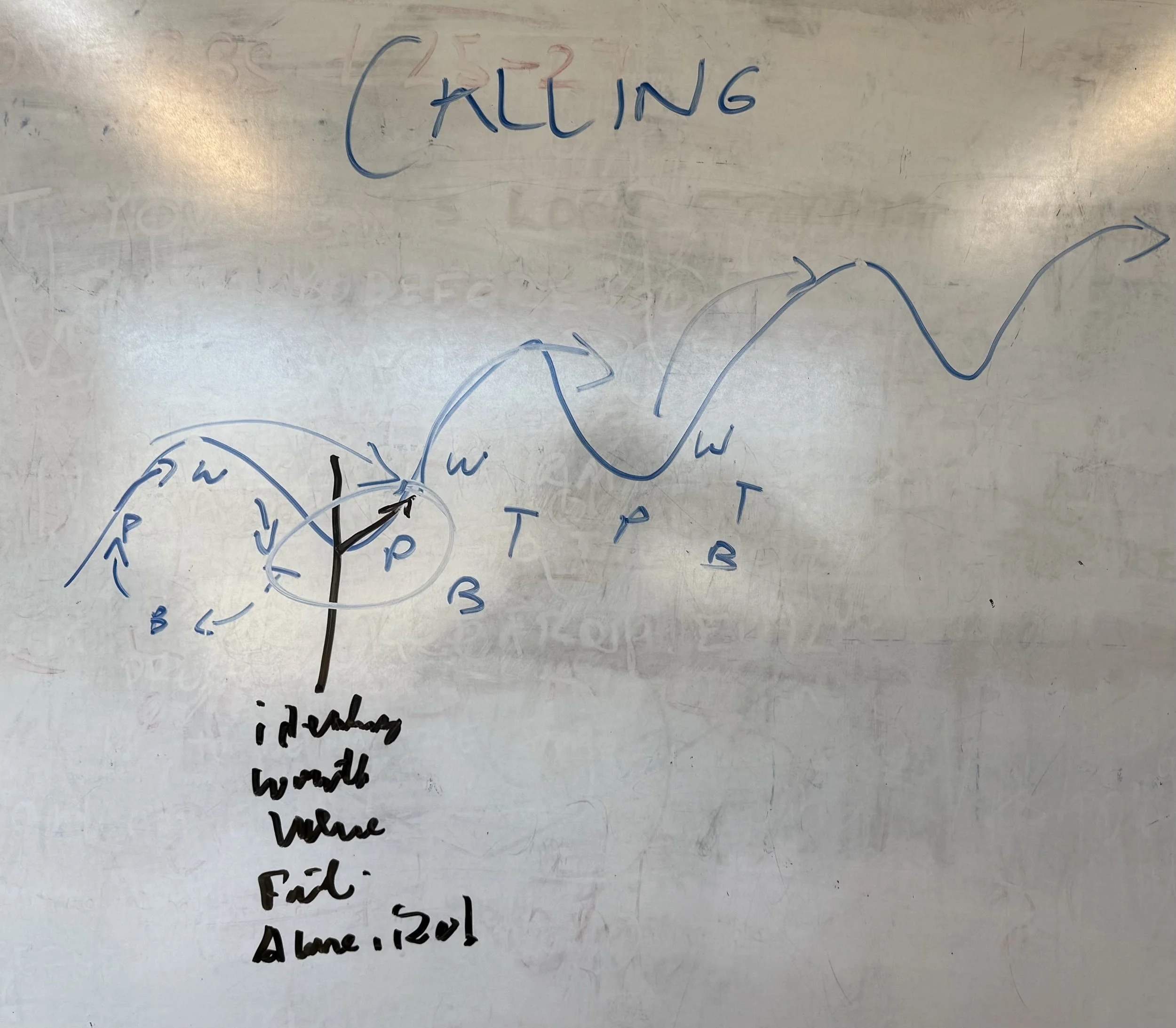
Drawing from the lives of Abraham, Moses, Joseph, David, Peter, Paul, and even Jesus Himself, Danny outlined six distinct movements that appear repeatedly in the spiritual formation of God's leaders:
Calling — The initial summons, the burning bush, the divine invitation
Wilderness — The season of isolation, testing, and stripping
Testing — The proving ground where faith meets fire
Breaking — The crushing that releases the oil
Promotion — The elevation into greater responsibility
Multiplication — The fruit that reproduces and extends impact
But here's where Danny's insight transcended typical leadership development paradigms: these stages don't form a straight line. They form circles.
"When I was over in Israel in 2018 and 2019," Danny explained, "our guide pointed out on these hills where sheep go to pasture—it looks like eyes. It's the shape of an eye, and it goes all the way up to the top of the hill. When these sheep are making their way up the hill, they circle. They don't go straight, they circle."
His guide, a man named Ari, called them "circles of righteousness." Up a little bit, down a little bit, back a little bit, then up some more. Not the efficient path. Not the path that makes sense on paper. But the path that forms rather than merely transports.
"As we go through these cycles in our lives," Danny continued, "this pattern—calling, wilderness, testing, breaking, promotion, multiplication—it's circles of righteousness. You're called, you got a destination in mind. You go through the wilderness, you're gonna go through some testing, you might go through some breaking, you're likely gonna go through some breaking, you're gonna get promoted. And then the end result, hopefully, is there's multiplication."
Tom— "If you look at the physics of waves in the ocean, people think that waves are moving across like that, but they're actually circles. The energy goes down hundreds of feet and it goes like this, and it affects everything around it. It creates these cells that are side by side that look like it's moving across the surface, but it's not."
The image landed. Life's forward progress isn't actually forward—it's cyclical, spiraling, circling upward through repetition and rhythm. And critically, as one man observed, "Every time you hit this level of promotion, God's like, 'Yeah, you leveled up, but now you got the next level wilderness. You got the next level testing. I'm getting you ready for the next thing.'"
Question One: What Season Are You In?
The first question Danny posed to the group was deceptively simple: Can you identify which season you're currently in?
Russell immediately grasped the multi-layered nature of the question. "Just even as you were talking, it's like I can almost resonate just even in the course of a day," he said. "Just even looking at what happens in the course of a day—the way I would put language to even this week is I got to hold this sweet little chunky cute baby, and then at the same time I'm dealing with death and dying all within the same few hours."
He continued, his voice carrying pastoral wisdom: "Just the juxtaposition of what happens in the course of a day where you're having a conversation and you're laughing your head off about something, and then you're crying. Just the fullness—what happens even in the course of the day, whether it's an email exchange or text or just in life is so full of dynamic. And it doesn't always have to be that way, but it's just like the cycles of waves you're talking about. But then just recognizing how that hits in seasons. And if we ignore that, man, things don't go well."
Danny validated this observation immediately: "You can be on multiple points of this at the same time. There can be something really great that's going on—just like the reconciliation stuff. There was something great happening as I was having a relationship reconciled on one Sunday, and at the same time, and it didn't really manifest until the next Sunday, God's like, 'This is awesome, but hey, you got some work to do over here too.'"
One man synthesized the insight beautifully: "God is helping you see a principle that is truth, and then He's showing you how that can apply elsewhere. Which is multiplication, right? You're getting clarity and then you're looking for application."
The men began to recognize that God doesn't necessarily limit Himself to revealing one thing at a time in our lives. Rather, He works on multiple fronts simultaneously—calling us forward in one area while crushing us in another, promoting us here while testing us there. The seasons overlap, interpenetrate, and inform one another.
Jeff— "We live in Colorado, we talk about seasons," another man offered. "This is like microclimates—small iterations of a different season within the big season. And I was thinking of those times my wife and I have been in that horrible testing, breaking moment. But what comes from that? The promotion. What comes from that? If there's a healthy relationship—which, but that's grace—the intimacy that comes from that brokenness and the times where we're literally on our knees in our bedroom and we just hold each other. That promotion, that multiplication, because that intimacy is a completely different intimacy from the physical, sexual intimacy. The most powerful intimacy in my marriage has been those times when we're in the shit, we're in the worst place, but we come together."
Todd added a critical observation about proportionality—or the lack thereof: "It's important to realize these are not proportional usually. If we're going with the waves analogy, if you are in a really deep part of the ocean, you have a deep wave and that's going down deep into that test or wilderness area. But then you could have a tsunami where your multiplication and promotion is a very massive wave. It's not usually proportional at all. You'll have small waves that are closer to shore, you'll have deeper waves that are further out. There's not often where it's 'alright, five days of this and five days of that.'"
The seasons, the men were discovering, are both simultaneous and successive, both micro and macro, both personal and corporate. Recognizing which season you're in—or which seasons, plural—becomes an essential skill in spiritual navigation.
Question Two: Arrival Focus or Formation Focus?
The second question Danny posed struck at the heart of how men typically approach life: Are you arrival-focused or formation-focused?
"If all of this is about 'I want to arrive at this status, this place, this whatever,' then those cycles, those circles of righteousness are gonna feel like walls," Danny explained. "They're gonna feel like you're stuck. But if I realize that—if I have a perspective of that being one cycle in my formation, of God calling me into sonship, God developing me into the man that He wants me to be—that's not a wall, that's a lesson."
The distinction cut deep. Most men, if they're honest, are wired for arrival. We want the summit, the trophy, the title, the achievement. We want to cross the finish line, plant the flag, and move on to the next conquest. Formation, by contrast, requires staying in the fire long enough to be shaped. It means valuing who we're becoming over what we're accomplishing.
But Russell, with characteristic insight, refused to let the distinction become binary. "As I look around at you men and as y'all are all speaking, I think about Matthew 11: 'From the days of John the Baptist until now, the kingdom of heaven has been forcefully advancing and forceful men lay hold of it.' There are men here at this table who have a fire in their belly to advance the kingdom of God. Otherwise you wouldn't be putting on an event this fall, otherwise y'all wouldn't be doing some of the things that you're doing. There's something that God has put inside the hearts of men to go after the things that God has called them to do."
He leaned forward, his intensity palpable. "So there is an arrival focus that is anointed. There's things that stir in your bones at three in the morning. You wake up with a shuddering that God is calling me into something. He's anointed and called you to do it. And He's put men around you to be able to see the thing done. So it's not that being arrival-focused or being goal-oriented is bad—it's just a matter of what the aim is directed towards. At the same time, there's a work that's happening in us so it can happen through us."
Russell continued with fire: "I don't have a problem with that arrival focus, but I also recognize that if I'm just going out there to get mine or conquer that hill for the sake of my own pride or ego, man, I'm off. So there's a balance of both. And I just want to be mindful not to dumb this thing down or emasculate ourselves, if I can say it. Y'all are leaders. Every one of you. You have influence in your bones. You go out and—He's made you to be strong and courageous, to be more than conquerors. That's arrival focus."
The room held the tension. Yes to formation. Yes to the long obedience in the same direction. But also yes to holy ambition, to Spirit-led boldness, to the aggressive advancement of God's kingdom through surrendered men. The key, the men were discovering, wasn't choosing between arrival and formation—it was ensuring that the formation preceded and sustained the arrival, that the inner work enabled the outer work, that character kept pace with calling.
"The harder you push towards the summit, the harder it gets and the more you feel like you're punched in the gut, you lose your air. Just the reality—whatever goal, whether it's an Olympics metaphor, whatever race you're running, the harder you push towards that, the more exhausted you are. And so there has to be something that fuels you, that gives respite, whether it's a marathon mindset or a sprint mindset or just, again, the cycles and understanding the rhythms."
Question Three: What Do You Usually Try to Escape From?
Danny's third question brought the discussion into uncomfortable specificity: What do you usually try to escape from?
He offered his own answer first, vulnerably sharing about building his first house—a teenage dream finally realized—and the incredibly difficult homeowner who showed up every day, cycling between happiness and rage.
"There's something that God is doing in me in dealing with him in the midst of this thing that I've always wanted to do," Danny confessed. "He's saying, 'You gotta—I need to teach you how to deal with this guy. I gotta teach you how to relate to this guy and to work through this, even though you're doing this thing that you always wanted to do. There's something that I gotta work out in you, Danny, in dealing with this guy.'"
The vulnerability gave permission. Danny continued: "And He's using this guy to sharpen this iron and it sucks. And a couple of weeks ago, I came in here and I gave this maybe really lofty sounding idea—I could quote Jim Carrey in a joke: 'I wish everybody could make a lot of money so they realize it doesn't do anything for you.' And God convicted me after that. And He's like, 'No, I brought you here and this is the first of many houses you're gonna build. But in the middle of all that, I gotta teach you how to deal with difficult people. And I gotta teach you how to put your pride down so that you don't walk up here on your first house thinking you know everything.'"
The room recognized the pattern immediately. God wasn't withholding the dream—He was using the dream as the context for formation. The arrival and the formation weren't sequential; they were simultaneous. And Danny's first instinct had been escape.
“When I'm around you men, something—I get heart back. My heart, I'm encouraged. And there's things that trip me up along the way that keep me from that. But that's what's common to me—there's things that the enemy can take me out and heap this stuff that results in me being discouraged where it's just like I got no fuel in the tank. And that's my greatest strength of encouraging men, but my Achilles is that I get discouraged."
He named it clearly: "Being aware of the temptations that are common to man and temptations that every one of us—where some of us are strong in some areas, we're weak in others. And being aware of what that is so we just don't give the devil a foothold. And just being reconciled with myself, with Carrie, with you men—there's just some things that take me out. And that's where the enemy absolutely 100% wins the day. Come hell or high water, that better not be the thing that takes me out, which is why I'm sitting here this morning."
The men began naming their escape routes: isolation when feeling like a failure, numbing behaviors when overwhelmed, workaholism when facing relational pain, cynicism when hope feels too costly. Each man's pattern of escape was unique, yet universally recognizable. And beneath each pattern was the same core issue: the unwillingness to stay present to what God was doing in the difficulty.
"My most common area that I have to watch out for leads to massive discouragement,"
"It just takes me out. I lose all my fuel, lose all my energy. I have no interest in doing anything. And the root of that is I lose heart. I lose heart. And so when I'm around you men, I get heart back."
The antidote to escape, the men were discovering, wasn't simply willpower or determination. It was presence—the presence of God and the presence of brothers who could carry hope when you couldn't see it yourself.
The Wall and the Breakwater
One of the newer members, Matt, brought a diagram to life that captured a struggle many men experience but few articulate. He drew on Danny's journal, creating a visual representation of his experience with the cycle.
"I don't see those things happening necessarily all the time in that order," Matt explained. "There's—like you said, you can be in two different seasons. But what I've struggled with over the years is that I get here"—he pointed to the breaking stage—"and then that season becomes a sentence on my life. And there's a wall here that prevents this movement to the next season because I lose identity, worth, value. I'm failing. Or it's just there's this space of being alone, isolated."
He continued, his honesty creating space: "Getting through the season usually is okay, but then it's like, I gotta face another freaking season and I've lost some things in the midst of some of these processes. And I don't know which—all of those things that I feel, that I've lost in the midst of that season, I have to restore that. My identity, I have to restore that. And for me, it's like this thing is a big piece of what finding all of those things is about. Because I can't do it on my own. It's gotta be with other guys. It's gotta be in that space where if my identity isn't straight with the Lord and my value isn't right, then I want to isolate. I feel like I'm failing."
Ron offered a stunning reframe: "It may not be failure per se, but using an ancient term—a breakwater. A breakwater breaks the energy so that you can find this rest, this joy. So that—see, that's interesting. God is calming you or us to be able to focus on these things. Like I said, He's not gonna show us everything all at once. Maybe He's giving us one thing at a time that we can handle to get to the next."
Matt's response was immediate and visceral: "So I see that wall as like a complete monster and a detriment. But when you look at it as just a place where it's calming the storm for the next tide to come in—wow. Ron, that one freaking hit me."
The conversation had shifted from viewing obstacles as evidence of failure to seeing them as instruments of formation. The wall wasn't blocking progress—it was creating the conditions for transformation. The breakwater wasn't stopping the journey—it was making the journey sustainable.
Todd added crucial theology: "It's important to realize who is behind this cycle, and it's not me, it's not life—it's the Father. So this cycle, it's His work in us. So the point is not to get from this point to this point. The point is to get right there"—he pointed to the breaking stage. "That's where you're at. The Lord is taking your identity to a more true and deeper level of identity. That's the whole point. You are the son of God who loves you. Your self-worth, everything you just said, everything comes from that. That's in your heart and that's what the Lord is after. It's your heart."
Matthias synthesized powerfully: "Those dips are pauses, those are times to pause. And He's given you that opportunity to reflect on what's your identity, what's your worth, what's your value. You're my son. I love you. Your identity is in me. Reflect on that. Look at that. Live on that. Soak on that. And the enemy can steal that and say, 'Oh, I'm just gonna get stuck. I'm just gonna isolate myself.' Or we could let Him step into that season or that moment."
Tom added: "We've talked about this in previous sessions—could it be that you're not losing identity? God's telling you what you don't know about yourself and stripping away what you thought was—false identities you built it on. You're not losing anything. You're gaining."
The wall, the men were discovering, was actually a classroom. The breakwater was actually a sanctuary. The pause that felt like death was actually preparation for resurrection.
Where Does the Enemy Fit In?
Rob raised a question that had been hovering over the entire discussion: "Where does interaction with the enemy and the spiritual war interface with this?"
It was a crucial question. Job's testing, after all, was permitted by God but executed by the devil. The wilderness where Jesus was tested was the same wilderness where Satan showed up to tempt. How do we understand the interplay between God's formative work and Satan's destructive agenda?
Rob offered the most comprehensive response: "I think it's important to realize—I don't think we should sell ourselves short by saying that those are the only places within those circles that the enemy works. Because for this arrogant, prideful man, I promise you, he works in the promotion just as much as he works in the wilderness and testing. That's where it gets real easy to say, 'Look what I just did. Look who I am. God really thinks I'm the stuff. He needs me. Watch me tear it up.'"
The insight shifted the framework. The question wasn't "where does the enemy fit in this cycle?" The question was "where isn't the enemy active in this cycle?" As another man said, "The question isn't where does it come in here—it's like, where is it evident in every single one of these?"
Todd added theological precision: "The Lord is after the restoration of our hearts, the transformation of our hearts. And the enemy is about the exact same thing. He's trying to tear down our identity. He's trying to strip us of our intimacy with the Father. And so at the very same time that the enemy is doing that, he doesn't realize that he's setting the Father up for a grand rescue and then greater restoration. The enemy often attacks us in our wounds—that's our vulnerability. And then our idolatry often comes out of our wounds. So the enemy attacks us in the vulnerability of our wounds. That's the exact same thing that the Father is after—the healing of our wounds and our hearts so we can be more wholehearted and more like Him. So they could be happening at the exact same time."
The men sat with this. God's agenda and Satan's agenda target the same territory—our hearts, our identity, our intimacy with the Father. But their purposes couldn't be more opposite. Satan attacks to destroy; God allows the attack to restore. Satan aims to isolate; God uses the isolation to create intimacy. Satan seeks to shame; God transforms the shame into humility that can receive grace.
Russell brought it back to practical vigilance: "Being aware of the temptations that are common to man—where some of us are strong in some areas, we're weak in others. And being aware of what that is so we just don't give the devil a foothold. Come hell or high water, that better not be the thing that takes me out."
The spiritual warfare isn't ancillary to the formation cycle—it's integral. Every stage of growth invites both divine development and demonic opposition. The key is learning to discern which voice is which and to align ourselves with the Father's purposes even when the enemy is active.
The Crushing That Releases the Oil
As the discussion deepened, Danny brought the group to Gethsemane—literally and metaphorically. "There's this really encouraging quote by A.W. Tozer at the bottom here," he said, reading from his notes. "'It's doubtful whether God can bless a man greatly until he has hurt him deeply.'"
He continued: "Wrapped up in all of this, if we go to Gethsemane and Jesus praying in the garden and asking, 'Hey, if there's another way can we do that?' There was a crushing. The Garden of Gethsemane is an olive grove, and there's 800 to 1,000-year-old olive trees, maybe older, growing there. And when you put olives into a press to get the oil out, there's actually like a weeping sound that they make. It sounds like wailing, like crying loudly. And that's exactly what was going on with Jesus to get the oil out. He was being crushed to get the acceptance of the cross. He was being crushed and hurt deeply."
The image landed with visceral power. Scripture says Jesus was sweating blood—the physiological manifestation of stress so extreme the capillaries burst. He was being pressed to the point of breaking to yield the oil that would anoint the entire world.
"In order for us to give God the glory, to be transformed into what He wants us to be," Danny concluded, "there is a crushing that has to take place. And we, like Jesus, have to say, 'Hey, not my will, but Yours be done.'"
The crushing isn't incidental to the formation—it's essential. The oil that brings healing, that lights the lamps, that consecrates the priests, only comes through the press. And the sound of that pressing is weeping. There's no shortcut. There's no crushing-lite option. There's only surrender: "Not my will, but Yours."
One man added from his own tradition: "In some translations of 2 Corinthians 3:18, it says we are being taken from glory to glory. That is through the transformation and seeing Him, His face with unveiled faces. We're going from glory to glory."
Sheldon— "That's also in Romans 5. Going through the transformation—nobody really wants the suffering, but the discipline leads to a harvest of righteousness."
The Biblical witnesses were unanimous: suffering precedes glory, crushing precedes anointing, breaking precedes multiplication. Not because God is sadistic, but because our hearts are stubborn, our false selves are entrenched, and our deepest healing requires the kind of surgery that only happens under extreme pressure.
The Miracle - Peace in the Middle of the War
As the men wrestled with the reality of crushing and breaking, a word that felt like oxygen in a smoke-filled room: "Even in the midst of all of this turmoil, somehow there's still this unbelievable miracle that we can have peace in the midst of it. And that's an amazing thing—that while we're even sleeping at night when all this war is going on, there's still peace in the middle of it. That is the miracle, because God is who He is. And that in the midst of all of this pattern, there still can be peace. That is a miracle."
He pressed the point: "It is a miracle. And it's the exception. Because where do you go buy peace? Do you take a pill? Sign up for a program? Somehow there can be peace in the midst of all of this. That is the good news. Because everything else is hell and crazy."
The men felt the truth of it. Peace isn't the absence of the storm—it's the presence of the Shepherd in the storm. It's Psalm 23 lived out: green pastures and still waters, but also the valley of the shadow of death. A table prepared in the presence of enemies. A rod and a staff that both comfort and correct. All of it, simultaneously. All of it, held by the One who sees the end from the beginning.
"I think the key with that," one man offered, "is it's despite the situation. The struggle we get caught up in is feeling like we're supposed to have peace, and the tension is that it doesn't eliminate the difficulty."
Another added: "I think the downside of focusing on any part of the cycle—whether it's the peak or the valley—is it shifts our focus away from what we should be focused on."
And what should we be focused on? Not the circumstance, but the Companion. Not the stage of the cycle, but the Shepherd who guides through all stages. Not our performance in the season, but His presence in every season.
Todd brought it back to Psalm 23 with surgical precision: "If you really take some time and dissect every single part of what the psalm is actually saying—the fact that, okay, You lead me to green pastures, You lead me to still waters, to the quiet waters. But there's also a valley. There's also a rod and the staff, which is correction and protection both. There's a table with bounty on it—awesome. But my enemy's sitting right next to me. There, like, who's already eating? Who gets to enjoy the same meal I get to enjoy? You're kidding me. But that's the invitation—into the fullness of life. All of these things are happening at the same exact time. And above it and outside of it and carrying it and leading us through is the Lord, the Shepherd, who sees something—who sees the hand already healed."
The peace, the men were discovering, isn't found by escaping the complexity. It's found by embracing the presence of the One who holds the complexity without being overwhelmed by it. He sees the healed hand before we do. He sees the restored heart before we do. He sees the multiplied impact before we do. And He invites us to trust Him in the not-yet, to rest in Him in the in-between, to abide in Him through all the circles of righteousness.
The Arrival Mindset and the Enemy at the Table
One man offered a confession that many could relate to: "I tend towards that arrival mindset, and so as such, I am constantly striving for the next peak. That's all I seem to care about if I'm not paying attention to myself. But what that means is I have to realize that when I get to that next peak—there's a table with an enemy sitting right there on the other side. There's a valley on the other side of it. If I'm racing forward and I'm peak-minded, then the valley is gonna shock me and hurt me because I'm not expecting it."
The insight was profound. The arrival mindset doesn't just miss the formation in the valley—it makes the inevitable valley more painful because it arrives unexpected. When we're fixated on summits, we're perpetually disappointed by descents. We experience the valleys as failure rather than formation, as setbacks rather than setups for the next ascent.
But there's another danger to the arrival mindset that the psalm makes clear: even at the peak, the enemy is present. The table is prepared, the cup overflows, the head is anointed—and right there, in the presence of all that blessing, sits the adversary. Pride, self-sufficiency, the subtle shift from "God did this" to "I did this," the temptation to forget the wilderness that preceded the promotion.
Danny had named it earlier: "For this arrogant, prideful man, the enemy works in the promotion just as much as he works in the wilderness." The summit isn't safe. The multiplication isn't the end. Every stage is spiritual warfare, and every stage requires vigilance, humility, and dependence on the Shepherd.
The only solution the men could identify was what they were doing in that very room: showing up, speaking truth, carrying hope for each other, refusing to let anyone walk the cycle alone. "As leaders, we all end up having moments where we have to be the carriers of hope for the cause that we're on," one man said. "Sometimes if no one else is gonna do it, you have to carry the hope. You have to carry the vision. But we can also be carriers of hope for each other on our walks. Because when I can't see clearly what God's doing or recognize that I'm loved and being around other people that are carrying hope—it is contagious. And I think we can do that for each other, but really only if we're able to be vulnerable."
Suffering, Perseverance, Character, Hope
As the discussion wound toward its conclusion, the men turned to the New Testament passages that frame suffering not as interruption but as instrument. Romans 5:3-5 became a touchstone: "Rejoice in your sufferings, because suffering produces perseverance; perseverance produces character; and character produces hope. And hope does not put us to shame."
"That's Tom's favorite verse for the year," someone joked, referencing the man who'd chosen 1 Peter 5:10 as his theme: "After you have suffered a little while, the God of all grace, who has called you to His eternal glory in Christ, will Himself restore, confirm, strengthen, and establish you."
The laughter was knowing. Nobody wakes up excited about suffering. Nobody volunteers for the wilderness. But the men around that table were beginning to grasp what James meant when he wrote, "Consider it pure joy, my brothers and sisters, whenever you face trials of many kinds, because you know that the testing of your faith produces perseverance so that you may be mature and complete, not lacking anything" (James 1:2-4).
Joy in the trial isn't joy about the trial—it's joy in the purpose behind the trial, joy in the Father's commitment to our completeness, joy in the certainty that He who began a good work will carry it to completion. The suffering is real, the pain is real, the crushing is real. But so is the formation, the transformation, the glory-to-glory progression.
One man summarized it perfectly: "I think when we're in the trials, if we can remember the whole point is up to the right—the Lord says in 2 Corinthians 3:18, 'And we all, who with unveiled faces contemplate the Lord's glory, are being transformed into His image with ever-increasing glory, which comes from the Lord, who is the Spirit.' In some translations it says we're being taken from glory to glory."
Glory to glory. Not peak to peak, but glory to glory. Because the glory isn't only at the summit—it's in the surrender at every stage. It's in the abiding through the valley. It's in the breaking that releases the oil. It's in the crushing that produces the wine. It's in the death that precedes resurrection.
Up and to the right doesn't mean avoiding the down. It means trusting that the down is part of the up, that the circles are how the climb happens, that the Shepherd knows the path even when it feels like we're going backward.
Questions for Reflection
Which of the six stages (calling, wilderness, testing, breaking, promotion, multiplication) do you find yourself in right now? Can you identify multiple stages happening simultaneously in different areas of your life?
Danny's story demonstrates how God's plans often diverge radically from our own—yet produce deeper formation. Where in your life has a "failed plan" actually become the context for your greatest growth?
Are you more naturally arrival-focused or formation-focused? How might you need to grow in embracing the other? How can holy ambition and humble formation coexist in your life?
What do you typically try to escape from? What patterns of avoidance (isolation, numbing, workaholism, cynicism) show up when you hit a wall in the formation cycle?
Matt described the wall between breaking and promotion as a "sentence on my life" where he loses identity and worth. Have you experienced this? How does Ron's reframe of the wall as a "breakwater" shift your perspective?
Where is the enemy most active in your current stage of the cycle? How might his attacks in your strength areas (promotion, multiplication) be as dangerous as his attacks in your weak areas (wilderness, breaking)?
The men identified that peace in the storm is a miracle, not an achievement. Where do you need to stop striving for peace and instead receive it as God's presence with you in the chaos?
"It's doubtful whether God can bless a man greatly until He has hurt him deeply" (A.W. Tozer). How does the image of Gethsemane—the crushing that releases the oil—help you understand and embrace your own seasons of breaking?
Who in your life carries hope for you when you can't see clearly? Who are you positioned to carry hope for? What makes vulnerability possible in those relationships?
The Challenge
This week, do two things:
First, map your current position. Take an honest inventory of where you are in the formation cycle—not where you wish you were, not where you think you should be, but where you actually are. Name the season (or seasons) without judgment. Just observe: This is wilderness. This is testing. This is breaking. This is promotion. Write it down. Share it with someone who can carry hope for you.
Second, choose one area where you've been trying to escape. Maybe it's a difficult relationship like Danny's challenging homeowner. Maybe it's a financial pressure that makes you want to quit. Maybe it's a health issue that feels like a sentence. Whatever it is, instead of strategizing your exit, ask God: "What are You trying to form in me through this? What false identity are You stripping away? What deeper truth are You revealing about who I am as Your son?"
Then—and this is critical—don't just ask the question and move on. Stay in it. Journal about it. Pray through it. Let the question work on you rather than working to find a quick answer. Formation takes time. The sheep circle up the hill slowly. The wave goes deep before it crests. The oil comes only through the crushing.
The goal isn't to arrive faster. The goal is to stay present longer—present to God, present to your brothers, present to the transformation happening beneath the surface of your circumstances.
Remember: circles of righteousness. Up a little, down a little, back a little, then up some more. Not efficient. Not comfortable. But formative. Always formative.
And remember Acts 18:9-10, the verse that grounds Matt: "Do not be afraid, but speak and do not keep silent. For I am with you, and no one will attack you to hurt you, for I have many people in this city."
You're not alone in this. The Shepherd is with you. Your brothers are with you. The Spirit is forming you. And what God begins, He completes.
From glory to glory, brothers. Not despite the valleys, but through them.
Closing Prayer
Jeff's voice carried the weight of the morning as he prayed the group into the rest of their day:
"Lord, thank you for this morning. Thank you for these men, for Matt being able to come join us for the first time. We pray, Lord, we don't scare him off. Just pray Your blessings on these guys, that we can just wrestle well as men, and that somehow we'll be undergirded through it. And somehow through the forge of all this, that we would stand as men full of character and that we would be formed to be more like You, Christ. And that we would not be alone, but we would be able to stand with one another through all of this.
"Guide us in our discussions. Guide us, Lord, where You want us to go for our encouragement, but also for the building up of others. And as was said today, this is gonna be for Your glory, Lord. So we just release that to You in Jesus' name. Amen."