
"The call to courage begins with vulnerability."
— Tom Strong
There are rooms where men walk in carrying everything — the weight of what they've done, what they've failed to do, what they're afraid others might find out. They sit down, cross their arms, and wait to see if this is safe. Most of the time, they leave the same way they came. Armor on. Nothing given. Nothing received.
Then there are the rare mornings — the ones you don't plan for — when someone speaks and something breaks open. Not the person. The silence. And suddenly the room shifts, and every man in it leans in just a little closer, because what was just said is what none of them had the nerve to say first.
That is what happened the Friday morning Tom Strong walked in and setting a picture of his military dress uniform jacket on the table. Not to impress. To tell the truth.
Tom has spent his adult life in rooms where the stakes were as high as they get. Combat zones. Field hospitals. Beside flag-draped caskets in forward operating bases. He has seen what men are made of when the performance falls away because there is simply no time or safety for it anymore. And what he found — what he has carried out of every one of those rooms — is that the men who endure, who lead, who actually help the people around them, are not the men who feel nothing. They are the men who feel everything and find a way to stay present anyway.
Vulnerability, Tom told us that morning, is not the opposite of strength. It is where strength is born.
— ✦ —
A Chest Full of Stories
Tom is a retired Army chaplain. A man who has worn the uniform of the Special Operations community, earned the Combat Action Badge, served in submarine units — a Navy badge on an Army uniform, as he noted with a quiet grin. He spent the better part of two years in combat zones across multiple deployments. He has sat with the dying. He has walked into rooms where men were trying to figure out how to keep living. He has helped carry the bags of men he knew.
But what Tom brought that morning was not his record of valor. He brought a story about a 250-foot tower, a torn calf muscle, and a limp he hid from the men who were paid to watch for it.
He was forty-five years old when his unit sent him to the Army's Airborne School at Fort Benning, Georgia — three weeks of learning to jump out of planes. There were 432 students in the class. Tom was the second oldest among them. And from the moment he arrived, the message was clear: chaplains fail. Don't be another one.
"Hey Chaplain," the black-cap instructors announced in front of everyone, "are you going to fail out like most of your fellow chaplains?"
Tom let the words land. He didn't argue. He suited up.
One of the culminating exercises was the 250-foot tower — a massive steel structure with four arms extending outward, each rigged to raise a jumper strapped to a parachute and then release them, letting them drift to the plowed earth below. It had been broken for three months. The entire class assembled. The black-cap instructors looked at Tom.
"Chappy, you are going first. This thing hasn't been used in three months and we want some good luck."
And then — because this is the Army and because there is always one more thing — they announced to all 432 students that the last man tested on the tower had blown into the frame, gotten caught, and fallen.
Tom stood at the base of that tower in front of more than four hundred people, carrying the weight of every expectation, every doubt, every chaplain who had quit before him. Four hundred sets of eyes watching to see what the old man of God would do.
He floated down soft as a leaf.
The first jump of the final week was different.
It was a long day. The kind where exhaustion settles deep into the joints. And somewhere in it, Tom felt it — a tearing, deep in his right calf. He looked down. He could see blood pooling beneath the skin. The muscle had torn, forty to fifty percent of it gone. Four more jumps remained before he could earn his wings.
That night, limping back to the barracks, Tom sat with something harder than physical pain. He sat with the weight of what it would mean to quit. The commanders who had believed in him enough to send him. The Army funds spent on his behalf. The 400 students watching. The instructors already waiting for the chaplain to confirm what they expected.
"Lord," he said, "what do I do?"
And a verse came.
"Fear not, for I am with you; be not dismayed, for I am your God. I will strengthen you, yes, I will help you, I will uphold you with My righteous right hand."
— Isaiah 41:10
The next morning, formation assembled before dawn. Every student ran a mile in boots and uniform to the gear-up site. The black-cap instructors lined the route, watching for any soldier whose gait gave them away. Tom knew this. Tom had one good leg.
So he limped on the good one.
He exaggerated the limp on his healthy left leg so that his stride evened out, and he ran smoothly through the screen. Four more mornings. Four more jumps. Blood still moving beneath his skin. Isaiah 41:10 still moving through his mind.
He earned his wings. The oldest man left standing.
Here is what struck Tom when he told that story and when the room received it — not the accomplishment, but what happened in the in-between moments, in the waiting around, in the pauses between training exercises. The black-cap instructors — the hard men whose job it was to break people down — would quietly pull Tom aside. "Hey Chappy, you got a minute?" And they would share their lives with him.
Not because he was impressive. Because he was honest. Because he was carrying something real and not pretending otherwise. Because there is a kind of gravity to a man who is clearly in over his head and has decided, with God's help, to show up anyway. People are not drawn to perfection. They are drawn to truth. And the truth Tom carried that week in Fort Benning — blood beneath the skin, verse on his lips, limp on the good leg — was the most compelling thing in that field.
— ✦ —
Two Sides of the Same Coin
Tom had been reading Brené Brown's Daring Greatly when something cracked open in his thinking. Brown told the story of a soldier who had received a medal for valor on the battlefield — and she connected that courage not to invulnerability, not to fearlessness, but to vulnerability. To the willingness to step into genuine exposure, genuine risk, genuine uncertainty, and go anyway.
"As soon as I read that," Tom told the room, "I thought — I have a chest full of moments where I was vulnerable. I just never thought about it that way."
That reframe is the whole ballgame.
For most men, vulnerability and courage exist on a spectrum — opposites pulling against each other from either end. The more courage you develop, the less vulnerable you become. Weakness on one end. Strength on the other. Toughen up and you move right. Show weakness and you slide left. That is the architecture of the Western hero, the lone gunslinger, the strong silent type — the man who has mastered his emotions so completely that he appears to have none.
But Tom was standing in front of a roomful of men saying: it is not a spectrum. It is a coin. Flip it over. On one side — courage. On the other — vulnerability. They are not opposites. They are the same thing, seen from two different angles.
"Vulnerability is really related to courage — but for many of us, we've never thought of it as a courageous act to be vulnerable." — Tom Strong
Thomas — a pastor who has spent decades watching this play out in congregations — pushed the idea further. He told the story about the door. The time he got into a fight with his wife, and she left for the airport and told him to figure it out. In a moment of rage, he kicked the bathroom door so hard it punched a hole through it. He spent the weekend sanding it down and spackling it over.
Months later, he stood in front of his congregation and preached on anger. He brought the door to the stage.
"I was terrified," he said. "I thought this is my last Sunday. Everyone's going to walk out. Here's the pastor who was supposed to be leading people to faith on airplanes, and he's been kicking holes in doors."
But something happened that he did not expect. Years later, more men from that congregation have told him that sermon changed their lives than anything else he ever preached or did. Man after man, pulling him aside: I punched a wall. I threw something across a room. I thought I was a monster. I came to church every Sunday ashamed, but I couldn't say it to anyone. And then you brought that door out and said that, and I thought — there's a way out. There's a man who did what I did and found his way through.
Not the pastor's polish. The pastor's hole in the door.
"There's a great power in being vulnerable as a leader," Thomas shared. "It begets vulnerability. It calls it out in others. It normalizes it and makes it possible." He paused and looked around the room. "I was watching Tom tear up over there and it was emboldening me in ways I didn't expect. Just watching that."
Vulnerability is contagious in the best possible way. One man breaks the seal, and the whole room breathes differently.
— ✦ —
What Keeps Us from the Coin
One of the men in the circle named what sits between us and vulnerability with unusual precision. He works with men navigating recovery — from addiction, from broken relationships, from the versions of themselves they can no longer sustain. He has watched men circle community, truth, and authenticity their whole lives. Longing for all three. Getting close. Retreating.
Every time, he said, it comes back to three things. Fear. Trust. Image.
"Vulnerability is putting yourself out there — not knowing in any way how that person is going to receive it, what they're going to do with it, how they're going to react. That's the courage of realizing I'm okay. I don't have to fear. I can trust. And this isn't about my image." — Matt
Fear of rejection. Fear that what you reveal will be used against you. Fear that the moment you stop managing the narrative, the narrative manages you.
Trust that doesn't yet exist, or that has been burned before. The men in that room have earned their caution. Some of them opened up at some point in their lives and got wrecked for it — by a friend who became an adversary, a community that turned cold, a moment of honesty that cost them more than they'd budgeted for. That scar tissue is real. It doesn't just disappear because someone in a Friday morning circle quotes Brené Brown.
And then image. The hardest one. The face that took years to build. The reputation that opens doors. The version of yourself that works — that leads, that provides, that handles things. The one you are not certain survives contact with the truth of what you've done, what you haven't done, what you're afraid of.
Tom had named this without using the word. Standing in front of 432 soldiers with instructors waiting for him to fail, he felt the full gravitational pull of external validation — the need to prove worth by performance. That pull is not weakness. It is deeply human. And it is the exact thing the gospel is designed to interrupt.
"We as men seek to validate our worth from the outside in," Tom said quietly. "And yet what God says about us — what the gospel is all about — is that we validate our worth from the inside out."
That sentence changes the whole equation. As long as your worth lives outside you — in the title, the performance, the perception of others — vulnerability is not just uncomfortable. It is existentially threatening. You cannot afford to be seen as broken, because broken is all you are without the external scaffolding holding you up.
But when your worth is grounded in something that cannot be revoked by circumstances or failure or an instructor's contempt — when you are held by a righteous right hand you did not earn and cannot lose — then vulnerability becomes something different. Not a liability. A doorway.
— ✦ —
The Perfectionist's Trap
There is a close cousin to the fear-trust-image triad that the room didn't name directly but kept circling around, the way you circle a word you can't quite find. It showed up in the man who talked about authenticity. It showed up in the executive who admitted he over-disclosed and lost his team's confidence. It showed up in Tom's story about the instructors waiting for the chaplain to fail. It is the perfectionist mindset — and it is one of vulnerability's most sophisticated and stubborn opponents.
Perfectionism is not the same as having high standards. High standards say: I want to do this well. Perfectionism says: I must do this without flaw, because if I fail, I am the failure. High standards leave room for honest effort and honest reckoning. Perfectionism does not. It demands an unblemished record — and since no such record exists, it demands something worse: the performance of one.
This is the thing that makes perfectionism so destructive in the context of vulnerability. It is not just that perfectionists don't want to fail. It is that they have constructed an identity so thoroughly built on not failing that failure — or even the admission of struggle — feels like the complete unraveling of who they are. To be vulnerable is to let someone see the seams. And for the perfectionist, the seams are everything he has spent his life hiding.
"People aren't so much enamored by our successes. They are enamored by how we failed — and then found a way to work through it and recover and find hope. That's when we're vulnerable." — Tom Strong
One of the men in the room put language to a version of this he has lived. He described himself as a highly authentic person — genuinely relatable, the kind of man people are drawn to, a storyteller who can bring a room along. He is not hiding behind a mask. He knows who he is. And yet there is a threshold he has identified, a line he doesn't cross without enormous effort.
"There is a big difference," he said, "between being real and authentic and then crossing that threshold of vulnerability — which is acknowledging a need. When I move from storytelling to saying I need something, I need help — that's a form of vulnerability that I still maybe lack. And it's an area where I want to continue to grow."
That observation cuts to the bone, because it describes something perfectionism does that we rarely acknowledge: it allows a very convincing imitation of openness. The perfectionist can be charismatic, even confessional — as long as the confessions are curated, the struggles are past-tense, the wounds are already healed. What he cannot do is say, in the present tense, with the outcome still uncertain: I don't have this. I need help.
Because that sentence — I need help — puts the result outside his control. And for the perfectionist, loss of control is the deepest fear of all.
The executive coach story one man shared said it differently. His bank had brought in a coach who asked the team to start distinguishing between employees who were reactive and employees who were self-aware. At first, that framing seemed off. Those aren't opposites, the man thought. But the more he sat with it, the more he saw it. Reactivity is what fills the vacuum left by self-awareness. When you don't know your triggers, your weak spots, the places where fear is running you rather than the other way around — you react. You perform. You manage the room. You present the version of yourself that has it together, because the only alternative your perfectionism allows is the version that has fallen apart entirely.
Self-awareness breaks that binary. The man who knows his triggers isn't free from them — but he is no longer blindsided by them. He can name them. He can even name them to other people. And that naming, that honest accounting of what moves in him and why, is the first form of vulnerability that perfectionism has to surrender to if anything is going to change.
"How often do we bring that into our relationship with God — being self-aware versus reactive? The verse says 'search me, know my heart.' How much do I actually go: help me see those things? Versus just being reactive with God?" — Andy
This is where perfectionism does its most insidious work — not in our relationships with other people, but in our relationship with God. The man who has spent his whole life managing his image brings that same energy to his prayer life. He presents the acceptable version of himself. He comes with what he has handled, what he has figured out, what he can report favorably. He is not dishonest, exactly. He is just selective. He edits himself before God.
And the tragedy is that God already knows. Psalm 139 is not a surprise to Him. The searching and the knowing are not a threat — they are the invitation. But the perfectionist has to unlearn a lifetime of believing that being fully seen means being found wanting. He has to discover, slowly and usually painfully, that the righteous right hand that upholds him does not first require that he have it together.
Tom's story at Fort Benning is a perfectionist's nightmare that became a story of grace. He could not be perfect. He could not hide the injury forever. He could not guarantee the outcome of those four remaining jumps. What he could do — what he did — was tell God the truth, get his boots on, and run on the good leg. Not flawless. Faithful.
There is a version of that moment that perfectionism would have scripted differently. Don't tell anyone. Don't show weakness. Either gut it out in silence or withdraw entirely — because those are the only two options the perfectionist mind offers. Tough it out perfectly or don't go at all.
But Tom found a third way. He acknowledged the limitation — at least to God and to himself — and moved forward anyway, with help he didn't earn and couldn't manufacture. That is what vulnerability looks like when it defeats perfectionism. Not dramatic confession. Not public breakdown. A man on his knees with a verse and four more jumps to go.
Marshall Goldsmith's line surfaced in the room: what got you here won't get you there. For the perfectionist, this is the hardest truth in leadership development. The same relentlessness that drove you to achieve, the same refusal to tolerate mediocrity in yourself, the same iron discipline that built your record — those are the exact qualities that will become your ceiling if they are not tempered by the willingness to be honestly, appropriately, courageously vulnerable. The perfectionist gets to a certain altitude on performance alone. And then he stalls, because he will not admit what he doesn't know, ask for what he needs, or let anyone see the cost he is paying to maintain the appearance of effortless competence.
The men who lead well for a long time — the ones others want to follow not just because of their results but because of who they are — are not the men who never failed. They are the men who failed and told the truth about it. Who stepped back from the perfectionist's binary of succeed-or-collapse and found the harder, truer posture: I am in process. I am held. I am moving forward. Come with me.
— ✦ —
Flourishing Requires Both
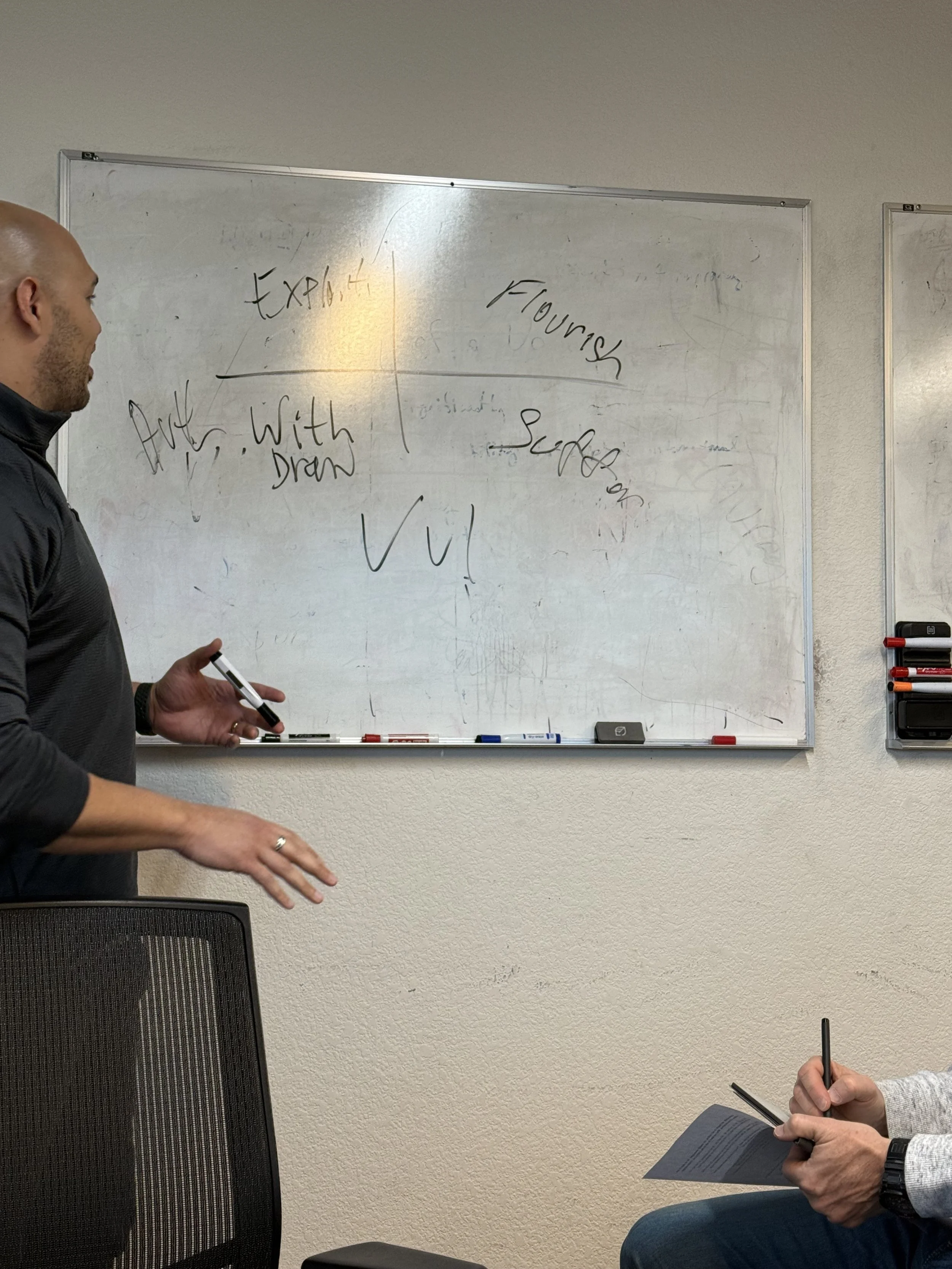
Jeff had been sitting with Andy Crouch's book Strong and Weak, and he brought the framework into the conversation at exactly the right moment. Crouch constructs a two-by-two quadrant: authority on one axis, vulnerability on the other. The four quadrants he names are flourishing, suffering, withdrawal, and exploitation.
High authority, high vulnerability: flourishing.
High authority, low vulnerability: exploitation.
Low authority, high vulnerability: suffering.
Low authority, low vulnerability: withdrawal.
The room felt the weight of that framework because every man there could locate himself in it — not just now, but at different seasons of their lives, in different roles, under different pressures. A leader who was flourishing at work while withdrawing at home. A father who was deeply vulnerable with his kids while exploiting his authority at the office. The quadrant was not a judgment. It was a map.
The insight that landed hardest: the failure mode for strong men, gifted men, men with genuine authority and capability — is not that they lack strength. It is that they wall off vulnerability so completely, for so long, that they slip into exploitation without even intending to. Power without exposure. Influence without honesty. The ability to shape rooms and outcomes without the willingness to be shaped by them.
"The way to be the most flourishing father is to be a father who understands his authority and responsibility — but who also has high vulnerability. And where I struggle is: I've been given the title, the authority. So I don't want to let anyone know that I don't have what it takes sometimes." — Jeff
Tim told the story of walking into a large leadership role he wasn't sure he was qualified for — a diverse international team, a cultural context he didn't fully understand. He started being radically transparent about his limitations. I don't know that. You're the expert. I trust you. And it almost backfired. Feedback came back through the grapevine: it would be nice to have a leader who seemed confident in his position.
He sat with that. Not to harden back up, but to ask the harder question the Crouch framework raises. What does it look like to be simultaneously strong and exposed? To carry the weight of the position without disappearing behind it, and to admit limitation without abandoning the people who need someone to actually lead?
"I wanted my team to flourish," he said. "Even when I was in a suffering quadrant myself — how do I still get above that line? How do I lead them upward even when I'm not there yet?"
The answer, the room decided together, is not a formula. It is a posture. And that posture is love.
"We're not courageous for courage's sake. We're not vulnerable for the sake of vulnerability. The reason we're courageous and vulnerable — the only reason that sustains it — is love for whoever has been entrusted to us." — Sheldon
Pat Lencioni's framework surfaced briefly: most leaders think the role is about privilege. That is the exploitation mindset. The leader who is flourishing understands that the role is about responsibility for the greater good. That reframe changes what vulnerability means. You are not exposing yourself for your own emotional processing. You are exposing yourself in service of the people in your care. That is not weakness. That is the deepest kind of leadership strength.
— ✦ —
The Strange Arithmetic of Suffering
Someone said something in the middle of all of this that no one had quite planned to say, and it settled over the room like a second presence:
"Your authority is one hundred percent related to your suffering. Through suffering, there's something that emboldens you. Your personal influence and personal authority is one hundred percent linked to your ability to suffer." Russell
It sounds counterintuitive until you sit in it a moment. We do not follow people because they have never been broken. We follow people who have been broken and found a way forward — or are still, humbly, finding it. The credential that matters most in the rooms where real things get said is not the title or the track record. It is the evidence that this man has paid a price. That he has gone somewhere hard and come back with something true.
David is the model the room kept returning to. The man anointed to be king who ends up in a cave at Adullam, surrounded by the desperate, the indebted, the discontented. Four hundred men in rough shape gathered around a man who is himself on the run. And out of that — out of his own suffering — he becomes their captain. Not despite the cave. Because of it.
"David could have said — I've got enough of my own problems right now," one man observed. "I don't have the capacity to lead you through your struggles. But he didn't. He went: okay. I've been called. I'm suffering. These people have a need. This is where God has me right now. So I'm going to do what I've been called to do in the context of my suffering."
There is a distinction, though, between leading out of suffering and performing suffering publicly. The leader who announces his wounds every week eventually has no one left to lead. That is not vulnerability — that is an abdication of the responsibility to actually show up for people. The movement that produces real authority is from "I have suffered" to "and here is what I am learning" — or the more honest version: "here is how I am, slowly, imperfectly, with God's help, working through it."
That is the sermon on the door. That is the limp disguised as a normal stride. That is the forty-five-year-old chaplain finishing jump school on nothing but a verse and a decision to lace up his boots.
Not victory. Faithfulness. And faithfulness, over time, builds the kind of authority that no title can manufacture.
— ✦ —
We Were Never Meant to Go It Alone
Tom came back, at the end, to where he always comes back: battle buddies.
On the battlefield, he said, if you ask any war fighter — male or female — were you ever vulnerable, they will say yes. Every single time. One hundred percent. Because the battlefield strips the performance away fast. Nobody gets to be invincible when the ground is shaking and there is no fallback position.
And yet we walk around in civilian life pretending the ground isn't shaking.
"Life is an adventure," Tom said. "And it's a battlefield. And it's hard. We've all seen that in each other and experienced it ourselves. And so we need each other."
Our youngest son Josh — Tom mentioned him with visible tenderness — is thirty-three, living in Seattle, working as a sous chef. They've been reconnecting, the two of them, in ways that feel like recovered ground. Josh called a few days before that Friday morning, and after they talked, he told his father: I was sitting here with a few minutes and thought — who am I going to call? I'm going to call Dad. His friend has been teasing him about it: your dad's whole thing about "battle buddies for life" — kind of cheesy. Josh shrugged. I like it.
Tom smiled telling it. Even cheesy things can be true.
One of the men told a quiet story about his divorce. A Saturday morning, alone in the house, unable to stop crying. The weight of brokenness and failure sitting on his chest. He picked up his phone and thought about calling a friend — a friend whose wife happened to work on his team, two levels down from him in the org chart. Which meant that if he called, she would know. And that meant the leader he'd worked so hard to appear to be would be exposed as the suffering man he actually was.
He called anyway.
The text came back: We're going hiking. Meet us here.
"I spent the rest of the day with them," he said. "It pulled me out of that pit. But it was vulnerable. And I was genuinely wrestling with whether it was courageous or just foolish."
That is the honest question, and the room didn't rush past it. Is vulnerability risky? Yes. Can you get hurt? Absolutely. Will it always be received the way you need it to be? No. The picture someone offered: a dog rolling over, exposing its belly — the softest, most undefended part of its body. The risk is real. But the possibility — of being known, of being helped, of connection that actually means something — is worth it.
"Life isn't about being safe," someone said. "It's about managing risk. And that's really what parenting is. What friendship is. What any real relationship is."
And then, almost under his breath, another man added: "Even in relation to yourself — coming down to a point where you love yourself enough."
That is the ground floor of it. The courage to be vulnerable is finally, at its root, an act of love. Love for the people in your life. Love received from a God who sees the whole of you and holds you anyway. And enough love for yourself to believe that the truth of who you are — the medals and the limp, the accomplishments and the hole in the door — is worth bringing into the room.
There is something else Tom observed that morning about what happens when a man is genuinely vulnerable: it is not only that it creates permission for others. It creates gravity. The black-cap instructors at Fort Benning, the hardest men in the room, came to the old chaplain not in spite of his obvious struggle but because of it. Because a man who is honest about what he is carrying — and still showing up — is the most trustworthy person in any environment. He has nothing to perform. He is just there.
— ✦ —
Questions Worth Carrying
Tom left the room with a few questions. Not the kind you answer on the spot. The kind you carry around for a while and let work on you, the way a good verse does — you think you're reading it, and then you realize it's been reading you.
1. How would life be different — from this point forward — if you held the coin of vulnerability and courage together, understanding them not as opposites but as two sides of the same thing?
2. How does this show up across the different areas of your life — your marriage, your parenting, your work, your friendships, your relationship with God? Where are you flourishing in this? Where are you stuck?
3. Personal development has been called "loving yourself." We are told to love God, love others, and love ourselves. Where does vulnerability fit into that third category — loving yourself honestly enough to be fully known?
4. Where does perfectionism show up in your life as a barrier to vulnerability? What is the performance you maintain, and what would it cost to let someone see behind it? What might you gain?
5. How do we lead by example rather than by performance? What does it look like when vulnerability becomes the thing people are actually following — not the results, not the title, but the honest humanity?
6. Where is vulnerability a liability? Not every room is safe. Not every moment calls for full exposure. What is the discernment required — what one man called "appropriate vulnerability" — and how do you develop it?
That last question matters most for the perfectionist, because his tendency is to take any principle and apply it absolutely. Vulnerability is good, therefore I should be vulnerable everywhere, always, with everyone, immediately. That is not vulnerability — that is indiscriminate exposure, and it produces exactly the kind of backlash the man in the room experienced when his team wanted to see some confidence.
Appropriate vulnerability is discernment. It is the opening story that lets a guard down without betraying a confidence. It is the admission of uncertainty that empowers a team rather than destabilizing them. It is the limp on the good leg — not because you are hiding forever, but because this is not the moment, and you know the difference. That knowing, that calibration, is itself a form of maturity that perfectionism cannot access — because perfectionism only has two speeds: flawless performance or complete collapse.
— ✦ —
The Call to Courage
There is a passage in 2 Corinthians that one of the men read aloud that morning, and it has the weight of lived experience behind it — Paul writing not from a comfortable study but from a life of shipwrecks and beatings and long nights in the dark:
"Therefore we do not lose heart. Though outwardly we are wasting away, yet inwardly we are being renewed day by day."
— 2 Corinthians 4:16
Wasting away and being renewed. At the same time. Not one after the other. Simultaneously. That is the strange, holy arithmetic of a life lived in honest dependence — on God, on others, on the truth of who you are and what you need and where you are falling short. The perfectionist wants the renewal without the wasting. He wants the inside work without the outside exposure. But Paul says they come together, in the same body, on the same day.
Tom stood at the end and said it plainly:
"The call to courage begins with vulnerability."
Not after vulnerability. Not despite it. Not once you've got it together and cleaned yourself up and prepared something worth saying. Begins with it. With the honest admission, the turned-over stomach, the hand over the heart, the blood beneath the skin and the verse on the lips and the decision to lace up the boots one more morning.
The men in that room carry a lot. One is watching a job evaporate. Another is in the long aftermath of a marriage that didn't survive. Several carry the faces of people they have lost — in combat zones, in hospital rooms, in their own families. More than a few are still learning, in their fifties and sixties, how to ask for help — really ask, not perform asking. All of them are wasting away in some measure and being renewed in another. All of them showed up that Friday morning to a room where they are, finally, allowed to say so.
That is not weakness. That is the bravest thing most men ever do.
Tom is moving on — a new city, a new season, the men in Tulsa who don't yet know what's coming. He will walk into new rooms, and eventually he will set something on the table that tells the truth. He will offer the limp behind the stride, the verse that got him through, the story about the tower and the blood and the dawn formation and the four more jumps. He will offer it not to impress but to invite. And because he does, other men will find permission to do the same.
That is how courage spreads. Not from the man who claims he was never afraid. From the man who was afraid, and went anyway, and can tell you — with specificity and without sentimentality — what held him up.
Retired Navy SEAL Mark Divine says: when bad things happen, they can destroy you, define you, or grow you. The men who stay in that third category — who refuse to be destroyed or merely defined by their worst moments — are the men who have made peace with vulnerability. Not as a program, not as a technique, not as a box to check. As a way of being. As the other side of the coin they carry everywhere they go.
— ✦ —
Reflections
As the morning ended, one of the men put words to what the room had been circling for an hour. He talked about his father — a man who had driven trucks for decades, had millions of miles behind him, and who could not physically ride in the backseat without reaching for controls that weren't there. He tied it, not cruelly, to the spiritual life. To all the ways we insist on having the wheel — on managing the outcome, on maintaining the appearance of control over things that were never ours to control.
"Vulnerability in that context," he said, "is not having control. It's a trust issue. Do you trust who has the wheel?"
We trust God with our eternity. We said the prayer, we mean the prayer, we are grateful for the prayer. But we white-knuckle the steering wheel of our daily lives — our reputations, our failures, our fears, our marriages, our finances, our bodies as they age and slow and ache — as if the surrender that saved us was a one-time transaction rather than a daily practice. As if God's mercies are new every morning in theory but we still need to manage our own image by noon.
The perfectionist in us comes out most clearly right there. We believe in grace for salvation. We are far less sure about grace for the Tuesday afternoon meeting where we didn't have the answer, for the Saturday morning in the empty house when we couldn't stop crying, for the calf torn forty to fifty percent and four more jumps to go. We want to bring God the cleaned-up version. And he keeps asking for the real one.
The men on that Friday morning were practicing it. In the imperfect, ordinary way that men practice things — imprecisely, incompletely, with long detours into football metaphors and leadership frameworks and the occasional well-timed joke. Telling true stories. Asking hard questions. Sitting in discomfort long enough for something real to surface.
Not performing courage. Being it.
One man offered the image, near the end, of a deaf translator struggling to find the sign for the word "vulnerability." She couldn't find it in the formal vocabulary. Finally she placed her hand over her heart and opened her chest — a gesture of the body, not the dictionary. Tom smiled at that and said nothing, because there was nothing to add.
That's the whole sermon, right there. Hand over the heart. Chest open. Not knowing if it will be received. Going first anyway.
Whatever version of the performance you've been maintaining — whatever limp you've been disguising, whatever door you've been spackling over, whatever injury you've been running through without telling anyone — the invitation is the same one that was waiting for Tom at the bottom of that tower. Step up. Say the verse. Float down soft. Tell someone what it cost. Let that be enough.
— ✦ —
A Prayer to Close
Jesus —
We thank you for the model you gave us. You left the safety of everything and walked among us. You were God and you became vulnerable — exhausted, grieving, betrayed, misunderstood, afraid in a garden on a Thursday night. Not performing vulnerability. Choosing it. For us. Freely and fully and without any guarantee of how it would be received.
Help us become men who hold the coin. Men who understand that the courage you call us to and the vulnerability you invite us into are not enemies, but companions. Two sides of the same act of trust. Two sides of the same act of love.
Where we are wasting away — in our bodies, our relationships, our finances, our sense of self — renew us inwardly, day by day. When the ground shakes, let us not reach for the performance. Let us reach for you, and for the men beside us.
Deliver us from the perfectionist's trap — from the belief that we must arrive fully assembled before you, before each other, before ourselves. Teach us that the blood beneath the skin is not shameful. That the limp is not disqualifying. That the verse on the lips and the boot on the ground are enough. That faithfulness is enough.
Teach us appropriate vulnerability — the discernment to know what room we're in, what season it is, what is ours to carry quietly and what is ours to offer out loud. And give us the courage to be the one who goes first. The one who breaks the seal. The one who tells the truth so the man sitting next to him doesn't have to carry his alone one more morning.
We pray for every man reading this who is running on a broken leg. Who is limping on the good side so no one pulls him out of the race. You see the blood beneath the skin. You know the verse he needs. Meet him there. Hold him. Strengthen him. Uphold him with your righteous right hand.
And may we never forget: the call to courage begins with vulnerability.
In the name of Christ — who was strong and weak, courageous and broken, full authority and complete sacrifice —
Amen.
— ✦ —