
The Self-Leadership Challenge Every Executive Needs to Hear Right Now
Something rarely talked about openly in executive circles: the leaders who are struggling most right now are not struggling because they lack talent, intelligence, or drive. They are struggling because their internal reserves have been quietly running on empty while the external demands on them keep growing.
That is not a character flaw. It is a pattern — and it is one we see with striking consistency across industries and leadership levels.
In our 2025 analysis of more than 50 executive coaching engagements, self-leadership and personal effectiveness emerged as the second most significant area of development focus, accounting for 19% of all coaching themes. The findings were consistent regardless of industry, company size, or level of seniority. Across the board, leaders were navigating chronic fatigue, emotional volatility, blurred boundaries, and a slow erosion of their personal health — often without fully recognizing how far they had drifted.
A client shared, "I don't have a time management problem as much as a priority management issue. If I'm honest, my stress gets the better of me. I carry an exceptionally full plate, and the risk of overextension and burnout is real. It’s worth my effort to guard against."
If that sentence lands with any weight at all, keep reading. This article is for you.
This Is Not a Private Problem — It Is an Organizational One
There is a tendency to frame self-leadership as a personal matter — something leaders should handle quietly, on their own time. But the data tells a different story. When a leader operates in chronic stress, the quality of their decisions declines. When boundaries collapse, strategic priorities blur. When energy is depleted, teams inherit the instability. The ripple effects are real: organizational drift, increased turnover, and fractured leadership pipelines.
The cost of leaders not leading themselves well is never contained to the leader alone.
Another client shared, "The self-awareness, drive, and care for people that you bring to your role are not just professional assets — they are the marks of my leadership whose work carries real significance. I know this to be true, the problem is me, and the hard work is living it out"
That significance is precisely what is at risk when the internal foundation begins to crack.
What Self-Leadership Actually Means
At its core, self-leadership is the discipline of keeping your internal capacity aligned with your external responsibility. It is the ongoing, often unglamorous work of managing your energy, protecting your priority time, maintaining emotional resilience, and ensuring that how you spend your days actually reflects what you say you value.
Self-leadership is well beyond time management, its energy, emotional, and relational management that starts with me. The beginning of Self-leadership is self-awareness.
The leaders in our research who struggled most were not lacking commitment or capability. They were simply out of alignment. Their calendars, habits, and recovery patterns no longer matched the scale of the roles they were carrying.
One COO shared, "How I see myself is how I will represent myself. Do my people see my values, beliefs, and my best, or only my fatigue and stress."
Self-perception shapes presence. And presence, as one leader put it with disarming simplicity, is everything:
"Presence is your most powerful leadership tool right now. Before the decisions, before the strategy, before the next chapter fully opens — be present for your people, for your family, and for yourself. Trust that the rest will follow."
The Patterns We Keep Seeing
Across our dataset, several predictable warning signs appeared again and again. None of them are signs of weakness. All of them are signals that the internal system needs recalibration:
Sacrificing sleep, fitness, and nutrition — despite knowing better
Emotional recovery taking longer after setbacks or difficult conversations
Work consuming personal life until the line disappears entirely
Difficulty protecting strategic time or maintaining meaningful boundaries
A quiet, hard-to-name sense of drift — motivational, spiritual, or existential
That last one deserves particular attention. Many high-performing leaders carry it in silence, unsure how to name what they are feeling or whether naming it is even appropriate. It is appropriate. It is important. And it is far more common than most executive conversations let on.
Structure Is Not the Enemy of Freedom — It Is the Source of It
One of the most persistent misconceptions about self-leadership is that structure and discipline somehow diminish a leader's flexibility or creativity. The leaders who have done this work well know the opposite is true.
One entrepreneur commented, “Structure is my friend, not my enemy. When I create the right structure around my yeses and nos, I am not limiting myself — I'm focusing on what matters most."
This includes deliberately protecting what restores you — not just what produces results. One leader described it as leaning into what is life-giving: a long walk, a good burn at the gym, a 3 -day weekend away, a meal shared with people who matter. These are not indulgences. They are strategic investments in the leader you are becoming.
A Practical Framework for Getting Back Into Alignment
The good news: you may not need a 3- month sabbatical or a dramatic life overhaul to reclaim your footing. Small, intentional shifts — made consistently — compound quickly. Here is a framework that has emerged from this research:
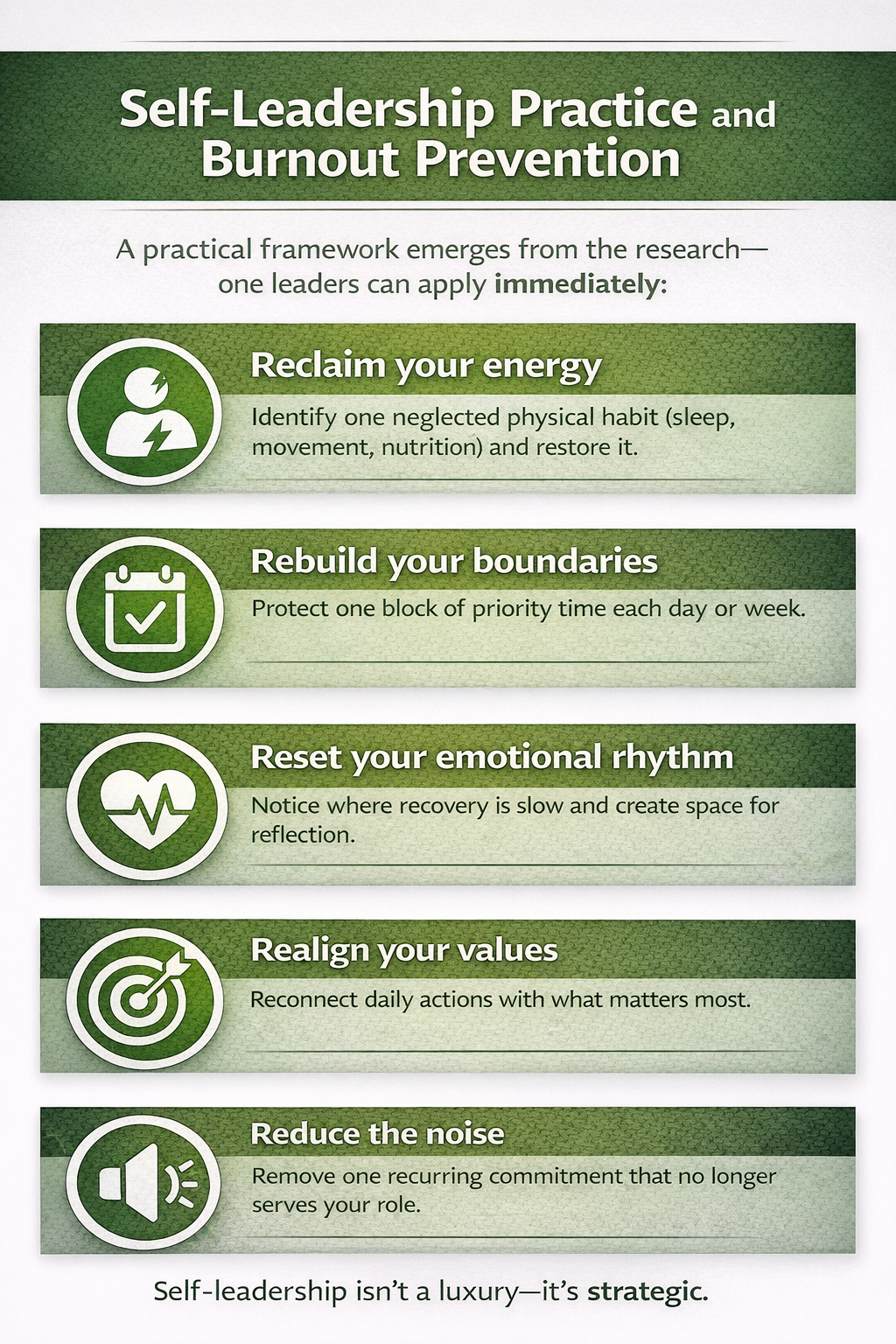
Leaders who make these shifts do not just feel better — they regain clarity, presence, and strategic capacity long before major burnout symptoms appear.
Simply stated by one leader, "I need to lead myself as boldly as I lead others.
A Note on Adversity and Formation
For those reading this in a particularly hard season — one defined by difficult relationships, unrecognized effort, or a role that is taking more than it is giving — this is worth holding onto:
One client reflected after our session, "The pain I'm experiencing today is forming the leader I will become tomorrow. I want to be a leader, leading myself well today, so I can influence others better tomorrow."
Self-leadership, in the end, is not about optimization. It is about stewardship — of the energy, capacity, and influence you have been given, and of the leader you are still in the process of becoming.
One Question to Carry Into the Week Ahead
Where are you currently out of alignment with the leader you are becoming — and what is the smallest meaningful step you can take to close that gap?
You already know the answer. The invitation is simply to act on it.
Next week, we’ll explore the third domain: Strategic Thinking and Prioritization.
For more on the 5 Domains and Communicating Effectively, download the full 2025 Executive Coaching Summary to explore the complete research today.
The path forward is clearer than it feels. Let's map it together.
Russell Verhey, PhD, MCC — Executive Coach, The Advance | russell@leadersadvance.net
— — —
All client quotes have been anonymized and are drawn from executive coaching engagements.