
The Shift From Urgency to Intentional Leadership
There comes a point in every executive's journey when working harder stops producing better results. The calendar is full, the inbox is overflowing, the pace is relentless — yet the impact doesn't scale with the effort. Analysis of more than 50 executive coaching engagements revealed this pattern across industries: leaders remain trapped in operational urgency long after their roles require strategic elevation.
Strategic Thinking & Prioritization accounted for 16% of all development focus, making it the third-largest leadership gap in the dataset. The consequences are significant. When leaders stay in execution mode, organizations miss opportunities, fail to anticipate disruption, and optimize for activity instead of outcomes. The cost is strategic drift — slow, quiet, and expensive.
This matters because strategy is not a document; it is a discipline. It requires the ability to distinguish what is urgent from what is truly important, to allocate time toward enterprise-level priorities, and to create clarity for teams who depend on direction. Leaders lose their way not from lack of effort, but from lack of alignment. Strategic thinking is the antidote to that drift.
The Pattern That Repeats
The data shows predictable warning signs: calendars dominated by reactive meetings, leaders pulled back into doing rather than leading, an absence of clear vision or direction, and measuring activity instead of outcomes. These are not capability gaps — they are identity shifts. The transition requires moving from personal output to organizational impact. That shift is the essence of strategic leadership.
One leader overseeing a $180M operation described it plainly when reflecting on what held him back most:
"I think he tries to help everybody so much that he gets bogged down and loses track of the big picture."— Stakeholder feedback, Construction Executive
What made him exceptional at a smaller scale — high warmth, relational flexibility, everyone pitching in — had become friction at scale. His team needed decisiveness and structural clarity more than availability. The coaching insight was not that he needed to become someone different, but that he needed to grow a new capability set that matched the size of what he was building.
In another engagement, a technology division leader preparing for a high-stakes pitch to his CFO and CEO arrived to the session still tangled in tactical details. Within the conversation, a strategic shift clicked: the real opportunity was positioning his division not as a cost center but as the enabling arm that drives product sales toward a $1.5B trajectory. The clarity around bottom-line profitability — rather than top-line volume — became the organizing frame for everything that followed.
And perhaps the most candid self-assessment came from a CEO one year post-acquisition, still wrestling with where to direct his energy:
"How much do I give? Where do I draw the line? Why am I here?"— CEO, Post-Acquisition Leader
These aren't signs of weakness. They are the honest questions of a leader standing at the threshold of a new role — one that requires letting go of the work that made him successful in order to lead at the level the organization now needs.
A Practical Framework for the Shift
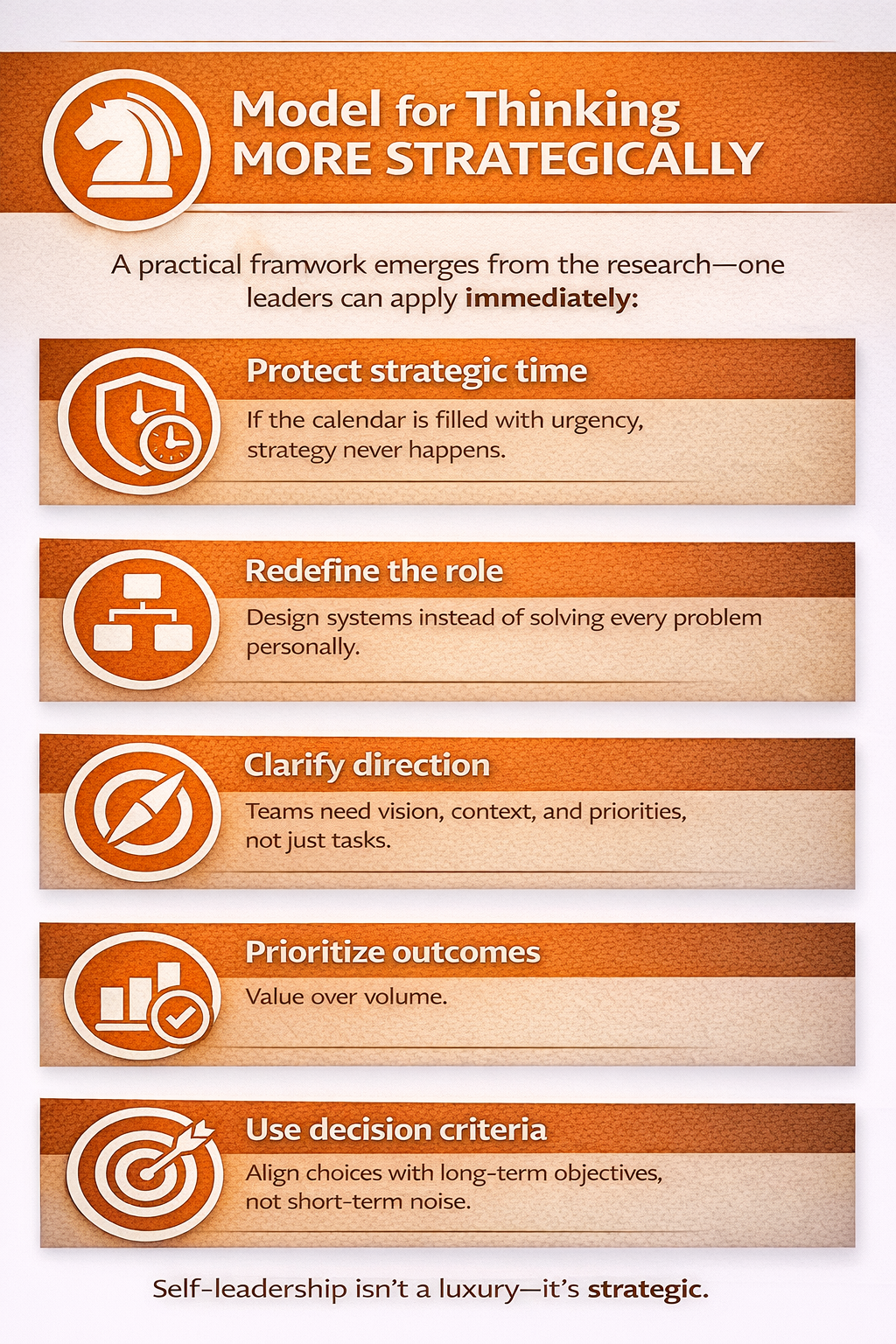
From the patterns across engagements, five consistent disciplines emerge for leaders making this transition:
One stakeholder said it directly when describing what his leader needed most:
"I want feedback on my ideas but sometimes I need his clarity and decisions. I need his leadership. i need him to say, here's what we're gonna do."—
Strategic clarity is not born from speed — it is born from space. Slowing down long enough to think, reflect, and recalibrate becomes essential to leading at scale.
The Question That Opens the Door
The leaders who make this shift share a common denominator: they give themselves permission to step back from the work they've always done in order to do the work only they can do. They stop measuring themselves by their output and start measuring themselves by their team's clarity, their organization's direction, and the quality of decisions made at the highest level.
As the week begins, consider this:
"What's one responsibility that needs to be stepped back from so focus can shift toward the work that truly moves the business forward?"
That question — answered honestly and acted on consistently — is where strategic leadership begins.
Next week, we’ll explore the third domain: we're focusing on your people, how executive leaders empower, develop, and delegate effectively.
For more on the 5 Domains and leading effectively, download the full 2025 Executive Coaching Summary to explore the complete research today.
The path forward is clearer than it feels. Let's map it together.