
What happens when one of the Global South’s most accomplished executives looks in the mirror — and fires himself from the most dangerous job title no one gave him.
Rohan leads one of India’s most consequential healthcare technology organizations — nearly a billion euros in revenue, 1,400 employees across 20 regional locations, and a reputation built over nearly three decades in the industry. By any measure, he is exactly who you’d want running a company like this. The problem? So is he.
That’s the paradox that surfaced during a pivotal coaching conversation. Rohan arrived accomplished, credible, deeply respected by peers and senior leadership. His 360-degree feedback confirmed it — high marks for leading the business. But when the data turned to leading his people, a gap appeared that no amount of market knowledge could close.
The feedback was direct: Rohan wasn’t developing his people. He was solving their problems.
“Despite his CEO title, he had quietly promoted himself to a position no one advertised — Chief Problem Solver. And he was very, very good at it.”
In one-on-ones, known internally as JoFix meetings, Rohan would arrive with energy, experience, and answers. Decades of institutional knowledge made him the fastest path to resolution in any room. Teams learned quickly: bring Rohan the problem and leave with a solution. It felt like leadership. It was, in fact, a bottleneck.
The epiphany came quietly. Reflecting on feedback from his direct reports — the group whose scores diverged most sharply from peers and superiors — Rohan named it himself: “I do hear them, but there is this natural urge… I need to let people solve.”
THE FIRING
So in the middle of a coaching session, Rohan did something rare for a leader of his stature. He fired himself. Not from the organization, but from the role he had unconsciously claimed. Chief Problem Solver — terminated, effective immediately. In his place: Chief Empowerment Officer. With, as he admitted with some humor, no idea where to begin.
The practice that emerged was precise. Before entering any one-on-one, prepare two or three genuine questions — not to lead witnesses to his preferred conclusion, but to draw out the expertise already in the room. The shift: from person who holds answers to person who holds space. Rohan recognized he’d glimpsed this posture before, in an unguarded moment with a junior colleague, where three thoughtful questions produced more insight than a full agenda would have.
He then committed to three visible changes: delegating revenue conversations entirely to his leadership team, stepping back from people decisions below his direct reports, and resisting the pull to build new customer relationships that would undermine the leaders he was supposed to be developing. The freed time would flow toward positioning India within global headquarters, building government relationships in a heavily regulated healthcare environment, and investing in the next generation of strategic leaders on his team.
And he decided to say it out loud — to his team, plainly: “I’m going to lead differently. I’ll need your help. Tell me when I slip back.” Public accountability, built into the operating model.
THE STAKES OF THE CHOICE
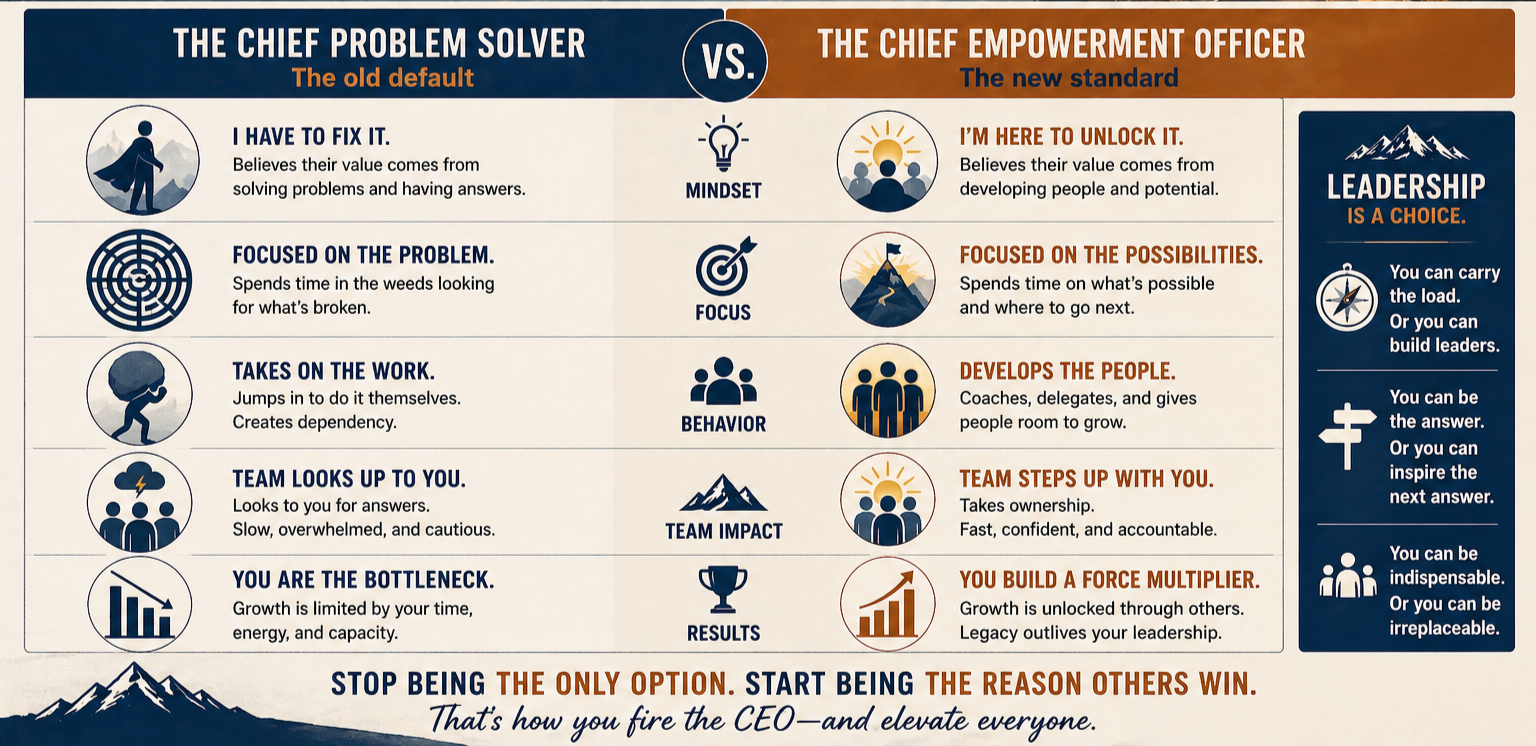
The difference between these two outcomes is not intelligence, not experience, not ambition. Rohan has all three in abundance. The difference is a single question, asked before every meeting: Is this conversation about them — or about me feeling useful?
THE NEW HIRE REPORTS FOR DUTY
For a leader at Rohan’s level, the math is simple but humbling. One person solving problems for 1,400 people is a ceiling. One person developing seven leaders who each develop seven more — that is a culture. That is scale. That is, finally, what a CEO is actually for.
He is, by his own admission, a work in progress. But the firing has already happened. The question now is whether the new hire shows up — consistently, in the meetings that matter, when the urge to just solve it quietly tugs at a mind that genuinely knows how.
“The smartest person in the room is the one who makes everyone else smarter.”
The model Rohan is building — questions before answers, delegation before control, public accountability before private intention — is not a leadership program. It is a philosophy, made practical one meeting at a time. And if it holds, the impact won’t stay in his seven direct reports. It will seep into all front-line employees.
Need help creating a more empowering culture? Let’s explorer the possibilities together for you and your organization. Schedule a strategy session here.