

A framework from Paul Stanley — lived out across a lifetime of mentorship
The higher you climb in leadership, the more the job description quietly changes beneath you. You were hired to direct work. You were rewarded for getting things done. But somewhere along the continuum from manager to executive, the metric shifts: it's no longer what you build — it's who you build.
"The value proposition of leadership isn't just getting work done — it's who you're bringing up."
My late mentor Paul Stanley called it a developmental bias — a bent toward growing people that shapes every conversation, every 1-on-1, every team engagement. It's the difference between telling someone what to do and asking how they plan to do it. Give a fish versus teach them to fish. The framework sounds simple. Living it is another matter.
THE CONTINUUM
Directing vs. Developing
Every leader operates somewhere on a spectrum. On one end: Directing — telling people what to do, running the work, driving toward the goal. This is where most of us begin, and where many of us stay. It's rewarded in construction, in operations, in any execution-heavy environment. Get the project done. Hit the budget. Meet the schedule.
On the other end: Developing — asking questions, provoking thinking, creating capacity. Not doing less, but doing differently. The further you move into leadership, the more your strategic value comes from raising the ceiling of your people rather than raising your own output.
Strategically, leaders distinguish themselves less by their acumen, instincts, and experience — and more by whether they discipline themselves to think before they act, and to help their people think differently. Starting with the shift from reactive to proactive.
THE ORGANIZATIONAL CHALLENGE
The Weight of the Work
One of the leaders I coached this week, Tyler, carries nearly $400 million in operational responsibility across thirty-plus projects this year. No one holds that load alone — not unless the people around you can actually run the work. A developmental bias isn't optional at that scale; it's the only viable operating model.
The image is apt: picture every responsibility as a ball. Thirty projects. Six senior project managers. Fleet management. Scheduling. Quality control. Hiring for a year projected to push $620 million. Now imagine juggling all of those at once. Some balls will drop. The question isn't how to hold them all — it's how to develop people who can catch them.
"You can't hand off what you haven't grown someone to receive."
Even delegation requires a developmental bias. You can't hand off what you haven't grown someone to receive. This is the organizational challenge of succession: growing your organization means more than scaling revenue or headcount. Leaders and organizations can outgrow their people, and when they do, the whole system strains.
THE MODEL
Mentorship as Methodology
Stanley modeled this over fifteen-plus years — hundreds of hours, hundreds of questions — never lecturing, always provoking. Facilitating deeper understanding. Giving perspective. Learning from evaluated experience. That kind of mentorship matured my leadership across every dimension: parenting, personal growth, professional practice. Its reach is still widening.
He never told me what to think. He asked questions that made me think differently. That is the essence of a developmental bias — not transferring answers, but building the capacity to find them. The questions themselves were the curriculum.
THE FRAMEWORK
Three Developmental Categories
Stanley's developmental bias gives us a grid for every 1-on-1, team engagement, or organization-wide conversation. In practice, it maps to three categories that help you grow your people where they are:
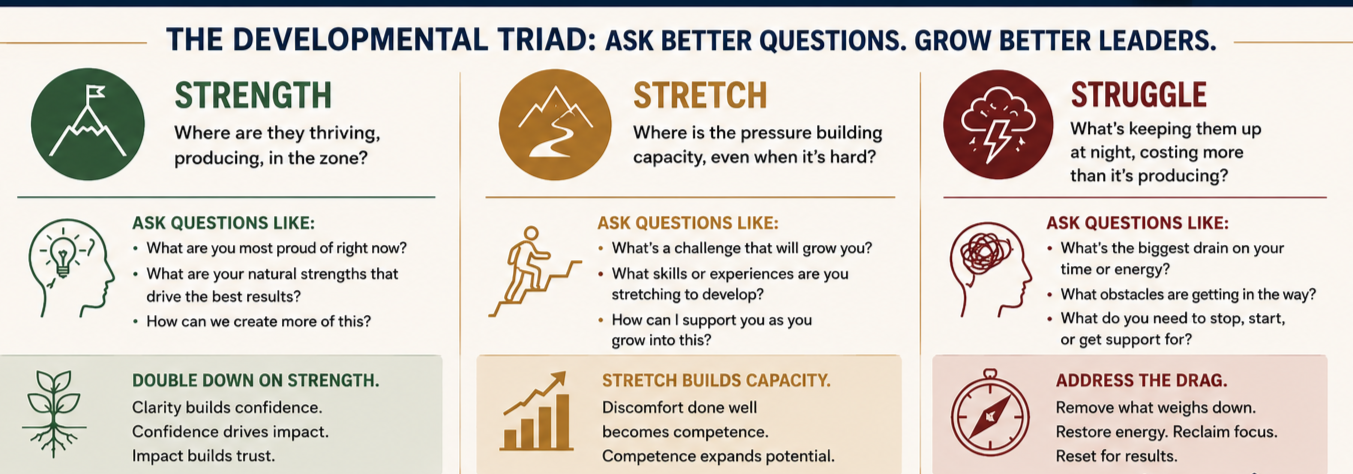
Strength — Where are they thriving, producing, in the zone? Affirm it. Build on it. Know what gives them energy, because that's where their best capacity lives.
Stretch — Where is the pressure creating tension that's hard, yet capacity-building? This is the growth zone. The goal isn't to remove the difficulty — it's to walk alongside it, to reframe it as formation rather than failure.
Struggle — What's keeping them up at night? What stress is unproductive, costing more than it's producing? This is the signal for realignment, reallocation, or bringing in additional resources. Unaddressed struggle becomes attrition.
All three are developmental. All three grow your people — which means they grow your organization.
THE INVITATION
Start Today
Successful organizations focus on succession. Deepening bench strength starts by growing your people — one conversation at a time, one question at a time, one developmental moment at a time.
Whether you're in the CEO seat, the executive suite, the director's office, or the manager's chair — the principle holds. Your greatest strategic leverage is not what you can do. It is what the people around you become capable of doing.
"Your leadership matters most not in what you accomplish, but in who you leave behind ready to carry it further."
Start today. In your next 1-on-1, lead with a question instead of an answer. Ask where someone is thriving, where they're stretched, what's keeping them up at night. Use the three categories as your grid. Stanley did it over hundreds of hours across fifteen years. You never know who your developmental bias may influence your people.
— Russell Verhey | Leadership Coach