
Walking Through the Valley
✦ ✦ ✦
The summer of 1982, Tim was eighteen years old, alone in the wilderness of Alaska, ten miles from another human being, and very close to not caring whether he made it back.
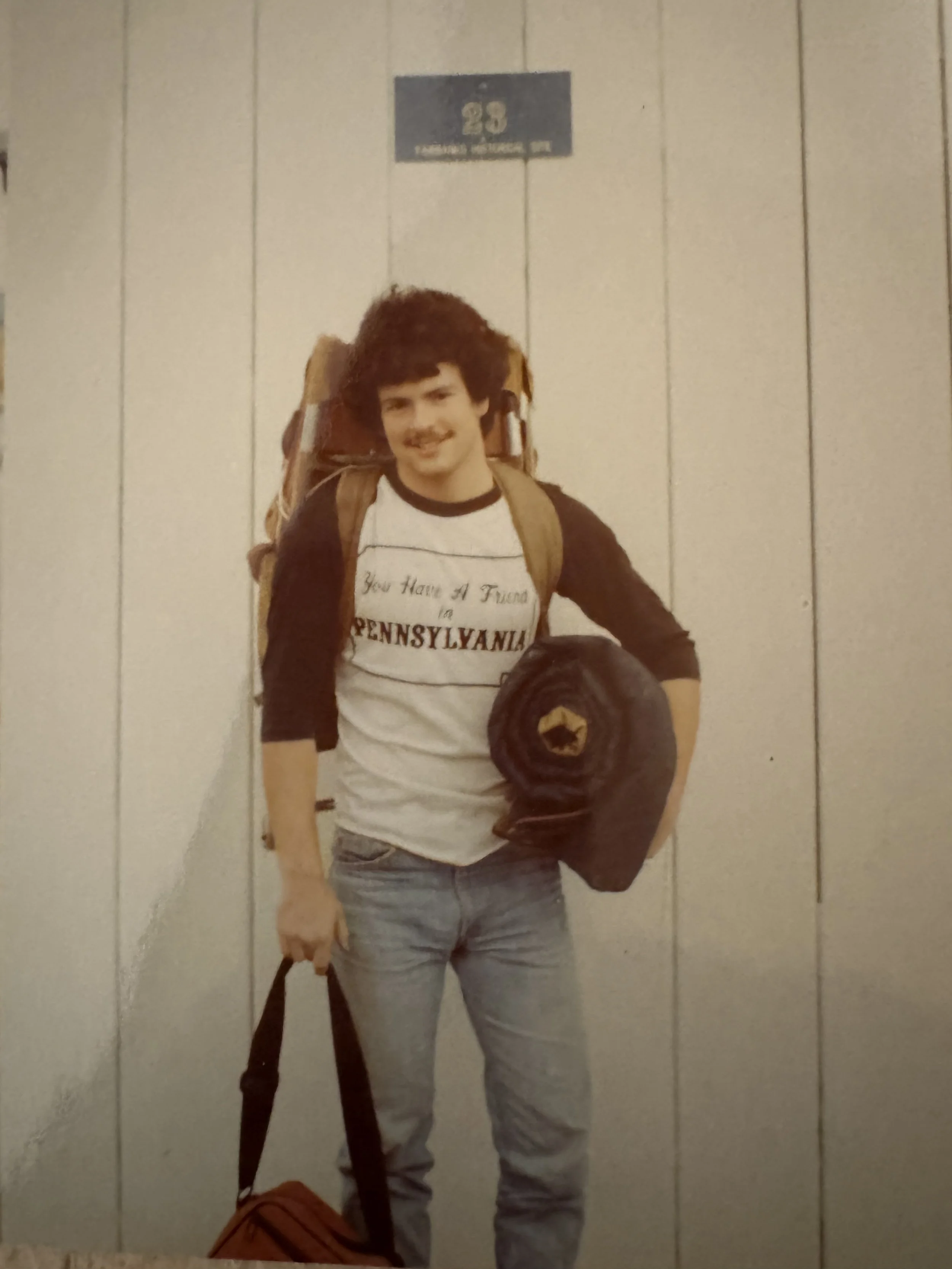
He had crossed a glacial river at its narrowest point — not knowing that the narrowest crossing is always the deepest. The water was barely above freezing. He had stripped down, lashed his boots to his pack, and waded in. The current grabbed him. The water nearly won. He made it to the far bank dripping and shaking, and stood there looking at the nothing around him.
And the thoughts came. No one knows where you are. No one would come. You could stay. Let the river take you next time. Part of him that summer didn't care if it did.
But something else stirred. A small, stubborn flicker. He wanted to live.
He crossed back the next morning.
✦ ✦ ✦
The Valley Is Not an Accident
Every man in the room that morning carried a valley story. You could feel it — the weight that settles in a group of men when one of their own starts telling the truth about where he's been. Tim had organized his teaching around two models and four passages of Scripture. But what made the room lean in wasn't the framework. It was the honesty. Because valleys feel like accidents. They feel like detours, like failures, like evidence that something went terribly wrong.
The Scriptures tell a different story. Before Tim introduced either model, before he drew the diagrams or opened the Hebrew dictionary, he went to four passages and let them lay the foundation. Because any honest conversation about valleys has to start with what God actually says about them — not what we feel in the dark, not what our shame whispers at 2 a.m., but what the ancient text has been saying for thousands of years to men standing in their own low places.
✦ ✦ ✦
What Does Scripture Say About the Valley?
The Hebrew word for valley in Psalm 23 is gay — a plain, ancient word for the low places of the earth. Tim, being the kind of man who looks things up, had checked the original. Because knowing what a word actually means in the language it was first spoken changes the weight of a sentence you've heard a hundred times without really hearing.
Yea, though I walk through the valley of the shadow of death, I will fear no evil: for thou art with me; thy rod and thy staff they comfort me. — Psalm 23:4
Notice the verb: walking through. Not walking into and camping. Not pitching a tent in the shadow and calling it home. The grammar of Psalm 23 insists on movement. The valley is terrain to be traversed, not a destination to inhabit. And the shepherd is present precisely here — not waiting on the ridge with a rope to throw down, but walking in the low place with his sheep, rod and staff in hand. The first word of Scripture on the valley: God goes into it with you. And you are designed to come out the other side.
The second passage surprised the room. Hosea 2:15 — God speaking to Israel in the middle of her most spectacular failure:
There I will give her back her vineyards, and will make the Valley of Achor a door of hope. — Hosea 2:15
Achor means trouble. This was the site of Israel's judgment — a place of consequence, a valley associated with things going terribly wrong. And into that specific valley of earned suffering, God speaks renewal. He does not wait until Israel has cleaned herself up and climbed back to high ground. He meets her in the valley of her trouble and transforms it into a threshold. Places of failure become entry points for renewal. The second word: God transforms the valley.
Every valley shall be exalted, and every mountain and hill made low; the crooked shall be made straight, and the rough places plain. — Isaiah 40:4
This is the language of radical topographical reversal. Not just accompaniment, not just transformation — but elevation. The low place is raised. The terrain itself changes. What was a valley becomes level ground. Tim put it plainly: valleys are temporary landscapes. They are not the permanent address of any man who walks with the Shepherd. The third word: God lifts the valley.
Multitudes, multitudes in the valley of decision! For the day of the Lord is near in the valley of decision. — Joel 3:14
This one Tim admitted he'd largely overlooked before. But the valley, Joel insists, is also a place of decision. The low place forces clarity that the ridge never requires. On the high ground, options feel optional. At the bottom of the valley, the question of which direction you will move becomes unavoidable. Danny would later name it from the New Testament: the Garden of Gethsemane sits in the valley of decision. Jesus was there. He could have refused the cup. He chose not to. The fourth word: God meets us in the decisions we make in the valley.
Four passages. Four anchors. God walks with us in the valley. God transforms the valley. God lifts the valley. God meets us in the valley's decisions. This is the theological ground Tim stood on before drawing a single diagram. The models that followed were built on this foundation — not as replacements for Scripture, but as lenses to help men see their own lives in its light.
✦ ✦ ✦
Model One: The Anatomy of the Valley
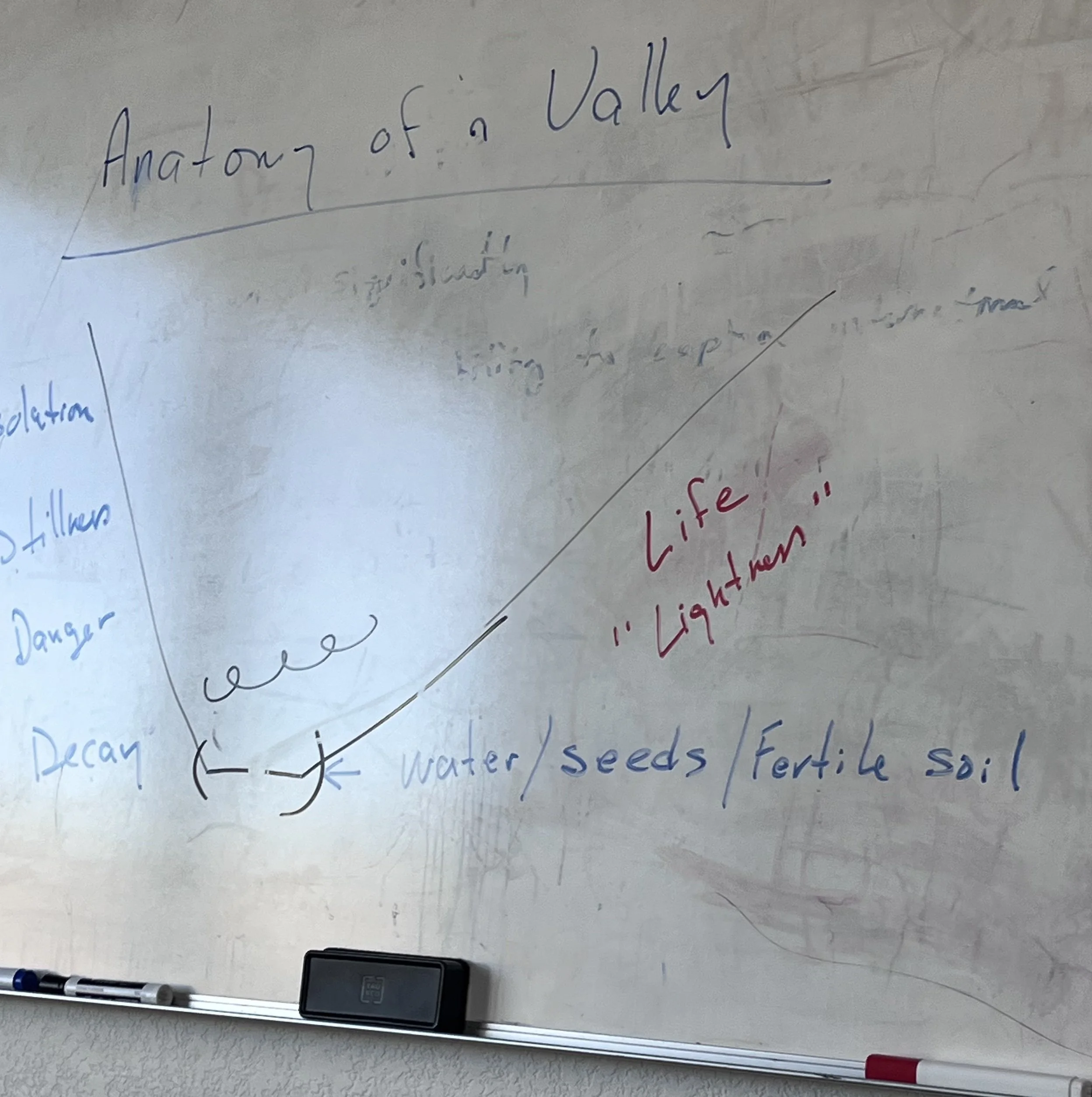
Tim called the first model the Anatomy of the Valley. It is not a model of failure. It is a map of what is actually happening — physically, emotionally, spiritually — when a man finds himself in the low place. And like any good anatomy, it names the parts so we can understand how they relate.
In a physical valley, everything flows to the bottom. Runoff from every surrounding elevation drains here. The debris, the cold air, the shadow — all of it settles at the floor. And for a man in a life valley, the experience is the same. The weight comes from every direction. Things that were held at a manageable distance on higher ground become impossible to avoid at the bottom.
Tim identified five movements in the anatomy of a valley. Not stages to be escaped as quickly as possible, but realities to be named, understood, and walked through with honesty. He drew from his own story, from Scripture, and from what Danny had taught the group in an earlier session about the cycles and rhythms of formation — the way God uses the low seasons not to punish but to prepare.
Stage 1 — Isolation: The valley narrows. The valley, by its very geography, cuts men off. The ridge was wide — there was room to move, to be seen, to function in a crowd. The valley walls press in. Connection becomes harder. Men who were relationally accessible on high ground find themselves pulling away in the low place. This is not always a conscious choice. It is the shape of the terrain. And for men especially, isolation is the valley's first and most dangerous feature — because it is the one that makes all the others worse. Tim sat alone in that house in Arkansas for a week. His kids were in Colorado. His wife had driven away. And the silence said what isolation always says: no one is coming. You are on your own.
Stage 2 — Stillness: The valley slows everything down. On the ridge, a man can stay in motion. There is always another meeting, another project, another conversation to move toward. The valley takes that away. The career that structured the week is gone. The role that gave the day its shape has ended. The relationship that provided rhythm has fractured. And what remains is a kind of enforced stillness that men are almost universally unprepared for. We are not trained for stillness. We are trained for output. But the valley insists. And in the stillness — which feels at first like emptiness, like failure, like wasted time — something else begins. Danny described it in his teaching on formation: the wilderness seasons are not unproductive seasons. They are the seasons where the soil of a man's soul is prepared for what cannot grow in the noise. Stillness in the valley is not God's absence. It is his workshop.
Stage 3 — Danger: The valley is not safe. This is not a comfortable truth, but it is an honest one. Tim knew it the moment he put his .45 in a box and locked it in the trunk. He knew what the valley was doing to him, and he knew himself well enough to know he needed to reduce the risk. The danger in the valley is both external and internal. External: circumstances compound. Job loss and marital crisis and children's pain and financial pressure do not typically arrive one at a time. They cluster. The valley seems to gather trouble. Internal: the enemy knows the terrain. He has worked it before. He knows which lies land hardest in the low place, which wounds to reopen, which fears to amplify. Tim named his: God is off doing great things for everybody else. But not for you. He's left you again. You're alone. The enemy doesn't invent new material. He finds the old wound and presses on it in the dark.
“Does the enemy know my song. He knows just what to sing.”
— Tim
Stage 4 — Decay: This is the stage that sounds the most like defeat — and is actually the most formative. In the physical valley, decay is how life works. The organic matter that breaks down at the valley floor becomes the most fertile soil in the landscape. Tim had set up aquaponics projects in West Africa — systems built entirely on the principle that waste and decay produce life. The fish waste, the breakdown of organic matter, the ammonia and nitrates released in decomposition: these are not byproducts to be eliminated. They are the engine. In the valley of a man's life, the breakdown of what he built — the career, the identity, the plan, the version of himself he had curated — is not the end of the story. It is the composting of it. Danny described this in his framework as the breaking stage: the crushing that releases the oil. The things we built on the wrong foundation do not survive the valley. And that is not loss. That is preparation.
“Decay and life are sitting in the same place. How can light and darkness sit in the same place? Because the valley doesn't just hold death. It holds the conditions for everything that comes next.”
— Tim
Stage 5 — Life and Lightness: The shift is not dramatic. It does not announce itself. But at some point in the valley — after the isolation has done its work, after the stillness has quieted the noise, after the danger has been faced with honesty, after the decay has broken down what needed to go — something new begins. A seed opens. A direction becomes clear. A man makes a decision — the valley of decision — and starts moving again. Tim described the ascent as slower than the descent. You can fall to the bottom of a valley quickly. You cannot fall your way back up. The climb requires intention, muscle, community, and time. But the life that emerges from a valley is different from the life that entered it. It is more rooted. It has been through the composting and come out with richer soil. It knows things about God that can only be learned at the bottom.
Danny's formation model from Chapter Two maps directly onto this anatomy. His six movements — Calling, Wilderness, Testing, Breaking, Promotion, Multiplication — are not a ladder that a man climbs once. They are circles of righteousness, spiraling upward through repetition. The valley is not a detour from that spiral. It is where the spiral bends. The wilderness and the breaking stages are the valley. And what Danny saw in Israel, watching sheep ascend a hillside in slow, winding paths rather than straight lines, is the same truth Tim was teaching: the long way through is the formative way through.
“You can be on multiple points of this at the same time. God is working on multiple fronts simultaneously — calling you forward in one area, crushing you in another, promoting you here while testing you there. The seasons overlap and inform one another.”
— Danny, Chapter Two
The Anatomy of the Valley is not a promise that the valley will be short. It is a map that helps a man know where he is, what is happening to him, and what God may be doing in it. Isolation, stillness, danger, and decay are not signs of abandonment. They are the terrain of formation. And life and lightness are not distant hopes. They are the destination that the valley itself is preparing you to reach.
✦ ✦ ✦
Model Two: The Contours of Life
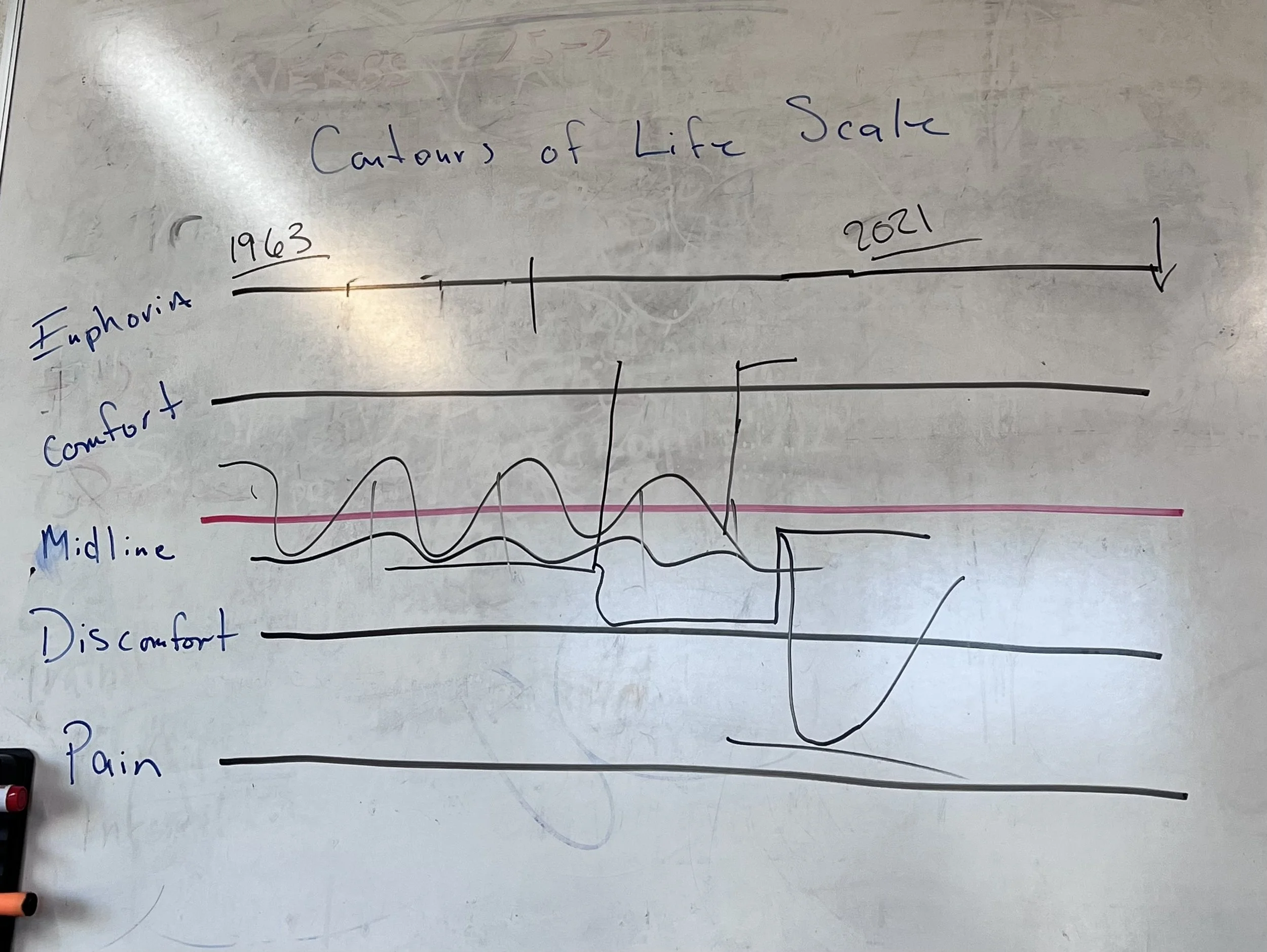
Tim's second model is a wave. Not a single wave, but a lifelong contour — the line that charts your actual lived experience across time. He called it the Contours of Life, or the Human Experience Spectrum. Imagine it as a graph, with time moving left to right and emotional-spiritual experience moving up and down. The line rises and falls, breathes and dips, traces the actual shape of a life fully lived.
Tim laid out five levels on this scale, running from the heights to the depths:
Level 1 — Euphoria (the peaks) — Moments of intense joy, celebration, achievement, profound spiritual experience. A daughter's wedding. A breakthrough. A season of abundance and clarity. These are real, and they are gifts. But euphoria, by its nature, is not a permanent altitude. It is a summit, not a plateau.
Level 2 — Comfort (the high midrange) — Life is going well. The career is productive, the marriage is warm, the faith feels alive. Not euphoric, but genuinely good. This is a sustainable range, and seasons here are not to be taken for granted.
Level 3 — Midline (the baseline) — The ordinary rhythm of a functional life. Not exceptional highs, not significant lows. The midline is home base — the calibration point we return to, the place against which everything else is measured. Most men, across most of their lives, orbit around the midline.
Level 4 — Discomfort (the low midrange) — Something has disrupted the midline. A job change, a relational conflict, a season of uncertainty, a loss. Life is hard but manageable. A man can still function, still show up, still move forward — but he is aware that something is wrong, something is missing, something is pressing in.
Level 5 — Pain (the valley floor) — The place Tim could not have described in his forties. The gut-wrenching, what-did-I-just-do-to-my-life, box-in-the-trunk place. Real crisis. Real grief. Real danger. The Year of the Basement.
The movement between these levels is not always slow. Tim was explicit about this: the descent is faster than the ascent. A man can fall from comfort to pain in a matter of weeks — a diagnosis, a betrayal, a catastrophic decision. Getting back up is slower. It requires intention. It requires muscle. It requires the kind of community that will walk the valley floor with you rather than throwing advice from the ridge.
We move through these levels in seasons or in days, depending on what we're facing. Russell captured this in the earlier conversation: in the course of a single day, a man can hold a newborn baby and attend a funeral. He can laugh his head off at lunch and weep in his truck on the way home. The Contours of Life are not only the macro map of a decade — they are the micro map of a Tuesday. The scale shifts, but the shape is the same.
“Just the juxtaposition of what happens in the course of a day — where you're having a conversation and laughing your head off, and then you're crying. The cycles of waves, but then recognizing how that hits in seasons. And if we ignore that, man, things don't go well.”
— Russell
When We Hijack the Rhythms: Artificial Stimulation and the Sliding Baseline
The Contours of Life model becomes most critical — and most urgent — when Tim addresses what happens when men stop allowing the natural rhythms of their experience and instead reach for artificial ways to manage the line.
The movement is predictable. Something drops the line from midline into discomfort or pain. The drop is real. The pain is real. And in the pain, the natural human response is to reach for relief. This is not, in itself, wrong. God designed us to reach — for him, for community, for restoration, for hope. The Psalms are full of men reaching from the valley. The question is not whether we reach. The question is what we reach for.
When what we reach for is a substance — alcohol, drugs, pornography, food, screens, adrenaline, achievement — it works. In the short term, it works very well. It lifts the line. It produces a sensation of relief, elevation, even euphoria. And the problem is not that it feels good. The problem is what it does to the baseline over time.
Tim laid it out plainly. If a man begins at the midline and something drops him to discomfort — say he's operating at a level four — and he reaches for a substance that lifts him artificially to a level two, the relief is real. But the substance does not return him to his actual midline. It creates a false midline. And over time, as the reach becomes habit, the real baseline — the organic floor of his experience — begins to migrate downward. What once registered as pain now registers as ordinary. The man requires the substance not to reach euphoria but simply to feel normal. What once lifted him to the summit now barely gets him to the midline.
“If we take something into the euphoric when we're already in a challenging season, and we continue to do that, our new normal shifts down. And then we have to take something just to get back to where we used to just be. That's how addiction works. That's how we get caught.”
— Tim
This is the anatomy of addiction — not a moral failure of willpower in isolation, but a physiological and spiritual recalibration of an entire system. The line that was meant to breathe naturally, to descend into valley seasons and ascend through formation, has been artificially flattened and then gradually depressed. The man is no longer experiencing the real contour of his life. He is experiencing the contour of his medication of it.
The spiritual consequences compound the physiological ones. A man who has been medicating his valleys is a man who has been avoiding the formation that happens in them. The isolation, stillness, danger, and decay of the valley — which were never designed to be escaped but to be walked through — have been short-circuited. The seed never went into the ground. The chrysalis never formed. The outer shell never broke down under the friction of honest engagement with God and with trusted men.
Tim did not say this to condemn. He said it because he had watched it happen. He had seen men who were brilliant, gifted, and genuinely loved by God spend decades managing the line rather than walking through the valley. And what they gained was the absence of acute pain. What they lost was the formation that was waiting for them on the other side of it.
The invitation of the Contours of Life model is not to manufacture suffering or to spiritualize unnecessary pain. It is to stop hijacking the rhythms. To let the line move as it will. To feel what you are actually feeling. And when the line drops — to reach for the right things. To reach for God, who walks into the valley with a rod and a staff. To reach for the men around the table, who have their own valley stories and will not be surprised by yours. To reach for the truth of what the season is forming rather than for the shortcut that avoids it.
✦ ✦ ✦
The Year of the Basement
Tim had a great career. Nine years at Compassion International, the last nine representing all of Africa — the only person without African heritage on a 700-person staff, trusted to carry the work of a continent. He went to Africa 49 times. He named a child in Togo — a boy named Micah, after Micah 6:8. He watched compassion change lives at scale. He was doing what he believed he was made to do.
Then the organization asked him to move to Africa permanently. His family discussed it for about eight seconds. His kids were unanimous: Right, Dad. We're not moving to Africa. So Tim stepped out of the role. And the line started dropping.
2020 arrived with its particular cruelty. Tim was home, unemployed, uncertain about what he'd just done to his career and his family's future. His son's best friend from high school died by suicide. His son stepped into a suicidal place himself. Tim and his wife were trying to hold each other and their children together in a pandemic — while Tim quietly came apart.
A position emerged — VP of Operations for a water mission organization based in Bentonville, Arkansas. Remote role. He accepted. Two days later they changed the terms: they needed him there. So Tim, who had just left one position that asked too much of his family, put his daughter through her senior year while commuting every two days from Arkansas for twelve months. He arrived at graduation, they loaded the truck, and moved to a dream property on Beaver Lake — a house with a boat slip, three-car garage, an acre of woods behind it. His wife had never seen it.
One month in, she packed the car. "The dog and I are going back to Colorado tomorrow," she said.
And she did.
Tim sat alone in that house for a week. Both kids were in basements in Colorado Springs, furious that their family home had been sold, furious that they didn't have a place to return to. His wife was depressed. The job was a nightmare. The dog had cancer. Tim put his .45 in a box and locked it in the trunk. He knew himself well enough to know he shouldn't have easy access to it that week.
"What did I just do to my life?" he asked the empty house. "I completely blew it up. I had a great job, a great family, everything was going so well — and now everything is blown up."
They moved back to Colorado. Into a friend's basement — four months, with cats (Tim is clear about his feelings toward cats), driving past his old house every time he went home. Unemployed. Estranged from his kids. Without a home of his own. Watching his wife grieve. They called it the Year of the Basement. And underneath all of it, the ancient lie the enemy had been singing since Tim was a pastor's kid watching his father leave for the next engagement: God is off doing great things for everybody else. But not for you. He's left you again.
“Does the enemy know my song. He knows just what to sing. And I've heard it again and again throughout my life when I go through a valley.”
— Tim
Matt named the second layer — the one that comes after the first wound and makes it compound:
“When the valley comes and it's not my fault, I'm quick to go to God. But when it's my fault, I don't go to him — because I feel like he's going to say 'I told you so.' The enemy gets you twice. The first time you get yourself. The second time is the shame that says: don't go to him now. You used up your credit.”
— Matt
This is the valley beneath the valley — the one where a man's own shame becomes a second wall. The terrain is hard enough already. The shame seals the exit. And the man who most needs to cry out to God finds himself convinced that this is the one valley God will not enter with him.
Hosea 2:15 speaks directly to this man. God is speaking to Israel — who did not stumble into her situation, who made a series of deliberate choices away from him, who has no one to blame but herself. And into that valley of earned trouble, he says: I will make this a door of hope. Not once you've sorted yourself out. Not once you've climbed back to respectability. Right here. In this.
✦ ✦ ✦
Why Life Happens in the Valley
Tim had originally planned to go deeper into the biology. He'd pulled up the equations. He'd wanted to trace the full chemistry of aquaponics — the fish waste becoming ammonia, the ammonia breaking into nitrites and nitrates, the nitrates feeding the plants, the plants purifying the water, the cycle sustaining itself. The full picture of how a system built on decay produces abundance. He let it go in the moment. But the image carried.
In a physical valley, everything moves to the bottom. The runoff, the organic matter, the cold air, the shadow. And the valley floor is the most fertile place in the landscape. The soil is richest at the bottom. The water is there. The seeds collect there. What looks like a gathering place of death is, in fact, the most concentrated source of life in the terrain. Decay and life sit in the same place. Light and darkness coexist at the valley floor.
“There had to be a death for there to be a life.”
— The room
The biologist in the group pressed it further. Every seed carries within it enough internal nutrition to begin sprouting. But that initial energy only carries it so far. To truly flourish, the sprout needs external nutrition — the richness of the soil it is planted in. And to be planted, the seed must go into the ground. It must go into the dark. It must experience the friction of the soil breaking down its outer shell. Without that friction, the seed stays a seed indefinitely.
“What has to happen for a seed to sprout? It has to go in the dirt. It has to decay. The friction breaking down the outer shell — that's what opens it. Without that, there is no growth.”
— Danny
The caterpillar completes the image. We speak of metamorphosis as a gradual process — a caterpillar slowly gaining wings, losing legs, becoming more refined. But that is not what happens. The caterpillar goes into the chrysalis and dissolves. Completely. If you opened the chrysalis in the middle of the process you would not find a caterpillar halfway to a butterfly. You would find goo. Undifferentiated biological material that has entirely surrendered its previous form in order to become something it could not have become by any other means.
“When you're in the middle of it, you don't know what's coming out on the other end. You're just goo. You don't know what that butterfly's going to be.”
— The room
The valley is the chrysalis. The goo is not a sign that something went wrong. The goo is the process. And what comes out the other side will bear no resemblance to what went in — except that it is the same creature, now capable of things it could not have imagined from inside the cocoon.
✦ ✦ ✦
What God Forms in the Valley
Tim closed his teaching by pointing toward 2021 and what came after. Because the year of the basement was not the end of the story. God has provided, he said. God has brought back what was eaten by the locusts — and then some.
His kids are not just present — they are thriving. Leading Bible studies with their peers, starting groups in their churches, not just attending but actively investing. His wife and he are not the same couple who drove to Arkansas in a truck with a dog and a dream. They are a better one. They live next door to their old house now — the one they sold, the one they drove past for four months with their hearts in their throats. Close enough to knock on the door. Close enough to have become good friends with the family that bought it.
"I don't have the same wife I had before 2021," Tim said. "And I don't want that same wife." The valley formed them both. Individually and together.
Russell brought in one final image — the passage his wife Carrie had spoken over him in his own dark seasons:
Do not be afraid, you worm Jacob... I myself will help you. See, I will make you into a threshing sledge, new and sharp, with many teeth. You will thresh the mountains and crush them. — Isaiah 41:14-15
You are a worm. In context, this is not an insult — it is an honest description of the creature's condition. Small. Vulnerable. Without much on its own. But the Lord himself will help. And what he is forming — through the friction of the soil, through the darkness of the chrysalis, through the descent to the valley floor — is a sharp instrument. A threshing sledge. Something useful in his hands precisely because of what it has been through.
“Whether caterpillar to butterfly, or worm to threshing sledge — the Lord is shaping us into a tool to be his instruments for the work he wants to do through us. The valley is not the interruption of that work. It is the heart of it.”
— Russell
✦ ✦ ✦
Back to the River
In 2018, Tim took his family back to Alaska. He went back to that riverbank — the one he had crossed at eighteen, naked and barely surviving. He stood on that peninsula and wept.
His son gave him space. Leave him alone, he told the others. He needs some time.
Standing there, Tim saw what he could not see at eighteen: the river crossing at its narrowest point is also its deepest. The shortest distance was the most treacherous. He had not known that at eighteen. But he had crossed it. He had made it to the other bank. He had wanted to live, and that flicker had been enough.
Now he had a daughter and a son who were leading people toward God. A wife who was his partner in ways she had never been before the valley. A faith forged not in easy seasons but in the Year of the Basement, in the summer of 1982, in 49 trips to Africa, in the dark mornings on his knees in an empty house crying out loud enough to be hoarse when his wife came home.
The valley did not break him. The valley formed him.
It is forming you too.
✦ ✦ ✦
Questions for Reflection and Discussion
The following questions are designed for personal reflection, journaling, or honest conversation with a trusted group of men. Take your time. The valley is not a place for rushing.
1. Looking at the Anatomy of the Valley — isolation, stillness, danger, decay, life and lightness — which stage are you currently in? Where have you been spending the most time?
2. When the stillness of the valley comes, what do you typically do with it? Run from it, endure it, or begin to listen in it?
3. On the Contours of Life scale — Euphoria, Comfort, Midline, Discomfort, Pain — where are you today? Where has your line been trending over the past six months?
4. When the line drops, what do you typically reach for? Has that reach been lifting your real baseline, or has it been gradually pulling it down?
5. Tim described the lie the enemy has been singing to him since childhood. What is the specific lie the enemy sings to you in your valley? Can you name it out loud?
6. Matt named the double wound: the valley itself, and then the shame that says don't go to God now. Is there a valley you've been unable to bring to God because of shame? What would it look like to go to him anyway?
7. Danny taught that the valley seasons are circles of righteousness — not detours but essential terrain in the spiral of formation. Looking at a past valley, what could not have been formed in you any other way?
8. Who is in the valley with you right now? If no one — who could you call this week, not to fix anything, but simply so you are not alone?
✦ ✦ ✦
The Challenge
This week, draw your own Contours of Life. Not the ideal version — the real one. Mark the high seasons and the low ones across your life. Note what was happening at each elevation. Look for the patterns: what you reached for in the dips, what lifted you, what slowly pulled the baseline down.
Then, through the lens of the Anatomy of the Valley, identify which stage you are in right now — or which stage a past valley put you through that you've never fully named. Write down what you believe God was forming in that terrain that could not have been formed anywhere else.
Finally: if you are in pain right now — if the walls are high and the light is dim and you put something in the trunk this week — tell one man. Not to explain yourself, not to ask for advice, not to have it fixed. Just to say: I'm in the valley. Walk with me.
You were not designed to cross that river alone.
✦ ✦ ✦
A Closing Prayer
Lord, we come to you from wherever we are on the map. Some of us are in the comfort zone this morning, grateful and full. Some of us are in the discomfort, trying to hold the line. And some of us are at the bottom — in the pain, in the Year of the Basement — and it has been so long since the line moved that we've started to wonder if this is just where we live now.
We thank you for Psalm 23 — that you walk with us in the valley, that your rod and your staff are present precisely in the low place. We thank you for Hosea — that you transform the valley of trouble into a door of hope, that you give back what was lost. We thank you for Isaiah — that the valley is temporary, that you are actively lifting what has been brought low. And we thank you for Joel — that you meet us in the decisions we make at the bottom, just as you met Jesus in Gethsemane.
Father, for the man in this room who is in the decay stage — who feels like goo, who cannot see what he is becoming — would you make yourself known as the God who designed the chrysalis and knows exactly what will emerge from it. For the man who has been hijacking the rhythms, reaching for the wrong relief — give him the courage to stop. Give him men who will walk the valley floor with him. For the man beginning his ascent — strengthen his legs for the climb. Remind him that the soil he is climbing out of is the richest in the landscape.
You are the God who forms threshing sledges out of worms. Who makes butterflies out of goo. Who walks into every valley because that is where the sheep are.
Walk with us. Transform us. Lift us. Meet us in our decisions.
In the name of the one who stood in the valley and chose the cup that carried us all through.
Amen.
✦ ✦ ✦
For the Man Who Is in the Valley Right Now
If this chapter found you at the bottom — if the Anatomy of the Valley named your current address and the Contours of Life showed you a line that has been descending for longer than you'd like to admit — we want to be direct with you.
The valley is real. The weight is real. The isolation presses in from every side. The stillness feels like a punishment. The danger is not imaginary. And the decay — of the plan, the career, the version of yourself you worked so hard to build — is painful in a way that is hard to put into words.
But here is what is also true, and it is not a platitude: Tim sat in that house in Arkansas alone for a week, with his .45 in the trunk, and God was there. Not as an observer. As the shepherd who walks into the valley floor precisely because that is where the sheep are. The darkness did not reduce God's presence. It concentrated it. And what came out of that valley — the marriage, the kids, the faith forged at the bottom — could not have come from anywhere else.
The Anatomy of the Valley is not a map of failure. It is a map of formation. Isolation, stillness, danger, and decay are not signs of abandonment. They are the terrain of the chrysalis. And the line on the Contours of Life that has been dropping — that line is not the final word on your story. It is the current chapter of it.
You are not goo. You are becoming something that could not have been made any other way.
Walk through. Not in. Through.
He is with you.