
Whose Glory?
Measuring What Matters in the Only Life You Have
“Man’s chief end is to glorify God, and to enjoy Him forever.”— Westminster Shorter Catechism (1647)
A Life That Didn’t Go Up and to the Right
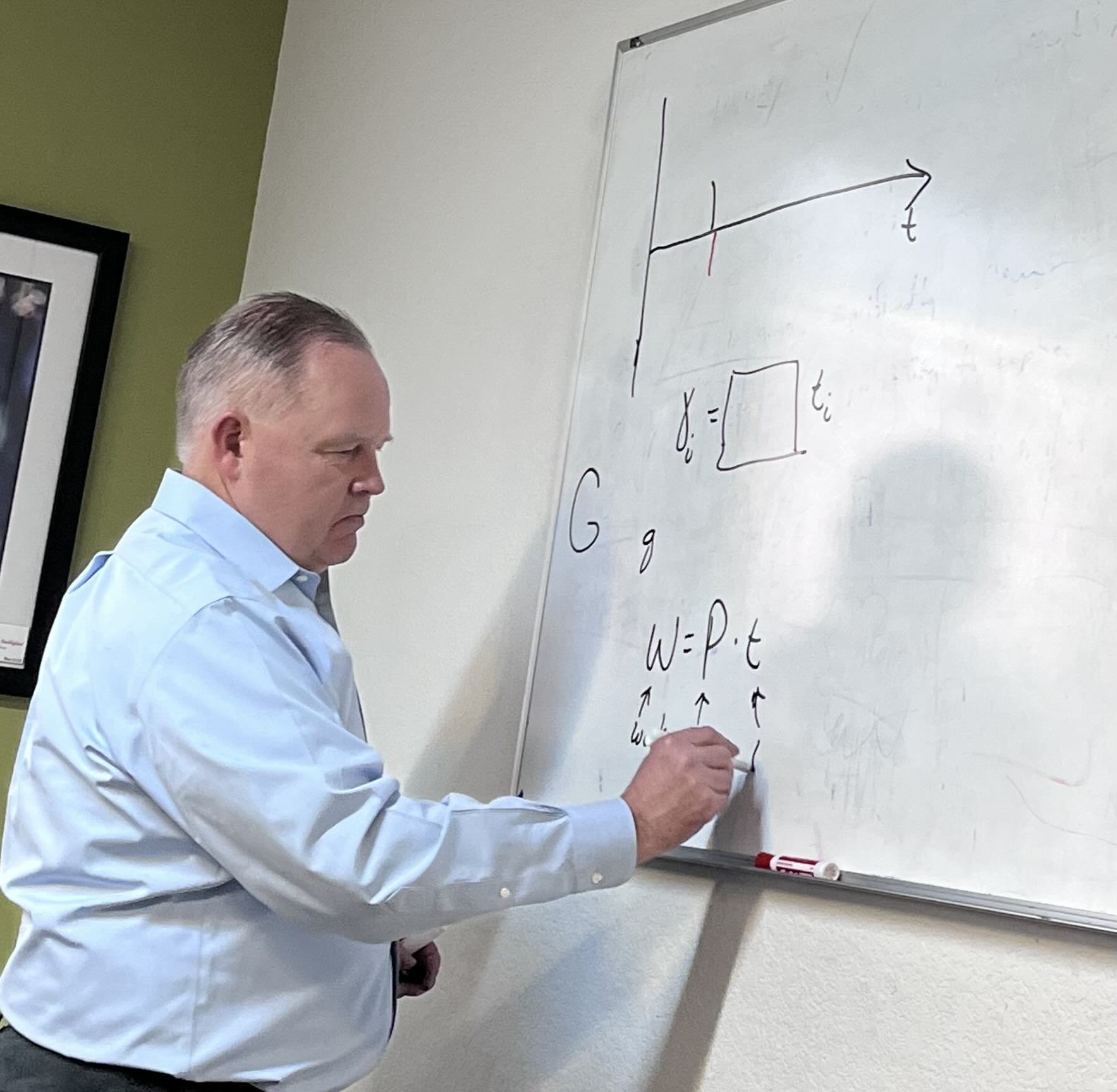
Working the whiteboard with a stack of hand-drawn sketches, Rob has the look of a man who had been wrestling with something all week. He’s an engineer by training, precise and methodical, the kind of person who wants to understand how systems work. But what he brought to the group that morning wasn’t a systems diagram for a machine. It was a diagram for a life — specifically, his own.
Before Rob ever picked up a marker, he paused. There was something he needed to say first. Something he doesn’t often talk about.
Rob’s life, by most conventional measures, has not always gone “up and to the right.” There were seasons of professional disappointment, of feeling like the trajectory he’d worked toward and planned for simply didn’t materialize the way he’d imagined. There were years when the chart of his circumstances — his career, his sense of control, his understanding of where things were headed — pointed stubbornly sideways, or worse, downward. Dreams deferred. Expectations unmet. Paths that curved away from where he intended to go.
And yet, sitting in that room, Rob is a man of depth, wisdom, and remarkable perspective. The kind whose words carry weight not because he’s never struggled, but precisely because he has. His engineering mind never quit working, even in the valleys. It kept asking questions. And those questions — forged in seasons of disappointment and recalibration — are what he brought to the whiteboard that morning.
He said something like this: “All the sales guys are all about revenues going up, profits are going up. Everything about life is ‘up into the right’ when everything’s working right. But what if the graph we’re all trying to plot is the wrong graph entirely?”
That question hung in the air. What if the measurement itself is wrong? What if we’ve all been tracking the wrong data?
What Rob’s formative years taught him — the years that didn’t match the plan — is that God is not particularly interested in managing our quarterly performance review. He is interested in something far more durable, far more significant, and far more beautiful. He is interested in His glory and our transformation into people who reflect it.
That’s the chapter Rob opened up that morning. And it’s the chapter we want to walk through carefully here, because it may just change the way you understand the whole story of your life.
The Question Behind All Questions
For most of us who didn’t grow up in a Reformed theological tradition, the Westminster Shorter Catechism sounds like something dusty and distant, a relic of another era. But the first question and answer of that catechism is arguably the most clarifying sentence in the history of Christian thought outside of Scripture itself:
“What is the chief end of man? Man’s chief end is to glorify God, and to enjoy Him forever.”— Westminster Shorter Catechism, Q&A 1
Let’s sit with that for a moment, because there’s more here than a quick reading reveals.
First, notice the word “chief.” Not the “only” end of man, but the chief end — the primary purpose, the organizing aim around which all other aims find their proper place. This tells us something important: life isn’t one-dimensional. We work, we eat, we love, we create, we rest, we make things and break things and repair them. All of that belongs to a full human life. But there is a chief aim, a north star, a supreme purpose that gives meaning and direction to everything else.
Second, notice that two things are named together: glorifying God and enjoying Him. Not glorifying God — period. Not enjoying God — period. Both. Together. Forever. This is not accidental. The catechism’s framers understood what our consumer culture constantly forgets: that true human joy is not found in competition with God’s glory, but in alignment with it. When we glorify God rightly, we are most fully ourselves. We are most fully alive. We are, in the deepest sense, most fully happy.
Rob put it this way: “The chief aim of man means there’s something it’s all for. There’s externally an objective, something to be accomplished out of all this.”
This is profoundly countercultural. The modern Western worldview tells us that we define our own purpose, that meaning is something we construct from within. The catechism tells us something radically different: meaning was already built into the structure of reality before we arrived. We don’t invent it. We discover it. We align with it. We participate in it.
The theological term for this is “doxology” — from the Greek word doxa, meaning glory. All of creation exists in a doxological relationship with God. The stars declare His glory (Psalm 19:1). The mountains and the oceans shout it. And human beings, made uniquely in His image, are designed to be the most articulate reflectors of His glory in all of creation.
But what does that actually mean? What does it look like to glorify God in a Tuesday afternoon meeting, in a season of disappointment, in a difficult marriage, in a body that’s aging, in work that feels ordinary? That’s where Rob’s engineering mind began to do something remarkable.
What the Scriptures Say About Glory
As Rob drew his diagrams, the group looked at several passages that informed everything to follow. These aren’t peripheral texts. They’re load-bearing walls in the architecture of biblical thought.
The Light of the Glory of God — 2 Corinthians 4:6
“For God, who said, ‘Let light shine out of darkness,’ has shone in our hearts to give the light of the knowledge of the glory of God in the face of Jesus Christ.”— 2 Corinthians 4:6
This passage does something stunning. It draws a direct line from the original act of creation — God speaking light into primordial darkness — to what God is doing in human hearts right now. The same creative, illuminating power that called the cosmos into being is the power at work in our inner transformation. The glory of God isn’t just something we see out there in sunsets and galaxies. It is something being formed in here, in us, through the knowledge of Christ. We are being lit from within.
The Image of the Invisible God — Colossians 1:15
“He is the image of the invisible God, the firstborn over all creation.”— Colossians 1:15
Christ is the image — the eikon, the perfect representation — of God. When the disciples asked Philip, “Show us the Father,” Jesus replied, “Anyone who has seen me has seen the Father.” (John 14:9) Christ is God’s glory made visible, made human, made approachable. And since we are being conformed to the image of Christ (Romans 8:29), we are being drawn into the orbit of that original glory — not as competitors with it, but as reflections of it.
Moses and the Face of God — Exodus 33:18–23
Rob pointed to the Exodus narrative, which his home church was preaching through at the time. Moses, after everything he had witnessed — the burning bush, the plagues, the parting of the sea, the giving of the Law — asks God one more audacious thing: “Show me your glory.” (Exodus 33:18)
God’s response is telling. He doesn’t deny the request. He says, “I will cause all my goodness to pass in front of you, and I will proclaim my name, the LORD, in your presence.” But He also says, “You cannot see my face, for no one may see me and live.” So God tucks Moses away in the cleft of a rock and covers him with His hand, and lets only His “back” — the trailing edge of His passing glory — be seen.
Even that partial exposure was enough to make Moses’ face radiant for days afterward, so much so that the Israelites were afraid to come near him. The glory of God is not a metaphor. It is a reality so concentrated, so luminous, so other than anything we are, that it can only be encountered in mediated form — at least for now.
Rob noted this and said: “There are even stories in the Bible about God’s glory being like this huge, super bright light.” That observation became the seed of his second model, which we’ll explore shortly.
Well Done, Good and Faithful Servant — Matthew 25:21
Rob also grounded the group in the Parable of the Talents. It’s a story about a master who entrusts his servants with resources while he travels, and then returns to settle accounts. Two servants invest well and hear the words every soul longs to hear: “Well done, good and faithful servant! You have been faithful with a few things; I will put you in charge of many things. Come and share your master’s happiness!” (Matthew 25:21)
As Jeff observed, this parable used to scare him. It felt like a threat, a warning about what happens to those who don’t perform. But he came to see it differently: “I moved from it being my least favorite parable when I thought it was just a scary thing about how much God hates people and wants to punish them — to understanding it’s really about stewardship of our life and the opportunity we have to take whatever God’s given us and return it to him at the end. At the end of my life, I want to be able to say: here’s what you gave me, here’s what I’ve done.”
This is the theology beneath Rob’s graph. We are stewards of a life. The question is not whether we will give an account, but what that account will look like.
And here, with all the gentleness it deserves, we return to the central truth: God’s glory and human joy are not competing interests. They are the same direction. When we glorify God, we become most fully ourselves. When we enjoy Him forever, we are doing exactly what we were designed to do. The chief end of man is not a burden. It is an invitation.
The Left Board: Plotting Glory Over Time
Rob walked to the whiteboard and drew what he called the “left board” — a graph with time on the horizontal axis and something called “glory” on the vertical axis. Then he asked the group one of the most penetrating questions of the morning:
“What if your success in this life is directly correlated to the degree that you are glorifying God every moment — and over the course of a lifetime?”
If that’s true, then the graph of a life doesn’t plot net worth or physical health or career achievement. It plots something else entirely: our moment-by-moment participation in the glory of God.
Big G and Little g
Rob introduced an important distinction. There is God’s glory — what he called “Big G Glory” — which belongs to Him alone, the intrinsic, infinite, uncreated radiance of who God is. And then there is the glory we generate — “little g glory” — our participation in and reflection of His, the contribution we make to the great doxological tapestry of creation and history.
The Westminster Catechism says that man’s chief end is to glorify God. Rob’s insight is that this means something we do, something we generate, something we produce — even if only as reflectors of a light that is not our own. We are not the source of the glory. We are, by grace, participants in it.
The First Question: What Are We Actually Plotting?
Rob invited the group to sit with a question he’d been wrestling with since a previous session where Russell had led the group in a discussion about success:
“What world would we actually put on this graph? If God were actually measuring — like us trying to measure — what would He be measuring? And how would He define success?”
Is success the amount of pleasure or pain we’re in? Is it our weight, our bank account, our net worth? Every culture offers its own answer to this question, and most of those answers look remarkably like the sales charts Rob described — up and to the right means good, down means bad.
But Rob pushed deeper. What if God’s measurement is something altogether different? What if He is measuring the degree to which, at any given moment, we are functioning as what He made us to be — image-bearers, glory-reflectors, little-g participants in Big G glory?
The Second Question: Positive, Negative, or Neutral?
This is where the engineering mind really came alive. Rob asked:
“At any given instant — what we’re doing, what we’re thinking, what we’re seeing — are we in a positive glory state or a negative glory state? And is there somehow neutrality?”
This question may be the most practically transformative one in the chapter. Think about it. At this moment, as you read these words: is your inner orientation one that is moving toward God, reflecting something of His character, participating in His purposes? Or is it moving away — driven by pride, fear, self-sufficiency, lust, bitterness, or simple distraction?
Rob’s instinct was that true neutrality is rare. We are always oriented. We are always moving in some direction. The question is which direction.
The Formula: Instantaneous Glory
Rob reached back into his engineering training and introduced the concept in the language of physics. In Greek, the letter gamma (Γ/γ) represents what he called “instantaneous glory” — the amount of glory we are generating or reflecting at any single moment in time. He wrote something like this:
γ(t) = [Some Function of Our Christlikeness] × dt
The exact function remains, as Rob admitted, “undefined right now.” But the concept is clear: at every instant of time (dt), we are either contributing to or detracting from the glory of God. The instantaneous glory of any moment is a function of how much, in that moment, we are like Jesus.
He said it plainly: “I circled back around and said, this is really just how much we’re like Jesus at that moment in time.” Jesus was the perfect human glorifier. Fully surrendered to the Father’s will. Fully empowered by the Spirit. Fully present to whoever and whatever was in front of Him. He said, “My Father is at work and I too am working.” (John 5:17) Jesus was the living answer to the question: what does it look like to produce maximum instantaneous glory?
The Formula: Cumulative Glory Over a Lifetime
From instantaneous glory, Rob moved to something even more provocative: the cumulative glory of a life. Using the language of calculus, he described it this way:
Gₙₑₜ = ∫ [from Christ to End of Life] γ(t) dt
In plain language: the total glory of your life before God is the summation of all the instantaneous glory moments — every act of faithfulness, every moment of surrender, every decision made in alignment with the Spirit rather than the flesh — integrated across the entire span of your life after Christ.
Rob made an important pastoral note here. He said the calculation begins after Christ, not before. “What we did before Christ — we’re not going to penalize ourselves for that.” The cross covers the negative balance of our pre-Christ life. The graph of meaningful glory begins at the moment of our new birth.
What this model envisions is a life whose cumulative glory trend is “up and to the right” — not because our circumstances always improve, but because over time we are learning to glorify God more consistently, more deeply, with fewer negative spikes and more sustained faithfulness. As Rob put it: “At the end of life, the summation of our glory is the summation of all the instantaneous glory that we’ve generated over the course of our life.”
Danny brought this idea into sharp theological focus: “Peter’s change — when he had a heart change and a change in his actions — it was because of a revelation of truth. Jesus had told him: when the rooster crows, you’re going to deny me three times. The rooster crowed. And he had this collision with truth. And that prompted a heart change in him to go out and weep and repent for what he had done. All repentance and all of our heart changes come because we come face to face with truth. And it’s what we do in that moment that makes a difference for how things go after that.”
The left board is not a ledger of condemnation. It’s a vision of possibility. It’s a picture of what happens when a human life, redeemed and Spirit-empowered, progressively learns to reflect the glory of God.
The Third Question: What Goes in the Box?
Between the instantaneous glory of any given moment and the cumulative glory of a lifetime is what Rob called “the box” — the set of factors, practices, orientations, and realities that determine how much glory we generate at any given time. He asked the group: what belongs in this box?
The conversation that followed was rich. Here is a synthesis of what the men identified:
Christlikeness. At the most fundamental level, Rob said: “how much we are like Jesus at that moment in time.” Jesus is the template, the reference standard, the North Star of instantaneous glory. Every other variable in the box is downstream from this.
The totality of who we are. Thomas offered a sweeping insight: “I would have to say the totality of who we are in that box — everything — before Christ and after Christ.” God doesn’t discard who we were before we knew Him. He redeems it. He uses our whole story — including the years of wandering, failure, and searching — for His purposes and His glory.
The work we are called to do. Rob added work to the list — not in the abstract physics sense, but in the vocational sense. We each have specific assignments, roles, and responsibilities. Husbands have a husband’s calling. Fathers have a father’s calling. Professionals have a stewardship of their particular gifts. How we do what we do matters deeply.
Obedience. General obedience to Scripture. Role-specific obedience. And what Rob called “specific assignments” — particular things God has called each of us to that no one else can do.
Love with all our heart, soul, mind, and strength. Rob referenced Mark 12 and Jesus’ summary of the law: the greatest commandment is to love God with everything we have. And Colossians adds: “Whatever you do, work at it with all your heart, as working for the Lord.” (Colossians 3:23) The heart — the center of our being — belongs in the box.
Sanctification. The ongoing process of being made holy, of having the flesh progressively submitted to the Spirit, belongs squarely in the box. Spiritual maturity doesn’t just mean more knowledge. It means fewer negative spikes on the glory graph.
Storing up treasure in heaven. Jesus said: “Don’t store up treasures on earth — store up treasures in heaven.” (Matthew 6:19–20) What we prioritize, what we invest in, what we treat as genuinely valuable — all of this feeds the box.
Seeking first the kingdom. Matthew 6:33: “Seek first His kingdom and His righteousness.” The posture of our whole life — what we seek first, not second or third — belongs in the box.
Phil captured the integrating principle of all of this when he pointed out that the disciplines we practice, the habits we cultivate, are not the goal in themselves but the means by which we maintain our orientation toward God: “The renewing of our minds is actually the thing that allows us to keep our focus more on Him and to have our desires be His desires. If we’re not spending enough time in that, then our desires are going to be more like our desires, not His desires.”
The Right Board: The Solar System of Grace
Rob wasn’t done. He had a second model, one that emerged from his reading of the Corinthians and Colossians passages about light and glory. He set aside the left board and turned to what the group began calling the “right board.”
Here, Rob drew a solar system. In the center: the Sun — representing God, or more specifically, Jesus Christ, the radiant image of the invisible God. Orbiting around the sun: us. Every believer, every human soul, in orbit at some distance from the Source.
Rob said: “The idea of the sun and light and how light — the energy and power of light — gets reflected. So a different way of thinking about what God is doing with us: Is the glory about doing something for Him, or is it about getting closer to Him, such that we are radiating, reflecting the power that’s coming into play?”
The Physics of Closeness: The Inverse Square Law
Here is where Rob’s engineering background produced something genuinely illuminating. In physics, the intensity of light received from a source is governed by what is called the inverse square law:
Luminosity Received ∝ 1 / r²
In plain language: if you move twice as close to a light source, you receive four times the light. If you move three times closer, you receive nine times the light. The relationship between distance and illumination is not linear. It is exponential.
The theological implication is stunning. The closer we draw to Christ — the more we allow the gravitational pull of His love to bring us into tighter orbit — the more we reflect His light, not by a factor of two or three, but by the square of our closeness. Small steps toward God produce disproportionately large increases in the glory we reflect.
Rob made the application explicit: “Over time, if we are allowing the gravity of the love of God — the love of the Son, Jesus — to pull us into closer orbits, the closer we are, the more our reflection is radiating. It’s not just like a factor of one. It’s related to the square of the radius. If you get, let’s say this is a distance, and you move in half that distance, you’ve increased the radiation by four times.”
The Fourth Question: What Keeps Us in Orbit Instead of Falling In?
A beautiful question arose from the solar system model. If God is the Sun, drawing us in with gravitational love, why don’t we simply collapse into Him? Why is there still an orbit at all — still a distance, still resistance?
Matt offered the answer: “The only thing that’s keeping the orbiting body from colliding and being sucked into and becoming one with the sun is the momentum of the motion away. There’s a force coming from the center that’s drawing us in, but it’s our lack of surrender — the flesh — that is the momentum that keeps us continually wanting to go away. And if we can decrease that, the two become one.”
Thomas built on this: “The less we focus on the Sun, the smaller the mass of God, and therefore the speed takes us further from God. Not like there’s another body pulling us away — but the less we focus on God, the less mass the central body has, and therefore the further we drift.”
In other words: the flesh, the world, our self-sufficiency — these are not so much rival gravitational forces as they are simply the velocity of our old momentum, the habit of moving away from center. And what counters that momentum is not more effort but more surrender — yielding to the gravitational pull of the Holy Spirit drawing us inward.
The Fifth Question: Who Else Is in Our Orbit?
Rob introduced one more dimension to the solar system model that the group found particularly rich: “Okay, who else is in orbit with us, like in this… and how many people over the course of our lifetime is our being in the image of the sun pulling them in toward the sun?”
Our proximity to Christ doesn’t just affect us. It affects everyone in our orbit — our families, our friends, our colleagues, the people who watch our lives from the outside and notice something different about the way we carry ourselves. Before any of the men in the room knew Christ, others in closer orbit to Jesus were reflecting enough light to make them curious, to make them lean in, to make them wonder: what does that person have that I don’t?
As one of the men reflected: “A lot of people in our collective stories have been in a closer orbit, and we’ve observed and said they’ve got something that I don’t have. I want to emulate them. There’s some sort of glory of Christ reflecting off of them that is attractive — drawing others to let go of what’s keeping them away from Christ and coming to a closer orbit.”
This is the missionary implication of the solar system model. Becoming more like Jesus is not a private spiritual exercise. It is an act of public witness. The closer we are to the Son, the more light we reflect, and the more that light falls on the people around us, warming them, drawing them, illuminating for them a path they didn’t know existed.
NEED A PIC OF THE BOARD
Both Boards, One Truth
At some point in the morning, one of the men made an observation that brought both boards together: “I think the right side is what fuels the up and to the right on the left.”
Yes. Precisely.
The left board — the graph of instantaneous and cumulative glory — is the output. The right board — the solar system of closeness, surrender, and reflected light — is the input. The relationship is not the same as performance and production. It’s more like the sun and the plant: the plant doesn’t produce light. It receives it, responds to it, and grows toward it. The glory it displays is not its own achievement. It is the natural result of proximity to the source.
Danny captured the danger of emphasizing the left board without the right: “The left board, if you try to operate it without the right board, is Pharisaism. It’s like the 600-plus laws they ended up with, just trying to manage behavior from the outside. But through the relationship piece — through what happens on the right board — it’s what takes this and makes this about righteousness, about glorifying Him.”
And Yuri pointed to the neuroscience that confirms what theology has always known: “Left board is left brain — performance, fear-based. Right board is right brain, joy-based, relational, whole-brained. And the right brain is 200 times faster than the left brain.”
The left brain manages. The right brain relates. And it is in relationship — in nearness to God, in the warm orbit of His love — that transformation actually happens. As Jeff observed: “This is transactional. This is transformational.”
The best leaders, someone noted, are transformational rather than transactional. They develop people. They don’t just check boxes. And this is exactly how God leads us. He is not managing our behavior from the outside. He is transforming us from the inside, writing the law on our hearts (Jeremiah 31:33), making our desires match His desires, turning what once required gritted-teeth effort into the natural overflow of a life lived near the Son.
The Power Source: Walking by the Spirit
No conversation about glory and transformation is complete without addressing the question of power. We cannot will ourselves into Christlikeness. We cannot discipline ourselves into closer orbit. The effort matters — but the power is not ours.
Danny read from Galatians 5:16–23 in the Complete Jewish Bible:
“What I am saying is this: run your lives by the Spirit, then you won’t do what your old nature wants. For the old nature wants what is contrary to the Spirit, and the Spirit wants what is contrary to the old nature... But the fruit of the Spirit is love, joy, peace, patience, kindness, goodness, faithfulness, humility, and self-control.”— Galatians 5:16–23 (CJB)
And in the Passion Translation, from another member of the group:
“As you yield to the dynamic life and the power of the Holy Spirit, you will abandon the cravings of your self-life... the Holy Spirit’s intense cravings hinder your self-life from dominating you.”— Galatians 5:16–17 (TPT)
The key word in both translations is “yield.” This is Rob’s “surrender,” in Paul’s language. We don’t produce the fruit of the Spirit by trying harder. We yield to the One who produces it. We open ourselves to the gravitational pull. We stop fighting the inward orbit and let ourselves be drawn close.
But — and this is crucial — yielding is not passivity. Jeff articulated the tension beautifully: “There’s a cliché thing that’s been around: pray like it all depends on God and work like it all depends on you. We err when we fall to just one. I’m never going to try to do anything, I’ll just pray. Or — the one I’m tempted toward more — I’m just going to go out there and work really hard at being me today. But I do need to act, and I also need the Holy Spirit. It’s a tension — a partnership — I’m trying to enter into and navigate each day.”
Rob connected this back to Jesus: “If we look at Jesus — he was the perfect example of bringing glory to God as a human man. And Jesus was the perfect example of surrendering and following the lead and being empowered by the Holy Spirit. He said, ‘My Father is at work and I too am working.’”
We work. God empowers the work. The glory belongs to Him. This is the rhythm of a life well-lived.
An Unexpected Variable: What If Suffering Produces More Glory?
Rob raised one more question near the end of the morning, almost as an aside. But it was one of the most important questions of the day, and it serves as the bridge into the next chapter of this book:
“What if we are actually producing more glory during times of suffering and adversity in terms of how we respond to it? What if the downs on the chart are not a bummer — but actually produce a spike of glory? Like degree of difficulty in the Olympics. What if God gets more glory if we land it with a higher degree of difficulty?”
The room got quiet for a moment.
We have all been trained — by culture, by our pain-avoidance instincts, by the “up and to the right” framework — to treat suffering as the opposite of flourishing. But what if that’s wrong? What if, from God’s perspective, the valley is not merely something to be survived but something to be inhabited — because it is precisely in the valley that the most profound glory is produced?
Paul seemed to think so. “We have this treasure in jars of clay,” he wrote, “to show that the surpassing power belongs to God and not to us.” (2 Corinthians 4:7) The vessel is deliberately fragile. The cracking of the clay is not a manufacturing defect. It is the design — because it is through the cracks that the light shines out.
And consider what Hebrews says about Jesus Himself: “Son though he was, he learned obedience from what he suffered.” (Hebrews 5:8) If the Son of God learned obedience — deepened His experiential knowledge of faithfulness — through suffering, why would we expect anything different for ourselves?
The Psalms, which Rob alluded to briefly, are the great biblical record of this reality. Two-thirds of the psalms are laments — the psalmist crying out from the valley, pouring out confusion and grief and fear, and then choosing — often against all apparent evidence — to trust. These psalms are not failures of faith. They are some of the most glorifying texts in Scripture, precisely because they capture a soul in the valley pressing toward the Sun.
As one of the men observed: “In the downtimes — it’s not so much when we’re suffering, but how we recover from when we’ve suffered that tells the story.”
This is the question that opens the next chapter. Because if suffering is not the absence of glory but potentially the context for its most powerful expression, then the valley is not a detour from the life well-lived. It is part of the road itself.
And that changes everything about how we face it.
Questions for Reflection and Discussion
Take time individually or as a group to work through these questions. Don’t rush. The most important conversations often begin with the questions that make us uncomfortable.
What are you actually plotting on the graph of your life? What metric have you been using — consciously or unconsciously — to evaluate whether your life is going “up and to the right”? How does that compare to what this chapter suggests God might be measuring?
The catechism says man’s chief end is to glorify God and to enjoy Him forever. In your own life, do these two things feel like they are in competition or in alignment? When do you experience joy as an expression of glorifying God, rather than a distraction from it?
Thinking about your last 48 hours — your conversations, your decisions, your inner life — what would the glory graph look like? Where were the spikes (positive or negative)? What was driving them?
The solar system model suggests that closeness to Christ — not just effort or discipline — is the key variable in how much of God’s glory we reflect. What does your current orbit look like? What factors are creating momentum away from the center? What might it look like to decrease that velocity?
Describe the tension between working as if it all depends on you and yielding as if it all depends on God. Where do you tend to land on that spectrum? What would a more integrated “partnership with the Holy Spirit” look like in your daily rhythms?
Who else is in your orbit — and how your closeness to Christ affects them. Think about the people closest to you: your spouse, your children, your close friends, your colleagues. What is the quality of the light they’re receiving from your proximity to Jesus right now?
What if suffering produces more glory, not less? Can you look back at a season of difficulty or loss in your own life and see ways that God was producing something in you — or through you — that couldn’t have been produced any other way?
The Week’s Challenge
This week, try an experiment in awareness. Set a reminder on your phone — three times a day, at random moments — and when it goes off, pause and ask yourself a single question:
“Right now, in this moment, am I reflecting the light of Christ — or am I drifting away from it?”
You don’t need to be harsh with yourself. This isn’t about guilt or performance. It’s about awareness. The Aura Ring measures your heart rate. This is your glory check. You’re simply noticing where your orbit is in this moment.
At the end of the week, journal your observations. When were the moments of closest orbit? When did you drift? What was driving the drift? And — this is the important question — what pulled you back?
For some of you, the pull back will come through prayer. For others, through time in creation. For others still, through honest conversation with a brother who can speak truth into the moment. However it comes, pay attention to it. That pull is the Holy Spirit. That gravity is the love of God. And the more you yield to it, the closer you draw, the more of His light you will carry.
A Prayer to Close
Father,
We confess that we have spent too much of our lives plotting the wrong things on the wrong graph. We have measured net worth and waistlines and career trajectories and the approval of people whose names we won’t remember in eternity. Forgive us for mistaking those measurements for the ones that matter.
Teach us to want what You want for us. Teach us to see our lives through the lens of glory — Your Big G glory, and the little-g contribution we have the privilege of making to it. Help us to stop striving for a closer orbit through our own effort and instead to yield to the gravity of Your love, which is already drawing us in.
Where we have been living on the left board alone — performing, striving, checking boxes — meet us on the right board. Where we have drifted into wide outer orbits of distraction and self-sufficiency, let us feel the pull of Your nearness. Where we have been afraid of the valley, give us the courage to trust that You are there too — and that even in the valley, especially in the valley, Your glory can be displayed through us.
And at the end of our lives — when the graph is complete and the summation is calculated — may the words that matter most be spoken over us: Well done, good and faithful servant.
In the name of the One who is the image of Your glory,
Amen.