
You’re Not Alone in the Dark Room
It came out of nowhere. A friend looked across the table, mid-conversation, and fired the question like a flare into a dark sky: “What’s your greatest fear, Russell?”
No preamble. No warning. Cold turkey. And in that suspended moment, something unusual happened. Instead of deflecting or reaching for an easy answer, Russell sat with it. He felt the weight of the question and recognized it as one worth answering honestly. Not because the room was safe enough to be vulnerable—though it was—but because there was something clarifying about being asked so directly.
That question, and the long morning that followed, became the seed of this chapter. Because when a room full of men begins to name their fears out loud—really name them, not the polished, preachable versions but the bone-deep ones—something remarkable happens. The darkness gets a little less dark. The thing that felt uniquely personal and shamefully private turns out to be almost universally shared.
This is a chapter about our relationship with fear. Not a clinical manual. Not a twelve-step program to eradicate anxiety from your life forever. Rather, it is an honest reckoning with something every man in that room—and likely every man reading this page—carries with him. Fear is not the enemy of faith. It is the terrain on which faith is exercised. And perhaps one of the most spiritually formative things a man can do is stop running from his fears long enough to actually look at them.
A Biblical Perspective on Fear
The conversation was anchored almost immediately in Scripture, because that is where men of faith must begin—not to find a shortcut around the hard work of self-examination, but to find their footing before they step into difficult terrain.
Russell opened with a verse that has been an anchor for him since his twenties, one he has spoken over himself in seasons of worry, dread, and near-collapse:
2 Timothy 1:7 “For God has not given us a spirit of fear, but of power and of love and of a sound mind.”
Three gifts in opposition to one spirit: power, love, and a sound mind. Russell shared that he’s returned to this verse not as a magic incantation to make fear disappear, but as a declaration—a prayerful reorientation of what is actually true when fear has told him a different story.
“In some ways, you think I’m grateful for power and I’m grateful for love. But in some ways, the sound mind is just—Lord, help me think and see this thing differently, because I’m so twisted around the axle I’m just not seeing it. And maybe the best way, ‘cause fear has got the better of me.”
— Russell
The phrase “sound mind” in the original Greek is sophronismos—a word that carries the sense of self-discipline, sobriety of thought, and the ability to see clearly. When fear hijacks us, it distorts our perception. We don’t see situations as they are; we see them filtered through the amplifying lens of dread. The promise of a sound mind is not the promise of a mind free from challenge—it is the promise of a mind that can, by the grace of God, perceive rightly.
The men weighed in adding biblical anchors, building what became a mosaic of scriptural truth about fear:
John 14:27 “Peace I leave with you; my peace I give you. I do not give to you as the world gives. Do not let your hearts be troubled and do not be afraid.”
Jesus spoke these words in the upper room, hours before his arrest, to men who were about to face the most disorienting night of their lives. His peace is not the world’s peace—circumstantial, fragile, dependent on outcomes. His peace is a settled presence that coexists with trouble. He does not say the trouble is not coming. He says, “Do not be afraid.”
Psalm 118:6 “The Lord is on my side; I will not fear. What can man do to me?”
The psalmist does not ask the question because the answer is “nothing.” Man can do quite a lot. The psalmist has already been squeezed on every side, surrounded by enemies, in distress. The question is rhetorical—not because threats don’t exist, but because none of them have the final word when the Lord is present.
Joshua 1:9 “Be strong and courageous. Do not be afraid; do not be discouraged, for the Lord your God will be with you wherever you go.”
Danny noted something important about this verse: God does not tell Joshua to be unafraid because the obstacles ahead are small. The obstacles are enormous—an uncrossed river, walled cities, an entire land yet to be taken. God tells Joshua not to fear because He will be with him. The answer to fear is not the removal of danger. It is the promise of presence.
Taken together, these verses reveal a consistent biblical posture: God does not promise a fear-free life. He promises something far more radical—Himself. In the midst of every fear, however real or irrational, He is there. That is the foundation on which everything else in this chapter rests.
The Battle with Fear: Stories That Shaped a Leader
The 40th Birthday Book
Russell came to this conversation having wrestled with fear for decades—not just intellectually, but personally and spiritually. One story in particular captures how deeply his relationship with fear has been shaped by love, or the withholding of it.
For his fortieth birthday, his wife Cari assembled a book of letters from the important people in Russell’s life. She reached out to friends, mentors, and family—including his father, a man famously withholding of words. Cari had to scratch and claw to get anything from him. What she received was barely a paragraph in a book where others had poured out pages. But that paragraph stopped Russell cold.
“What a miserable example I have been in comparison to the man that you’ve become. The one thing I want to pass on to you is this: you are so impossibly loved, Russell. You are rooted and established in love.”
— Russell’s Father
The phrase is from Ephesians 3—Paul’s great prayer that believers would be able to comprehend the breadth and length and height and depth of the love of Christ. His father, a man who had rarely voiced anything tender, chose this as his singular legacy. Not advice. Not a record of accomplishments. Just this: you are loved. You are rooted in it.
Russell says those words have been etched into his bones for 243years. Because they go directly against the fear that drives so many men: the fear that they are not enough, not loved, not secure. When fear whispers “you’re on your own,” a father’s voice—however imperfect, however belated—can cut through the noise and say, “You are rooted. You are established. You cannot be uprooted by what you are facing.”
A Grandmother’s Blessing: Romans 8
There is another voice that has shaped Russell’s resistance to fear—the voice of his grandmother, and a biblical blessing she spoke over him as a child. It comes from Romans 8, a chapter that builds toward one of the most defiant declarations in all of Scripture:
Romans 8:37 “No, in all these things we are more than conquerors through him who loved us.”
This single verse—spoken as a blessing, written in that worn Bible with its one sticky note—became a life verse. But Russell has wrestled honestly with what it means, because the default reading can feel like pressure: “Do I feel like a conqueror today? Not so much.”
What he discovered, over years of returning to it, is that the verse is not a call to generate more courage. It is not telling you to try harder, push through, man up. It is rooting conquest in something outside yourself entirely: in him who loved us. The chapter is communal. We are more than conquerors—together, and only because of love.
In 2011, Russell wrote something in the margin of his Bible beside that verse, and it has guided him ever since:
“The degree that you believe you are loved will determine your conviction not to be conquered.”
— Russell, 2011
This is not a call to feel brave. It is a call to receive love. The gateway to courage is not willpower—it is settled identity. When you know you are loved, when you are rooted and established in it, fear still comes but it cannot own you. It cannot define you. It cannot make you hide.
That insight connects directly back to one of the oldest fear stories in human history—the moment in the Garden of Eden when Adam heard the sound of the Lord walking and hid. When asked why, he gave the answer that has echoed through every generation of men since: “I was afraid.”
“That’s where Satan came in and said, ‘I got it right there.’ Because I can’t take their salvation. I can’t break their relationship with the Lord. But the moment I keep them living in fear, they’ll hide from God. That’s how I’m gonna get these guys.”
— Matt
Fear makes us hide. It isolates us from God and from one another. And an isolated man is a vulnerable man. The battle with fear is therefore not primarily a battle of nerve. It is a battle of belonging.
The Dark Room: Understanding How Fear Operates
Before the men began confessing their particular fears, one of them offered a metaphor that landed with the whole group—a framework for understanding how fear does its work in the mind.
“Fear is like a dark room in our mind. When we get into that dark room, it’s like a negative hits us—and all of a sudden, right in front of us, all of our insecurities, our misgivings, our failures, get developed and hung on a clothesline. But you know what happens when someone runs in and turns on the light? Those images black out. They get overexposed. Light is the cure.”
— Matt
The imagery is exact. In traditional photography, the darkroom is the place where negatives are developed into images. The negative already exists—but it needs darkness to become what it threatens to become. Fear works the same way. The negative—the wound, the failure, the insecurity—was already there. But fear provides the darkness in which it grows into something that feels overwhelming, fully formed, hanging right in front of your face.
The antidote is light. Not analysis. Not willpower. Light. The light of truth. The light of community. The light of God’s presence. When we bring our fears into the open—to God in prayer, to trusted men in community—they lose their power to develop into the monsters they threaten to become.
This is why what happened in that room mattered. Men naming their fears out loud is not weakness. It is the act of turning on the light.
Confessions from the Table: What Men Actually Fear
What followed in that morning was one of the most honest hours any of these men had shared together. Russell had set up the question, offered the framework, anchored them in Scripture—and then opened the floor. One by one, men began to speak.
What emerged was not a random catalogue of anxieties. Across the diversity of ages, backgrounds, careers, and life stages represented around that table, the fears began to sort themselves into recognizable categories—some uniquely personal, some so widely shared they could have been read from a script written for every man in the room.
Fear of Financial Ruin
More than one man named the fear of financial collapse—not as an abstract worry but as a visceral dread shaped by lived experience. For one man, the memory of going bankrupt before was not a cautionary tale. It was a ghost. He knew the precise texture of that season: the shame, the helplessness, the sense that the ground had opened beneath his feet. And with a new season of uncertainty in front of him, that ghost was loud.
“Going bankrupt again—that was horrible. Just knowing the apprehension of what’s going on with my work situation right now. I know how that feels. I’ve walked that road before and I don’t want to walk it again.”
— One of the Men
Financial fear in men is rarely just about money. It is almost always about identity, provision, and worth. A man’s ability to provide—for his family, his team, his mission—is bound up in his deepest sense of self. When that is threatened, the fear is existential, not merely practical.
Fear of Marital Loss
Several men named, in different ways, the fear of losing their marriage—or more precisely, the fear of being the one who destroys it. For men who had already blown up one marriage, or who had come close to losing their current one, the fear was not hypothetical. It had a face and a history.
“One of my fears is that she is going to say, ‘I appreciate what you did and that you got well—I just don’t want to get hurt again.’ I’ve known my wife since she was twelve. I was fifteen. I don’t know what life would look like without her.”
— One of the Men
Another man, divorced and never remarried, gave voice to a different shade of the same fear: not the fear of losing a marriage, but the fear of sabotaging one if he were ever to risk love again.
“I blew up my marriage when I was 25 years old and caused a lot of hurt. That still plays out to this day. I fear just doing that again. Nobody has intentions of doing that going in. But I did it. And so I think that shows up in self-sabotage and not wanting to let anybody get too close.”
— One of the Men
The fear of repeating a past failure is one of the most immobilizing forms of dread, because it takes the very lesson a man has learned—that he is capable of destruction—and weaponizes it against any future hope.
Fear of Cognitive Decline and Physical Mortality
With fathers and family members facing dementia, with personal health diagnoses that had arrived too early, with the sound of ringing that never stopped—several men named the fear of what their bodies and minds might become.
“I fear getting dementia. I’m watching it with my dad, and there’s a big part of me that doesn’t want to think about it, doesn’t want to talk to him about it. But you have to engage in it a little bit. You have to be with it.”
— One of the Men
Another man sat with the fear of a heart attack or sudden death—not abstractly, but shaped by his father’s cancer and his own early health challenges. Having a brother die unexpectedly in the previous weeks made the fear present and pressing.
This category of fear is unique in that it is almost entirely beyond our control. We cannot negotiate with our own biology. We can steward our health, but we cannot guarantee outcomes. For men accustomed to solving problems and commanding outcomes, the fear of bodily decline cuts particularly deep.
Imposter Syndrome: The Fear of Being Found Out
Perhaps the most universally recognized fear in the room was what several men named as imposter syndrome—the gnawing sense that whatever role, title, or reputation one holds has been obtained by some mistake, and that at any moment, the curtain will be pulled back.
“I’ve told my leadership team here recently: I am leading from a place of fear right now. I know the things I need to do, the decisions I have to make, the hammers I have to drop—but I keep delaying and pushing out and not doing the thing. It’s a weird ordeal.”
— One of the Men
Another man pinpointed the core of the fear with unusual precision:
“It’s not that you’re not somebody, or that you’re not doing good stuff. It’s that you are not the somebody you think you are. It’s the picture you have of yourself.”
— One of the Men
This is the precise wound. Imposter syndrome is not the fear of failure. It is the fear of being exposed as a fraud—of having the self you present to the world discovered to be discontinuous with who you actually are. For men whose number one personal value is integrity, that is not a small thing. It is the thing.
Fear of Loneliness and Disconnection
One man returned again and again to a single word: loneliness. The fear of being the only one at the table. The fear of watching his siblings take different paths while he built something they didn’t share. The fear that success itself could become a kind of isolation.
“Everything seems to funnel down to loneliness. I don’t want to be the sole guy out there. I feel lonely even though I’m one of nine kids, because they’ve taken different paths. It all seems to funnel to: I don’t want to be alone in this.”
— One of the Men
Another man named a related fear: the dread of disconnection from his children. Having lived through a season where his kids were not in contact with him, he now walked with a heightened sensitivity to any sign that it could happen again—a hypervigilance shaped by loss.
Loss of Identity and Adequacy
Several men, particularly those in career transition or facing unwanted change, named the fear of no longer knowing who they are when stripped of the role or competency that had defined them.
“Now my job was taken away from me. I’ve applied, I don’t know, sixty places. Got one interview. You talk about imposter syndrome—maybe I’m not what I thought I was. Sitting over fifty, unemployed. Life’s cloudy. My dreams are cloudy. My fears are cloudy. It’s disorienting.”
— One of the Men
This is the fear beneath the fear of many men: not that they will fail at something, but that they will discover they were never as capable or worthy as they believed. Identity built on performance is always one lost opportunity away from collapse.
Mapping Our Fears: The Rational–Irrational / Real–Perceived Framework
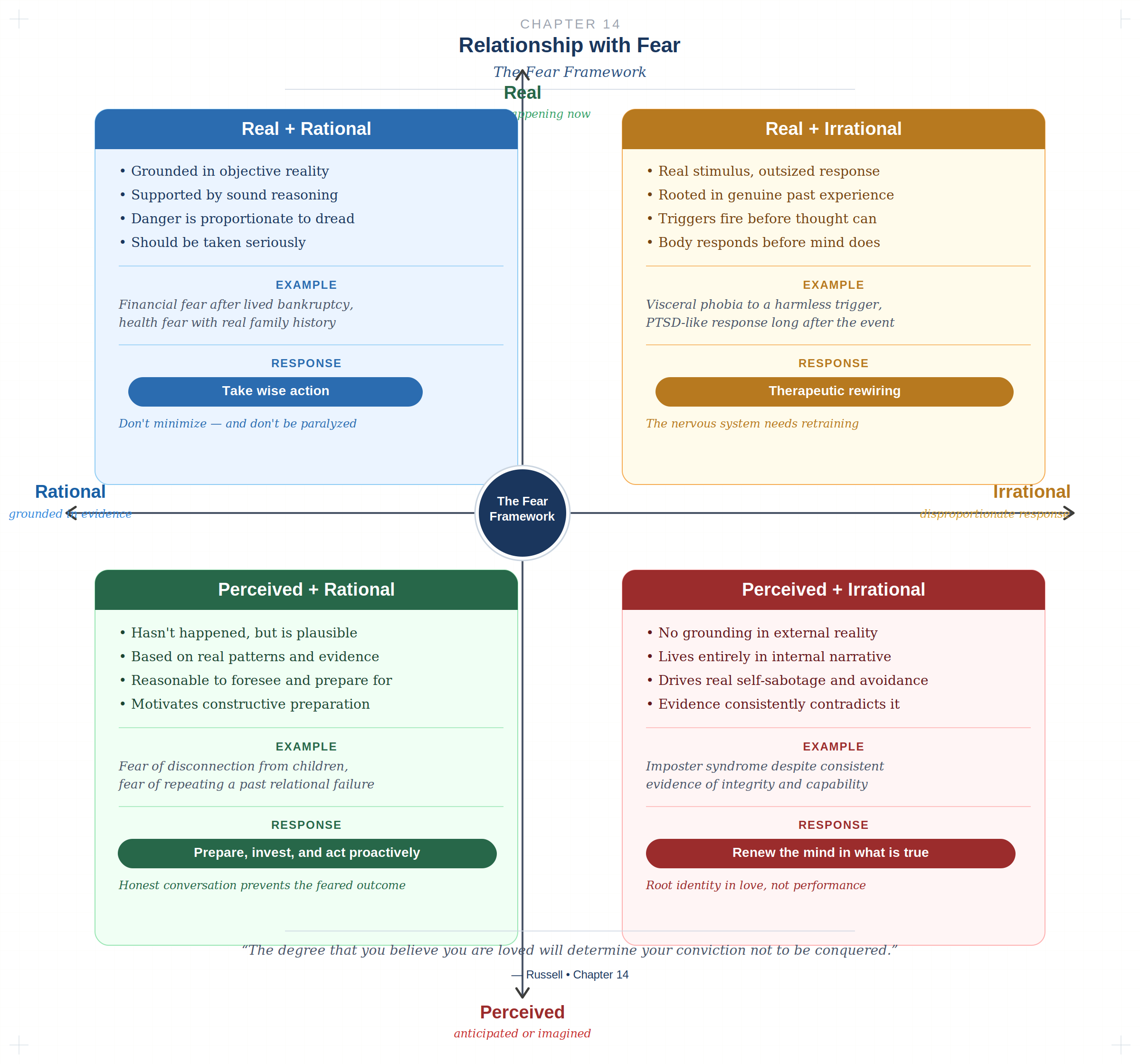
As the confessions continued, Russell began to offer a framework—not to minimize anyone’s experience, but to help men gain the self-awareness to understand what kind of fear they are actually dealing with. Because not all fears are the same, and the response to a fear depends on understanding its nature.
A simple two-axis model: a horizontal axis running from Irrational to Rational, and a vertical axis running from Perceived to Real. Together, these two axes create four quadrants that describe the landscape of human fear.
THE FEAR FRAMEWORK
Rational ↔ Irrational (East–West Axis) | Real ↔ Perceived (North–South Axis)
Quadrant 1: Real and Rational
These are fears grounded in objective reality and supported by sound reasoning. A man who has experienced bankruptcy before and whose current business is genuinely struggling has a real and rational fear of financial collapse. A man with a family history of dementia who begins noticing memory lapses has a real and rational fear about cognitive decline. These fears deserve to be taken seriously, addressed practically, and brought before God with honest prayer. They are not to be dismissed or minimized. They are also not to be allowed to become all-consuming. The appropriate response to a real and rational fear is wise action, not paralysis.
Quadrant 2: Real and Irrational
These are fears where the stimulus is real, but the response is disproportionate to the actual threat. A man who experienced a painful divorce may have a real history to draw from—but his fear that every conflict in his current marriage is a precursor to another breakup may be irrational given the evidence. The fear feels entirely justified, because it is rooted in genuine experience. But it is firing in response to triggers rather than to present reality. Thomas’s visceral physical reaction to clowns—described with honesty and even some laughter around the table—is an example of this quadrant. The stimulus is real (a clown appears). The response is real (his body reacts before his mind can intervene). But the actual danger is not commensurate with the physiological alarm. These fears often require therapeutic work to rewire the nervous system’s response.
Quadrant 3: Perceived and Rational
These are fears about things that have not happened yet but which a reasonable person could foresee as possible. The fear of being alone in old age. The fear that one’s children might someday pull away. The fear that a trusted colleague might betray a confidence. None of these have happened. But they are not crazy to imagine. They are rationally constructed scenarios based on real patterns and possibilities. These fears are often invitations to preparation, to honest conversation, or to the kind of proactive relationship investment that can reduce the probability of the feared outcome.
Quadrant 4: Perceived and Irrational
These are the fears that have the least grounding in external reality and the most grounding in internal narrative. Imposter syndrome often lives here. The fear that one’s success is fraudulent, that people are about to discover you’re not who they think you are—when the evidence consistently points the other way—is a perceived and irrational fear. It is not harmless. It drives real behavior: delay, self-sabotage, avoidance of intimacy, reluctance to lead decisively. But it is also, of all four quadrants, the one most directly addressed by the renewal of the mind—by anchoring deeply in what is actually true about who you are and how you are seen.
The framework is not a tool for dismissing fear. It is a tool for understanding it—for giving a man enough clarity to know what he is actually dealing with. Is this something to act on? Something to work through in therapy? Something to bring before God in prayer and release? Something to take to a trusted friend for a reality check? Knowing where your fear lives on this map is the beginning of knowing what to do with it.
“The question isn’t whether fear will show up. It will. The question is what kind of power we hand it once it arrives.”
— Russell
The Anatomy of Courage: Lessons from Warriors
Russell had been listening to a Art of Manhood podcast by an eighty-year-old scholar, William Ian Miller, a historian, professor of law, and the author of The Mystery of Courage. He spent decades studying biographies of soldiers—from the Civil War to modern combat—specifically examining the anatomy of courage. What he shared from that research was illuminating.
Different men can handle different kinds of fear with completely different capacities. Some soldiers who walked without flinching through rifle fire would collapse at the sound of incoming mortars. Others could sustain a single moment of advance—that hour of courage—but could not endure the grinding months-long siege. Research suggested that most soldiers, under sustained intensity, had a threshold of approximately thirty-one days before they began to break.
And then there was the reverse of post-traumatic stress disorder—something one man at the table, who works with Special Forces soldiers, described as a lack of traumatic stress disorder: men who functioned brilliantly in high-danger environments but fell apart when the threat was removed. They had been shaped by intensity. Ordinary life had become unbearable.
The point was not that courage is impossible or that fear always wins. The point was that courage is contextual, non-transferable across domains, and finite in supply when the supply comes only from ourselves. No man has unlimited courage in all areas. The man who can walk into a difficult negotiation without blinking may freeze when it comes to having a hard conversation with his son. The man who never flinches under physical danger may be paralyzed by the prospect of emotional vulnerability.
This is not a character flaw. It is the condition of being human. And the men at the table recognized themselves in it. As one reflected quietly near the end of the morning:
“I know I’ve got huge courage in some areas. I know I’m doing stuff way beyond what I’m comfortable doing. And then in the same moment, some other part of my life, I’m falling into a black hole. How do these things happen simultaneously?”
— One of the Men
They happen because we are not the source of our courage. And that leads directly to the most important insight of the entire morning.
The Power of With: Battling Fear Together
As the morning drew toward its close, something crystallized in the room. The men had been vulnerable. They had named real things. They had laughed a little and grown quiet a lot. And then Russell said something that named what had been happening all along—the antidote to fear that Scripture had been pointing toward in every verse they had shared:
“Just stand with me. I don’t need a lecture. I don’t need another book to read. I don’t need a sermon to listen to. I don’t need a praise song. I need you to just stand with me. Put a hand on my shoulder. Just knowing you’re there. That’s the power of presence in the middle of fear.”
— Russell
This is the gift of community. Not answers. Not advice. Not a perfectly constructed theological framework, however useful such things might be. The gift is presence. Were you with me on the mountaintop? Were you with me in the pit?
The pattern runs through every verse the men shared that morning. God’s answer to fear is almost never to remove the source of the fear. It is to be present in the midst of it. “Do not be afraid, for I am with you.” “My peace I give you.” “I will never leave you nor forsake you.” The Lord is with you wherever you go.
And what God does in the relationship between a man and his Creator, He also works through the relationship between men in community. When we confess our fears to one another, we are not just being vulnerable—we are practicing the very thing the enemy most wants to prevent. We are turning on the light in the dark room. We are refusing to hide.
“I believe the tactic of the enemy is to make us feel like it is unique—like it’s just you. And I love that verse in Joshua because his answer to fear is presence, not yanking us out of the situation. His answer is: I’m going to be in it with you.”
— Danny
The Body Keeps the Score—a book Thomas referenced in the conversation—documents how trauma becomes embedded in the physical body, causing people to respond to non-threatening situations with the full alarm of genuine danger. What was designed to protect us gets stuck in the wrong setting. And while that book has no particular spiritual framework, the men around the table recognized a spiritual parallel: the same hypervigilance, the same mis-firing alarm system, the same need for something outside ourselves to interrupt the loop.
For men of faith, that interruption comes first from God—His Word, His Spirit, His promise of presence. And it comes secondarily from one another. The book of 2 Timothy opens with exactly this pattern: Paul, in prison and facing death, writing to Timothy not with a sermon but with a reminder. Four times in that letter he says some version of: “I remind you. I recall. I remind you. I remember.”
We need to be reminded. We forget what God has done. We forget who He has said we are. We forget that we are not alone. The men around a table who are willing to say their fear out loud are doing one of the most spiritually potent things a group of men can do. They are reminding each other of what is true.
One man offered a practice that had helped him bridge the gap between knowing truth and living in it:
“If I could journal better, I think I would have more progress. Because I would have more courage knowing what God has already brought me through. Just like the Israelites—we forget, day to the next. We need to be reminded.”
— One of the Men
The Israelites set up stones of remembrance. They sang songs about what God had done. They told the stories to their children. Memory is a spiritual discipline, and for men who struggle with fear, the practice of cataloguing God’s faithfulness—in writing, in conversation, in community—is one of the most practical ways to prepare for the next encounter with fear.
Russell’s Challenge: A Declaration Over Your Fear
Russell closed the morning not with a summary or a takeaway list. He closed it the way he had opened it—with a verse that had been an anchor since his twenties, but now spoken differently. Not just as a reminder. As a declaration.
He had shared that speaking 2 Timothy 1:7 over himself—prayerfully, out loud, as a declaration of what is true when fear says otherwise—had been one of the most formative spiritual practices of his life. Not as performance. Not as self-help affirmation. But as a man standing in the truth of who God is and who God has made him to be.
The challenge he extended to every man at the table, and which we extend now to every man reading this chapter, is this:
Name your fear out loud—before God and before at least one other man.
Then speak this declaration:
“God, you have not given me a spirit of fear.You have given me power. You have given me love.You have given me a sound mind.I am rooted and established in love.I am more than a conqueror—not because of my strength,but because of Your love for me.”
Say it in the morning. Say it when the email comes that triggers the old dread. Say it when the ringing in your ears reminds you of what you cannot control. Say it when the financial statement looks dark. Say it when you do not feel like a conqueror. Especially then.
And then—find a man to stand with you. Not to fix it. Not to give you a five-step program. Just to be present. Because the power of “with” is not a therapeutic technique. It is a theology. It is the shape of the incarnation—God entering the darkroom of human experience and turning on the light.
Reflections
REFLECTION QUESTIONS
1. If someone asked you, “What is your greatest fear?” right now—what would you say? Take a moment to write it down before answering with what you think you’re supposed to say.
2. Using the Rational–Irrational / Real–Perceived framework, where does your primary fear fall? What does that tell you about what kind of response is most needed?
3. In what area of your life does fear most often masquerade as something else—anger, control, avoidance, perfectionism, or over-work? What might it look like to name the fear underneath that behavior?
4. Who is the person in your life who can “just stand with you” in the middle of your fear? Have you given them access to what you’re actually carrying?
5. What would it mean for you to be so rooted in God’s love that the presence of fear no longer determines your conviction to move forward? What would need to change?
6. The degree that you believe you are loved will determine your conviction not to be conquered. Where do you most struggle to believe you are loved? What lie is your fear telling you about that?
A Prayer for When Fear Has the Loudest Voice
Lord God,
I am here. And some days, so is the fear.
I name it before You now—not because I have it figured out, and not because I have enough faith to make it disappear. But because You already know it, and You’ve told me I don’t have to hide.
I confess that I have let fear have a voice in my life that is louder than Your truth. I have hidden from people I love. I have delayed decisions You were asking me to make. I have looked for control in the places where You were asking me to trust.
Remind me that You are with me in this—not on the other side of it, waiting for me to get it together, but here, in the middle of it with me. Remind me that I am rooted and established in love that I did not earn and cannot lose.
You have not given me a spirit of fear. You have given me power, and love, and a sound mind. Help me think clearly today. Help me see what is actually true. Help me receive Your presence as enough.
And God—give me at least one man who will stand with me. Someone who will not lecture me or fix me, but simply be present. Let me be that for someone else, too.
In all of this, I am more than a conqueror—not because of me, but because You loved me first. I choose to build my conviction on that today.
Amen.
★ ★ ★
Fear is not going anywhere. It is a reality. It is a matter of what power we give it in our lives.
God has not given us a spirit of fear.