
Living Well in the Mystery
Walking the Wilderness — The Place Where What Is Known Ends and the Unknown Begins
— — —
The Man Who Planned to Stay
Ron, a man who built a career as an engineer. He's always been a man with a plan. In a field where precision matters — where calculations must be right and margins for error are thin — he built a career on the confidence that most things, given enough time and expertise, could be figured out. He had timelines. He had benchmarks. He had, as he would later describe with a wry smile, “plans for his plans.” There's confidence in control. Yet, we’ve learned we make our plans and God laughs, at least gives a sincere smile. There’s always more at play than our well laid plans.
The original plan was simple enough: stay through 2030. See a major infrastructure project through to completion. Finish strong. It was the kind of plan a man like Ron makes — measured, responsible, forward-looking. But somewhere in the years between intention and execution, something shifted. Not the project. Not the timeline. Ron.
The tightness in his chest began arriving at night, quietly at first, like an unwelcome guest who doesn’t announce himself. He would wake at two in the morning, heart clenched, mind already grinding through the next day’s problems before the sun had agreed to show up. He went to bed stressed. He woke up stressed. Cortisol was doing things to his body that no spreadsheet could account for.
“God was showing me what my physical and mental limitations were,” Ron said, sitting in that circle of men Friday morning, his voice carrying the quiet authority of someone who has wrestled something true out of a hard season. “I could have sucked it up and put my head down and kept plowing through. But it was going to eat away at my body. And I realized — God was speaking to me through my limitations.”
He retired earlier than planned. And in doing so, he stepped into the very thing he had always tried to avoid: the mystery. The unmapped territory. The place where what is known ends and the unknown begins.
That is where this chapter lives. That is the territory we are about to walk together.
— — —
A Biblical Perspective: The Hebrew Word That Changed Everything
Ron had done his homework, but not the way an academic does homework. He had done the homework of a man searching for language that matches the ache — the kind of searching that happens when the head needs the heart to catch up.
He brought a discovery to the group that morning that stopped the room.
In Hebrew, the word for wilderness or desert is מִדְבָּר, transliterated as midbar. It carries the straightforward meaning most of us would expect: a desolate, open, uninhabited place. A wasteland. A desert. But Ron had dug deeper, into the layered beauty of the Hebrew language, where root words do unexpected and holy things.
The root of midbar — dalet, bet, resh — also forms the Hebrew verb meaning to speak. To declare. To reveal.
Wilderness and revelation. Desert and speaking. The place of desolation and the place of divine utterance — in Hebrew, they come from the same root.
“In the wilderness, God speaks,” Ron said simply. “In the mystery, there is revelation.”
Consider what this means for the way we read our own stories. Every barren season, every uncharted stretch, every morning we wake with a tight chest and no clear answers — this is not silence. In the Hebrew imagination, this is precisely where God opens His mouth.
The examples come quickly once you start looking. Moses, exiled to the wilderness of Midian after his catastrophic mistake in Egypt, encounters the burning bush not in the royal courts of Pharaoh but in the middle of nowhere, while tending someone else’s sheep. The wilderness is the address of the theophany. It is where God says, “I AM WHO I AM.”
The Israelites, freed from Egypt with no GPS, no certainty, and no clear destination, are led through the wilderness for forty years. Not because God lost the map, but because the wilderness was the classroom. The tabernacle — the very dwelling place of God among His people — was a wilderness structure, portable and present for the entire wandering.
Elijah, spent and despairing under a broom tree, asking God to take his life, is redirected into the wilderness where he hears the sound most of us spend our whole lives straining to hear: not the earthquake, not the fire, not the great wind, but the still small voice. The gentle breath. The mystery communicating through silence.
Hosea speaks it most tenderly. God says of Israel, His wandering, wayward people: “I will lead her into the wilderness and speak tenderly to her.” Not punish her there. Not abandon her there. Speak to her there.
John the Baptist preaches in the wilderness. Jesus is led by the Spirit into the wilderness. In both cases, the wilderness is not a detour from God’s plan — it is the plan. The mystery is not an interruption of the divine story. The mystery is the story.
Reflection: How do you define mystery in your own life? What does it conjure when you imagine living in the unknown — fear, adventure, or something in between?
— — —
Living Well in the Mystery
Ron opened the conversation with a question he had been turning over for weeks.
“How do you guys define mystery?” he asked. “If the idea is life in the mystery, what does it conjure in your mind?”
The answers came like tributaries joining a river.
“Things I’m not in control of,” someone offered. It was honest and immediate, carrying the weight of hard-won self-knowledge.
“It’s a source of fear for me,” another man added. “Just not having something you’re in control of. Not sure what could happen. I like to have safety nets for my safety nets.” There was knowing laughter — the kind that says, same, brother. Same.
But then: “I think there’s an element of risk. I also think there’s a little bit of adventure in it too. Like some mystery thrillers — there’s a thrill with it. There’s some adventure.”
Ron smiled at that. “Like the motion wheel,” he said. “Four-fifths risk and worry, and one-fifth wonder.”
That ratio is honest. Most of us would admit the wonder gets squeezed out by the worry. We want to lean into the adventure, but the fear wins the weekly vote. We admire the sea turtle metaphor Matthias offered — that each time you make it across the beach, you are a little better prepared for the next crossing, even if new predators await in the deep water. The preparation accumulates. The mystery doesn’t disappear, but you learn to move through it differently.
Russell brought an unexpected frame to the conversation. He had been thinking about a wedding he’d attended the night before — the rehearsal dinner, two families filling a room, each carrying their own histories, their own complications, their own mysteries.
“The mystery of marriage,” Russell offered, his voice carrying genuine wonder. “How do two people become one? They’re sitting there in this bubble moment of what is this even going to look like? In light of all these backgrounds — uncle whoever, aunt whatever, grandma’s over there being the crazy one. You’re watching the mystery and miracle of two becoming one. It’s just… beautiful.”
It was the right word. Beautiful.
Because mystery is not only the territory of grief and uncertainty. It is also the territory of wonder and becoming. The same wilderness that disorients can also open. The same desert that strips can also reveal. Learning to live well in the mystery means learning to hold both realities at once: the fear and the adventure, the grief and the joy, the not-knowing and the trust.
Thomas put it with the clarity of a man who has thought about this for decades: “I went to seminary to solve the mystery. I have a row of books and charts and everything that explains it. But the older I get, the more I love the mystery. I don’t feel like I have to understand and figure Him out as much. I appreciate the mystery I used to try to solve.”
That is a long journey. From solving to savoring. From explaining to accepting. It is the journey from information to wisdom — and it almost always runs through the wilderness.
Reflection: Where do you find yourself on the spectrum between trying to solve the mystery and learning to live in it? What has helped you move toward peace with the unknown?
— — —
Wilderness and Revelation
There is a pattern in Scripture that is almost impossible to miss once you see it: God leads His most beloved people into the wilderness on purpose.
Not as punishment. Not as accident. As formation.
Ron traced the pattern carefully: Moses in Midian, the Israelites at Sinai, David fleeing Saul across the Judean desert, Elijah under the broom tree, Hosea’s wayward Israel, John the Baptist in the Jordan wilderness, Jesus driven by the Spirit into the desert for forty days. In every case, the wilderness precedes the assignment. The desolation precedes the commissioning. The stripping precedes the equipping.
The psalms are the wilderness journals of the people of God. In them, we hear the raw, unfiltered voice of those who are in the mystery and not yet on the other side of it. David doesn’t write these from the comfort of resolution. He writes from the middle.
Psalm 13:1–2
How long, Lord, will you forget me forever? How long will you hide your face from me? How long must I wrestle with my thoughts and day after day have sorrow in my heart? How long will my enemy triumph over me?
And the Passion Translation of Psalm 77:7–10:
Psalm 77:7–10 (Passion Translation)
Would you really walk off and leave me forever, my Lord God? Won’t you show me your kind favor? Has your well of sweet mercy dried up and your promises never come true? Have you somehow forgotten to show me love? Are you so angry that you’ve closed your heart of compassion toward me, Lord? What wounds me most is that it’s somehow my fault that you’ve changed your heart toward me.
These are not the words of unbelief. These are the words of belief pressed to its limits. They are the sound of faith still holding on, even when it doesn’t feel like holding.
Job is the great wilderness document. He asks why over and over and over — and God never actually answers the question. What God does is show up. He speaks from the whirlwind. He answers Job’s why not with an explanation but with a revelation of who He is.
Thomas noticed this pattern in the conversation: “When we ask why questions, God rarely says, ‘Oh, let me explain.’ He gives who answers. We ask why did this happen? And He says, ‘Who am I? Let me remind you who I am.’ That’s the whole book of Job. He never gets the answer to his why. He just gets — wow. Let Me tell you who I am.”
Moses asks what he should tell the people, and God answers: “Tell them I AM sent you.” Not a list of attributes. Not an explanation. A name that is a declaration of being itself.
This reframes the wilderness profoundly. We go in asking why. We come out knowing who. And it turns out that who is the only answer that actually sustains us. Because circumstances change. Explanations become outdated. But knowing who God is — that knowledge holds.
“I feel like I know less than I ever knew,” Thomas continued. “But I know deeper. This is who He is.”
The wilderness is where the knowing goes from wide to deep. And that is a trade worth making.
Reflection: Have you noticed God answering your “why” questions with a revelation of who He is rather than an explanation? What did that look like in your own wilderness?
— — —
Unanswered Questions: The Questions We Carry Through the Decades
Ron asked the group to get honest. Not about theology. About their actual lives.
Reflection: What unanswered questions did you have — or do you have now — in your twenties, thirties, forties? Who were you looking to for guidance, feedback, or wisdom? And in hindsight, what do you see?
The room got quiet in the way that means something real is about to happen.
In Our Twenties: The Questions of Formation
One man shared a memory from his first year of marriage — a blanket over his head, his wife holding him, tears he couldn’t quite stop. He had just read a book called Healing the Masculine Soul, and it had cracked something open.
“The question was why, Lord,” he said. “Just why. When it came to my family. Why have they rejected faith? Why does my dad struggle with alcoholism and he can’t get over it? Why do they struggle? When the grace of God is so freely given and they just completely rejected it — and I’m sitting here living in the wake of it.”
He paused. When he continued, his voice had the texture of a man who has carried something long enough that he knows its weight precisely.
“I was at the depths of ache. Crying after the Lord. I’m here, I am starting my family, and I don’t have answers to these things. But all I know is I want my heart turned to the Lord. Because I’m sitting here living in the havoc of a generation of some really dumb choices. And that marked a lot of my twenties. It was formative — ultimately to begin the process of asking: what kind of man do I want to be?”
That is the question the wilderness asks in our twenties. Not what do I want to accomplish, but who do I want to become? The twenties are often the decade of formation — and formation is rarely comfortable. Most men in their twenties, as one member of the group noted, are “a little too dumb to seek guidance.” They are also, more charitably, still building the relational infrastructure that makes wisdom-seeking possible.
In Our Thirties: The Questions of Pattern Recognition
Another man described the questions of his early thirties differently. He had watched people he admired — leaders, family members, mentors — and seen them fail. Moral failures. Relational collapses. Things that shouldn’t happen to people who seemed to have it together.
“In my early twenties I thought: why is it so hard? It doesn’t seem like it should be that hard. What are you doing?” he said. “It was more from the perspective of judgment. But now, being in my later thirties, looking back — asking the same question, but really more from a place of empathy and compassion. And my own experience in it. Man, why does this have to be so hard?”
The questions don’t change as much as we imagine. What changes is the posture from which we ask them. The thirties are often the decade when judgment begins its slow conversion into mercy — when we stop wondering why other people can’t get it together and start recognizing that we have our own version of the same struggle.
He had been through divorce. He had remarried. And he arrived at this confession, honest and undefended: “I still find myself in my second marriage going, dang it. Why does it have to be so hard? It’s just different. It’s just new challenges.”
There is grace in recognizing that the mystery doesn’t resolve with more experience. It simply presents new dimensions. More money, more problems, as one man quipped — and the group laughed because it is true. The stress doesn’t disappear. It upgrades.
In Our Forties and Fifties: The Questions of Stewardship
By the forties, the questions often shift from identity to stewardship. What do I do with what I’ve been given? What do I pass on? The wilderness of this decade is frequently the wilderness of limited energy — of realizing that you cannot do everything you once could, and must choose.
Peter shared openly about his season: the uncertainty of a new business direction, real estate investments whose outcome was unclear, and the profound, tender mystery of raising an adopted son with a complicated history. “Is he gonna end up in prison like his birth parents? Is he gonna become dangerous? Is he gonna become a productive adult? Who knows?”
These are the questions of a man in his forties who has learned enough to know he controls very little. “In general,” he said, “limitations are truly getting to a point where you’re not in control and you actually realize you need help. From God. From others. And you actually start embracing and receiving that.”
Ron himself was living this question. His body had answered the question his ambition was still arguing with. The tightness in his chest. The cortisol. The sleepless nights. God was using physical limitation as wilderness language — as speaking.
In Our Sixties and Beyond: The Questions of Legacy
There is a particular quality to the questions that come in the later decades. One man described it beautifully: “I’ve been going through old photographs. I literally dumped them all on the floor — two big rubber tubs in the basement. And I keep going down there and not getting them put away because I just keep thinking and looking. I’ve been going through these decades and it’s starting to pull something out of me.”
He is not dwelling in the past. He is making sense of it. He is connecting the dots that can only be connected in retrospect. “I look back a lot more than I’m looking forward now. Not that I’m stuck there — but looking at where God came through. Where He blessed me. Trying to look at the positive things, to help me stay strong going forward.”
The Israelites had their own version of this problem. They kept looking back toward Egypt — toward the known, even the oppressive known — because at least it was familiar. The mystery ahead was terrifying. But the man with the photographs is doing something different. He is not looking back toward slavery. He is looking back toward faithfulness — mining the past for evidence that God shows up, so that he can step forward into the unknown with something to carry.
That is wisdom. That is what Deuteronomy 29:29 is pointing toward:
Deuteronomy 29:29
The secret things belong to the Lord our God, but those things which are revealed belong to us and to our children forever.
We do not get to know everything. But what has been revealed — those moments of faithfulness, those answered prayers, those burning bushes we encountered on our own ordinary days — those belong to us. And we are meant to carry them forward into the wilderness still ahead.
— — —
Success by Dimension: Seeing the Journey Differently
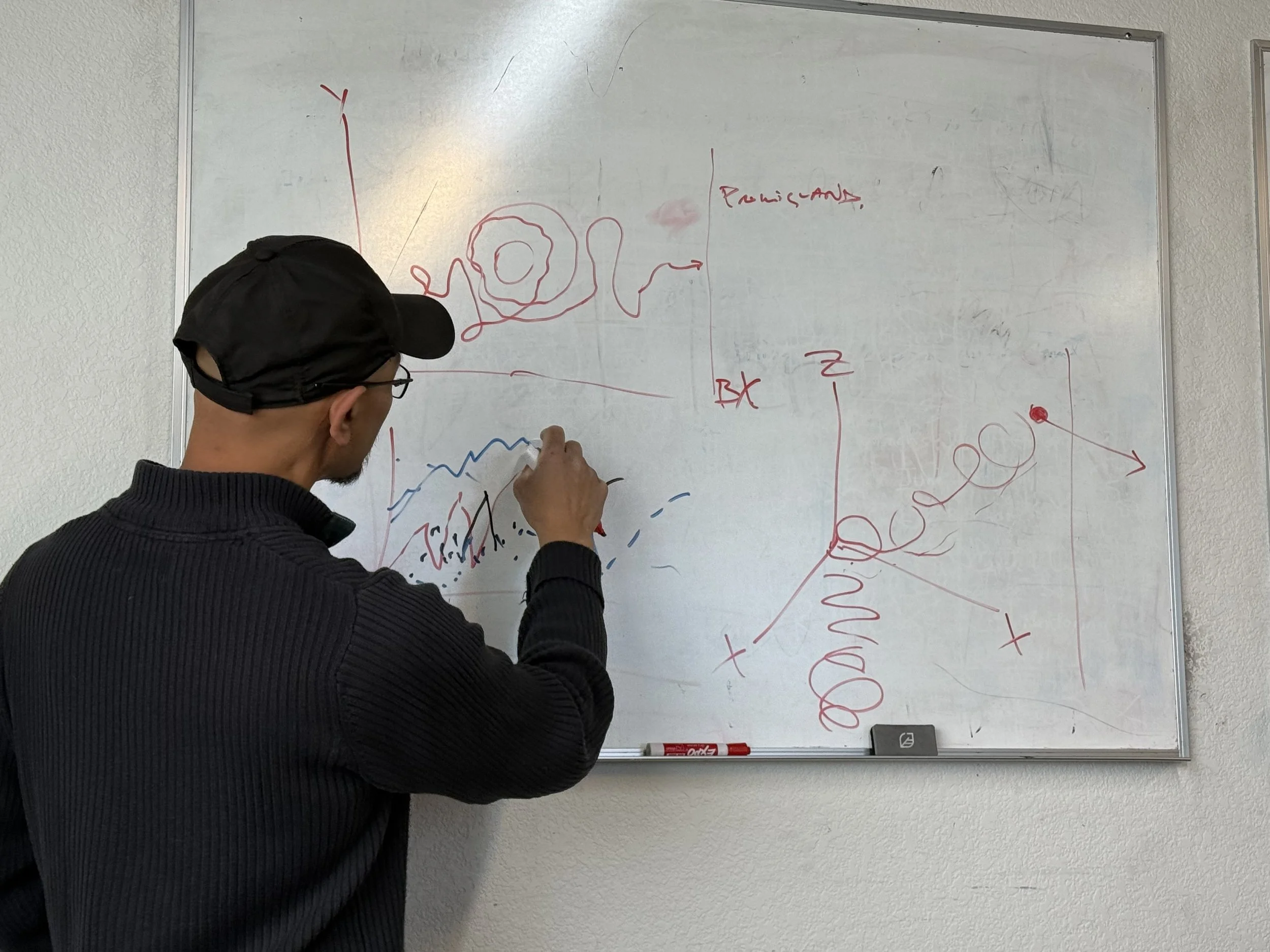
Ron is an engineer by training and disposition. He thinks in systems and structures. So when he wanted to help the group rethink what “going well” actually looks like, he reached for a visual.
Most of us, he suggested, have been trained to read our lives on a two-dimensional bar chart. X-axis: time. Y-axis: achievement, income, status, accomplishment. The goal is the line that moves up and to the right. More. Better. Further. Up and to the right.
It is a useful framework for certain things. But it is catastrophically limited as a framework for a human life. Because a human life is not two-dimensional.
“If you look at this thing in 3D,” Ron said, sketching the idea in the air, “now you’re really talking.”
Take the Israelites wandering in the wilderness. In two dimensions, their forty-year journey looks like aimless circling. They wander. They complain. They circle back. They never seem to get anywhere. On a two-dimensional map, it’s a mess.
But add a third dimension — the vertical axis of spiritual formation, of character, of intimate knowledge of God — and the picture changes completely. Those forty years were not wasted. They were the making of a people. Every manna morning, every water-from-the-rock crisis, every plague and provision — it was all moving the people not just across a map but upward in their understanding of who God is and who they were in relationship to Him. They arrived at the Jordan River not just geographically ready for the Promised Land, but spiritually formed for it.
In two dimensions, they went nowhere. In three, they went up and to the right the whole time.
Ron extended the metaphor to the full scope of a human life. We are not one-dimensional beings. We are what he called multidimensional — mental, emotional, physical, and spiritual. Each dimension has its own trajectory, its own seasons of growth and decline, its own wilderness and revelation.
Physically, we grow rapidly in youth, plateau in midlife, and decline in age. That trajectory, viewed alone, is discouraging. But alongside it, the spiritual dimension often runs in reverse — the very physical limitations of aging that feel like loss become the very conditions under which wisdom deepens, prayer intensifies, and eternal perspective clarifies.
Ron had experienced this directly. The physical symptoms that told him to leave his job early were not failures. They were revelations. God was speaking through the body to protect the soul. The limitation was the mercy.
A man in the group who works with young people framed it with unusual clarity: “God said, ‘Let there be light,’ and there was light. Was it really that simple? When my kids are young and ask about lights, I say, ‘You flip the switch and the light comes on.’ A little older: ‘There’s electricity and it opens the circuit.’ Older still: DC and AC, conductors and resistors. God’s understanding and knowledge is so much greater than ours. But as we get spiritually more mature, we can interpret information better, ask different questions. It helps me be comfortable in my own limitations — knowing that as I continue to mature, the understanding will be different.”
The mystery doesn’t shrink as we grow. Our capacity to inhabit it faithfully expands.
Reflection: Where are you right now in each of your four dimensions — mental, emotional, physical, and spiritual? Is there a dimension that is being neglected? Is there a limitation in one area that might be an invitation to growth in another?
— — —
The Wisdom of Acknowledging Our Limitations
Mark 12:30
Love the Lord your God with all your heart and with all your soul and with all your mind and with all your strength.
Jesus names four dimensions of human being: heart, soul, mind, strength. We might map these onto Ron’s framework: emotional, spiritual, mental, physical. And Jesus commands us to love God in all of them. Not just the ones that are strong right now. All of them. Including the broken ones. Including the limited ones.
There is something profound in that. The invitation to love God with all your strength is also, implicitly, an invitation to love Him in your weakness. To bring not only your capacity but your limitation into the relationship. To say: this is what I have. This is what I don’t have. And You are welcome to all of it.
Jeremiah 33:3
Call to me and I will answer you and tell you great and mighty things which you do not know.
Jeremiah’s promise is remarkable: the mighty things, the hidden things, the things you do not know — those are the very things God is waiting to reveal. But the condition is calling. Reaching. Acknowledging that you don’t have it figured out. The limitation is the doorway.
Mental Limitations
Ron spoke honestly about the mental toll of his final years at work. The anxiety that wouldn’t lift. The intrusive thoughts at two in the morning. The sense of his mind being worn thin by sustained pressure. “My mind couldn’t handle what I’d experienced in the three years, and what I would face in the next five.”
He might have called this failure. He might have white-knuckled through it. Instead, he let it be revelation. God was speaking through the limits of his mental capacity to show him something about what his life was actually for.
In college, Ron had found that when he reached the edge of his own understanding, something happened in sleep — he would wake with answers he hadn’t had when he fell asleep. He learned to bring the problem to God before bed and trust the mysterious overnight process of revelation. The limitation created the prayer. The prayer opened the mystery.
Emotional Limitations
One of the men shared the most tender story of the morning. His close friend — a loving father and grandfather — had fallen off a ladder and died. His wife had spent two hours on the phone with the widow. And he sat listening, in the strange helplessness of grief at close range.
“Just the mystery of that,” he said. “The unknown. Why? Here’s a dad, loving on his kids and grandkids. And the mystery of that loss of a life. And now looking at my own life — I think I know what’s going to happen in the years ahead. But you don’t know that. That’s the mystery. And I think if anything, it’s those experiences — the heavy ones, the loss — that we walk through that deepen us. He’s got it in His hands. And we don’t. And at my age, I’m still trying to wrap my head around that.”
Emotional limitation is not weakness. It is the place where our need for God becomes undeniable. When our emotional capacity runs out, we discover whether what we have been saying about God — that He is good, that He is present, that He holds all things — is actually what we believe, or just what we have been repeating.
Physical Limitations
The body has a language. It speaks in aches and exhaustion and chest tightness and sleep disruption. And for most of our lives, we try to override it. We push through. We add more coffee. We tell ourselves we will rest “later.”
Ron’s body eventually said what he had been unable to say for himself: enough. And in the saying of it, God was not punishing Ron. He was protecting him. He was leading him into a new wilderness — the wilderness of open time and quiet and photographs spread across a basement floor — so that something could be revealed.
“I feel physically healthier,” Ron said, months after stepping away. “I look back at old pictures. My cheeks were fat, my neck was different. I’ve lost weight. And I feel like God was showing me that those limitations were the very thing He used.”
Spiritual Limitations
Perhaps the most important acknowledgment of limitation is the spiritual one: we do not understand God. We cannot fully know Him. He exceeds our categories and surpasses our theology. This is not a problem to be solved. It is the nature of the relationship.
Russell, who has led this group through many seasons, put it with the plainspoken authority of a man who has stopped pretending: “My dad often said to me, almost on the edge of annoying — Russell, you’re a limited commodity. There’s only so much of you to go around. And you have plenty of limitations. The embracing of limitations is oftentimes where God does His best work.”
To acknowledge spiritual limitation is to stop trying to be your own god. It is to release the controls and trust the character of the One who actually holds them. It is the hardest thing most of us will ever do. And it is the beginning of wisdom.
Reflection: In which of these four dimensions — mental, emotional, physical, spiritual — have you most resisted acknowledging your limitations? What might God be trying to reveal to you through that very limitation?
— — —
Welcoming the Mystery: Ron’s Challenge
Ron had more questions than he started with. That was the point.
He sat in that circle of men, this engineer who had spent a career calculating outcomes, and offered what was perhaps the most counter-intuitive invitation of the morning: What if the mystery is not the enemy of the faithful life? What if it is the address where the faithful life is actually lived?
He left three questions on the table — not as homework, but as companions for the road:
What are your current unanswered questions?
Are you comfortable with them not being answered right now?
How are you engaging the mystery — with fear, or with trust?
One of the men offered what became the chapter’s most clarifying image. He had planned a date weekend in Denver for his wife without telling her any of the details. And she was not anxious about it. She was excited. Because she trusted who was leading her through it.
“Anxiety versus excitement,” he said. “It’s the same physical reaction. Same emotions. One is when you’re not sure the outcome is going to be positive. The other is when you’re confident that it is. And if you trust the outcome and trust who’s leading you through it, then you’re excited for the adventure — not terrified of it.”
That is the invitation of the wilderness. Not naivety — not pretending the desert isn’t hard or the night isn’t long. But trust. Trust that the One who led you in knows where the water is. Trust that the still small voice is still speaking. Trust that even when the two-dimensional map looks like wandering, the three-dimensional reality is upward and forward and full of purpose.
Ron closed his career chapter not with a triumphant announcement but with a quiet step into open space. He didn’t know exactly what came next. There were photographs to sort and journals to read and something new to discover about who he is when the title and the project and the chest tightness are gone.
That is the mystery he is choosing to welcome. Not because he has become someone who doesn’t need safety nets. But because he has decided to trust the One who holds the net he cannot see.
"The secret things belong to the Lord our God, but those things which are revealed belong to us and to our children forever. — Deuteronomy 29:29"
— — —
Reflections for the Road
As you sit with this chapter, let these questions settle in you slowly. There is no rush. The wilderness doesn’t reward hurry.
1. Where is your current wilderness? What is the name of the desert you are walking through right now — vocational, relational, physical, spiritual?
2. What has God been saying in your wilderness? Are you listening, or mostly asking why?
3. What limitations — physical, mental, emotional, spiritual — might actually be invitations? Where has God done His best work in the places where you ran out of yourself?
4. What is your unanswered question right now? Can you hold it with open hands instead of a clenched fist?
5. When you look back at past wildernesses, what evidence of God’s faithfulness do you find? How does that evidence change how you face the wilderness ahead?
And one final provocation, Peter shared, in the spirit of the morning:
"Happiness is your current situation minus your expectations"
We all already have, today, what we were desperately hoping for five years ago. The mystery always delivers. Not always what we planned. Not always on our timeline. But it delivers.
What if the mystery you are dreading today is the answered prayer you will be grateful for in five years?
— — —
A Prayer for Those Walking the Wilderness
Father,
We confess that we are men who prefer maps to mystery. We like to know where we are going, how long it will take, and whether there are rest stops along the way. We have built elaborate systems for managing what we cannot control, and we have called it planning.
Forgive us for the times we have mistaken certainty for faith. For the times we have avoided the wilderness because it frightened us, not knowing that You were waiting for us there. For the times we have asked why when You were trying to show us who.
We ask for the grace to welcome the mystery. Not to love the pain of it — we are not there yet. But to trust that You are in it.
Speak to us in the wilderness. We are listening.
Lead us in and through the desert, as You have always led. Not around it. Through it. And in the going through, form us into the men You always saw when You looked at us.
For the secret things belong to You. And what You have revealed belongs to us, and to our children, forever.
In the name of the One who was led into the wilderness and did not stay there,
Amen.
— — —
Up and to the right. In every dimension.